
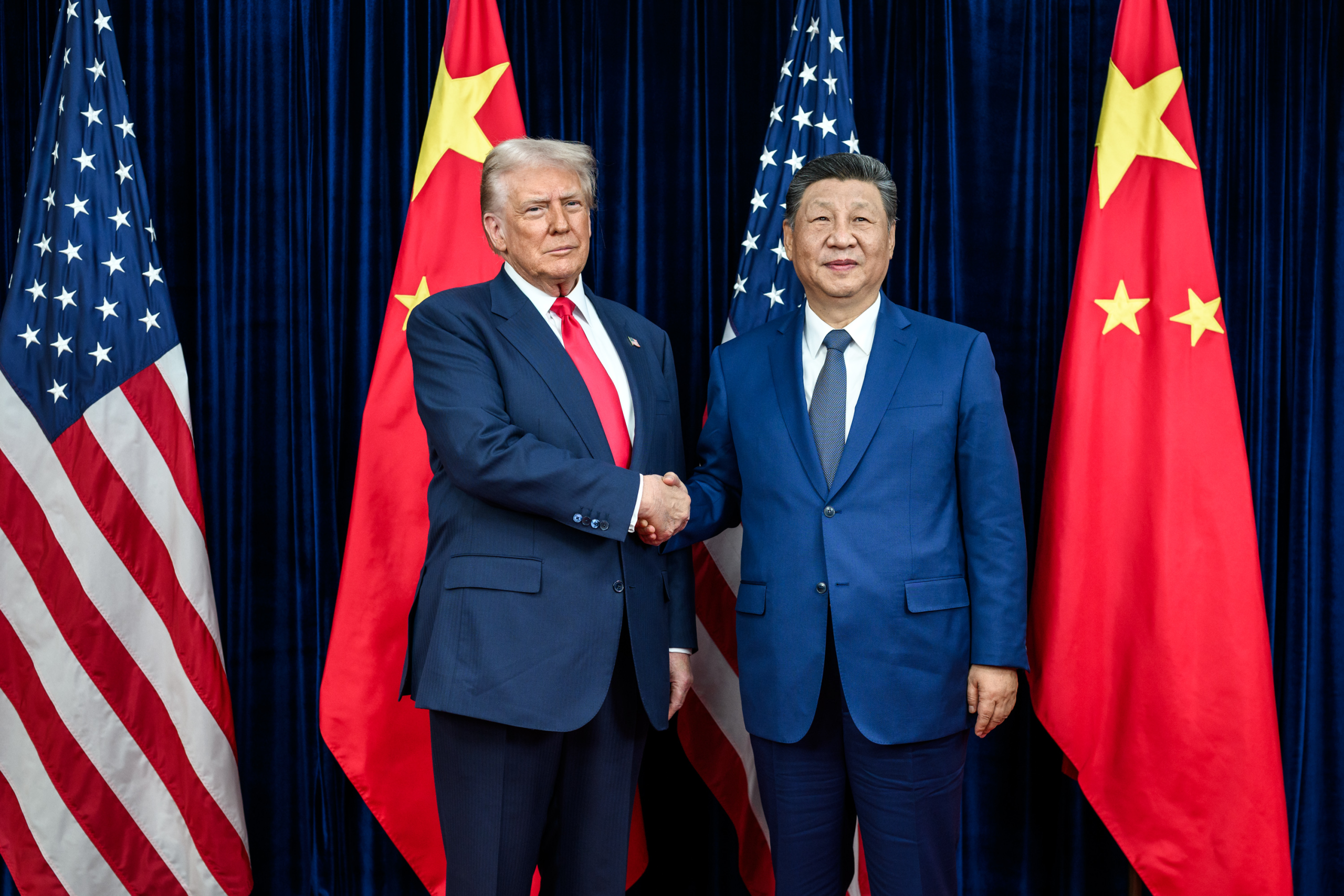
Cover Image Source: President Donald Trump greets Chinese President Xi Jinping before a bilateral meeting at the Gimhae International Airport terminal, Thursday, October 30, 2025, in Busan, South Korea. (Official White House Photo by Daniel Torok)
US President Donald Trump’s upcoming visit to China is more than a high-level diplomatic meeting. It is also about who gets to shape the next phase of US-China relations and on what terms.
China’s Foreign Ministry has confirmed that Trump will pay a state visit to China later this week, at the invitation of President Xi Jinping. The agenda could include trade, rare earths, Iran, Taiwan, artificial intelligence and nuclear issues. That breadth alone shows this is not simply another trade negotiation, nor a return to the old era of engagement. It is a test of whether the world’s two largest economies can impose some order on a relationship still defined by strategic rivalry.
What matters, however, is not only what Trump and Xi discuss behind closed doors, but how each side wants the meeting to be understood. In Washington, the framing is pragmatic and transactional. Reuters has cast the summit as a discussion spanning some of the most sensitive bilateral and global issues, while the Center for Strategic and International Studies and Brookings have both treated it less as a breakthrough than as a chance to put a floor under further deterioration.
Beijing’s framing is political as well as diplomatic. Chinese official statements stress head-of-state diplomacy, mutual respect and equality. Foreign Ministry spokesperson Guo Jiakun said the two presidents would exchange views on China-US relations and world peace and development, while Xinhua and China Daily have portrayed the visit as a stabilising moment in an increasingly turbulent international environment.
These are not just different emphases. They are rival narratives about what this summit is for. Washington wants proof that engagement with Beijing can still produce concrete gains without rewarding coercion. Beijing wants proof that the relationship cannot be managed through pressure alone and that China must be treated as an equal power, not simply a problem to be handled.
Trump will almost certainly want to present the trip as an exercise in deal-making. The White House is likely to look for visible economic deliverables: purchases of US aircraft, agricultural goods and energy, steps to support trade and investment, and perhaps an extension of existing arrangements on rare earths. Those outcomes would give Trump an easy domestic story that personal diplomacy with Xi can still produce business results.
Yet even if such announcements emerge, their strategic meaning should not be overstated. A package of purchases or implementation pledges may ease immediate tensions, but it would not resolve the structural disputes driving the relationship: industrial policy, technology controls, supply-chain security and the widening overlap between economic exchange and national security. In that sense, any deliverables from Beijing are likely to function less as a settlement than as a temporary political bridge, allowing both governments to claim momentum while postponing harder conflicts that neither side is ready to concede.
But the hardest questions in US-China relations do not fit neatly into a commercial script. Taiwan is the clearest example. AP has noted concerns that Taiwan could become exposed to the logic of transactional diplomacy, while Reuters reported Taipei’s hope that the Trump-Xi meeting would bring no surprises. Beijing will press its position that Taiwan remains a core interest. Washington, in turn, will need to reassure Taipei, Tokyo and other regional partners that no private understanding with Beijing alters existing US commitments or the cross-strait status quo.
That does not mean Trump is about to trade Taiwan away. It means ambiguity itself becomes a strategic risk. A careless remark, an imprecise readout or even a subtle shift in tone could unsettle allies and invite over-interpretation. In the Indo-Pacific, perception is often part of the policy outcome.
Iran provides a second test case. Washington would like China to use its leverage with Tehran, especially on energy flows and regional stability. But Beijing will resist looking like an auxiliary to US crisis management. It has its own ties, its own energy interests and its own conception of regional order. Here, too, each side wants a different story told after the meeting.
This is where the balance has changed since Trump’s first visit in 2017. The United States still retains greater aggregate power, but China now has more summit-specific leverage than it once did. Critical minerals, trade implementation and Iran-related diplomacy all give Beijing tools to shape the agenda rather than simply absorb pressure. At the same time, China also needs calm. A more predictable external environment would ease pressure on exporters, investors and technology firms still exposed to US tariffs, sanctions and political volatility.
That mutual need for stability helps explain why both sides may prefer a carefully managed summit over a genuinely ambitious one. Neither Washington nor Beijing has much incentive to raise expectations it cannot meet. For the United States, a limited success is better than a visible failure. For China, symbolic parity and a reduction in external volatility may matter more than any single concession. The likely result is a meeting designed not to transform the relationship, but to choreograph it: to show domestic and international audiences that rivalry can still be bounded by high-level political control.
That is why the most realistic outcome is not reconciliation, but managed rivalry. The two sides are unlikely to restore trust. They may, however, be able to build limited guardrails: understandings on trade implementation, AI risk communication or crisis management that lower the odds of miscalculation without changing the basic character of the relationship.
The real danger is that each capital reads the meeting only through its own political needs. If Washington sees the summit solely as a test of leverage, and Beijing sees it solely as a demand for recognition, both sides could leave dissatisfied. But if each understands the other’s narrative as a constraint to be managed rather than an insult to be rebutted, the visit could still serve a useful purpose.
Trump’s trip to Beijing does not signal a return to the old era of engagement, nor does it mean strategic competition is easing. It signals something narrower but still important: that two powers locked in rivalry and interdependence are still searching for a more disciplined way to coexist. That is why this visit matters. It is not only a negotiation over interests, but a struggle to define the terms on which the relationship will be conducted.

The Missing Capital and Investment Dimension in U.S.-China Economic Stabilization