

The Gerald R. Ford-class is the newest and most powerful fleet of nuclear-powered aircraft carriers (CVNs) in the U.S. Navy to date. This new class of ship is designed to last 50 years, with six new ships set to eventually replace the entirety of Nimitz-class ships that entered service between 1975 and 2009. Since the Navy is required to maintain 11 operational aircraft carriers at all times, 10 of which currently belong to the Nimitz-class and one belonging to the Gerald R. Ford-class.
The new class has a plethora of features, with arguably the most significant upgrade being a 30% increase in aircraft sortie launches per day. Within a 24-hour surge period, the Ford class could sustain up to 270 sorties. The Ford class’ operational capacity is largely due to its four electromagnetic catapult launch system (EMALS), which generate an 150% increase in electrical power to launch fighter jets with more fuel and weapons. This launch system combined with a 500-900 reduction in crew members, renders the Gerald R. Ford-class significantly more powerful than its predecessor.
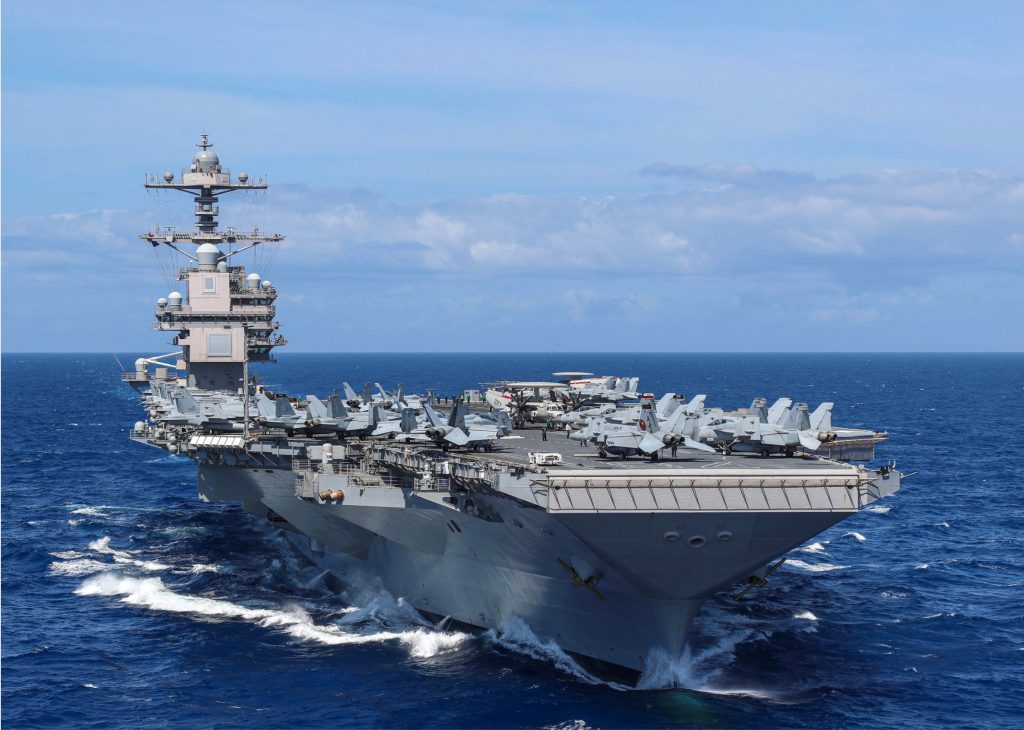
On the surface, the U.S. possessing 11 super carrier ships while the People’s Liberation Army Navy (PLAN) only having 3 super carrier ships seems like a clear advantage, however both entities possess only one super carrier with the EMALS system. Significant delays in the integration of the fifth generation stealth fighter jet known as the F-35C into the EMALS system beginning in the 2010s has effectively allowed China’s own fifth generation fighter, the J-20, to be completed and deployed in half the amount of years it takes the U.S. to produce them.
On Thursday, August 13, President Trump issued a national security memorandum for the U.S. Navy to completely overhaul the current design and functionality of the Gerald R. Ford ship-class. They are instructed to redesign the ship class to resemble those that were in service during World War II, where the current ELAMS system would be replaced by an older, steam-powered catapult system although production of the steam-powered catapult system has been phased out and are no longer in production. Risks associated with future Ford class ships such as the USS Doris Miller, include “significant cost, schedule and integration risks” that are posited to be regressive in nature.
Although the USS Gerald R. Ford was docked following its 326 day deployment across Mediterranean Sea, Caribbean Sea, and finally the Middle East Suez Canal in May 2026, recent news indicates that there currently is no estimate on the completion of its scheduled maintenance. Larger ship maintenance periods have lasted longer than anticipated than in the past, from six months to one year or longer. Prior to its return, the ship had conducted launch and recovery systems back in February 2026 but had only just been released to the public at the beginning of the third week in August. The results indicate that the generation rate of sorties compared to the Nimitz-class saw a 120-130% increase.
While the U.S. Navy has stated clear goals in its procurement, delivery, and deployment processes regarding future CVN Gerald R. Ford-class shipbuilding, the ship’s embodiment of projection of U.S. power is at odds with a sustained progression of U.S. industrial policy. In the wake of the fortification of the PLAN across the South China Sea, the Taiwan Strait, and other maritime areas, the ways in which both deployed and anticipated Ford-class models have been managed has taken the shape of a generalized, crisis response instrument.
The USS Gerald R. Ford CVN-78 experienced its longest deployment of any U.S. vessel since the Vietnam War: 326 consecutive days. The deployment has generally been touted as “record breaking”, a celebratory spin on industrial policy that signals overextension and delayed shipbuilding capacities. The ship’s deployment across hemispheres, from the Caribbean Sea in November of 2025, to the Mediterranean Sea, before finally supporting Operation Epic Fury in February 2026, obscure the fact that the longer the vessel is deployed, the longer the number of days its rest period will amount to. If the fire that ignited in the main laundry spaces aboard the ship spread, there is no telling the length of adaptive measures the U.S. Navy would confront having its most expensive vessel suddenly out of commission. The reliance on one model while the other six are still in development poses significant risks to not only the projection of U.S. naval power across the globe, but more importantly, the ability of a fleet to perform multiple functions such as catapult launches and recover aircraft on the flight deck simultaneously.
By contrast, China has shifted its focus from smaller coastal vessels to larger carriers that would potentially rival the Gerald R. Ford-class. This shift is evident in the quick turnaround time of the construction of the Fujian 003 ship, which is equipped with an electromagnetic aircraft launch system, although not identical to the EMALS system. While the “test and trial period” for the Ford class lasted at least about 18 months, the Fujian 003 was both commissioned and deployed within just one year. The U.S. Navy’s most powerful and expensive ship, the Gerald R. Ford-class, is only one example in which underestimation of its associated risks mark the ships’ trajectory as a key factor in potential escalation with the PLAN.
This Spotlight was originally released with Volume 5, Issue 8 of the ICAS MAP Handbill, published on August 28, 2026.
This issue’s Spotlight was written by Max Cowan, Part Time Research Assistant Intern at ICAS.
Maritime Affairs Program Spotlights are a short-form written background and analysis of a specific issue related to maritime affairs, which changes with each issue. The goal of the Spotlight is to help our readers quickly and accurately understand the basic background of a vital topic in maritime affairs and how that topic relates to ongoing developments today.
There is a new Spotlight released with each issue of the ICAS Maritime Affairs Program (MAP) Handbill – a regular newsletter released the last Tuesday of every month that highlights the major news stories, research products, analyses, and events occurring in or with regard to the global maritime domain during the past month.
ICAS Maritime Affairs Handbill (online ISSN 2837-3901, print ISSN 2837-3871) is published the last Tuesday of the month throughout the year at 1919 M St NW, Suite 310, Washington, DC 20036.
The online version of ICAS Maritime Affairs Handbill can be found at chinaus-icas.org/icas-maritime-affairs-program/map-handbill/.