
ICAS Bulletin (online ISSN 2836-3418, print ISSN 2836-340X) is published every other week throughout the year at 1919 M St NW, Suite 310, Washington, DC 20036.
The online version of ICAS Bulletin can be found at chinaus-icas.org/bulletins/.
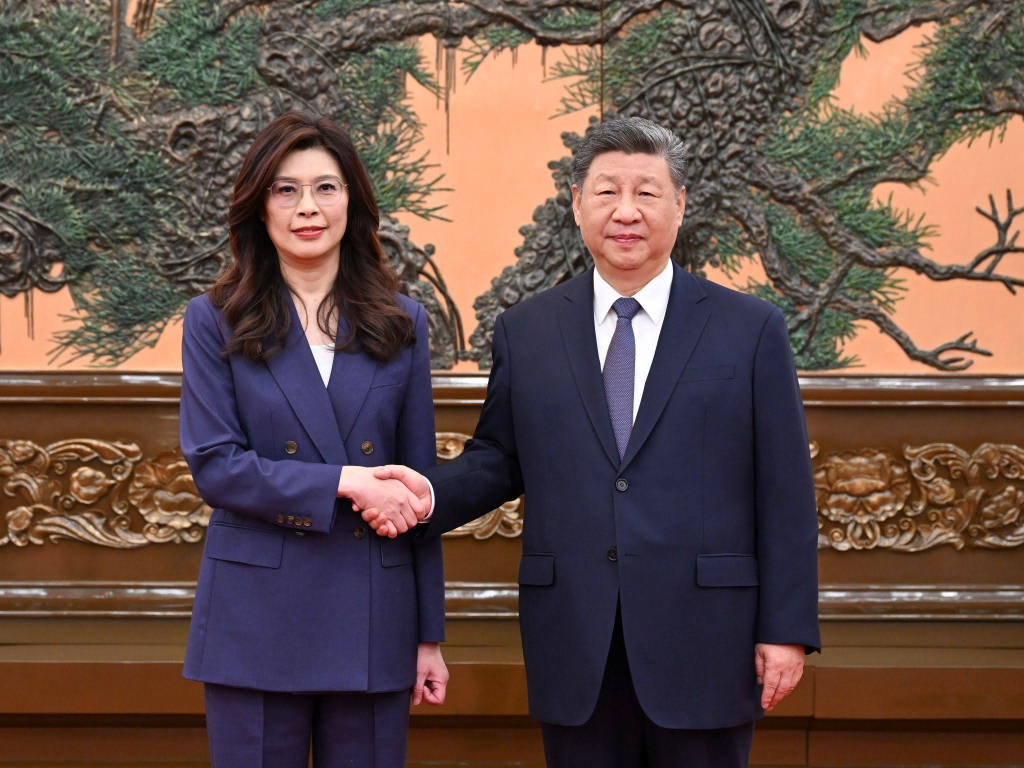
– Chair of the main opposition party, the Chinese Nationalist Party (or the Kuomintang, KMT), Cheng Li-wun visited mainland China from April 7 to 12 at the invitation of President Xi.
– This visit was the first by a sitting chairperson of the KMT in a decade, with Cheng calling it a “journey of peace.”
– Cheng met with President Xi in Beijing on April 10, where Xi reaffirmed that reunification with Taiwan is an “historical inevitability” and condemned Taiwan’s ruling government as a threat to peace in the Taiwan Strait.
– Cheng said Taiwan should become “a symbol of peace jointly safeguarded by Chinese people on both sides of the strait” and that she would invite Xi to visit Taiwan if the KMT wins the 2028 election.
– On April 8, Cheng laid a wreath at Sun Yat-sen’s mausoleum in Nanjing and called for “reconciliation and unity” across the Taiwan Strait, praising mainland China’s development.
– China announced on April 12 that it would resume some ties with the island of Taiwan, including direct flights to some mainland cities and lift bans on certain Taiwanese aquaculture imports.
– KMT lawmakers on April 9 boycotted Taiwan’s cross-caucus defense budget negotiations and submitted a supplementary resolution requiring all U.S. arms sales to undergo separate legislative reviews, a move Democratic Progressive Party (DPP) legislators condemned as an attempt to stall the government’s proposed NT$1.25 trillion special defense budget.
– China’s Taiwan Affairs Office on April 15 dismissed U.S. claims of Chinese military pressure on Taiwan as “a complete distortion of the facts,” and urged Washington to handle Taiwan-related matters carefully.
– Lai Ching-te on April 10 urged Taiwan’s opposition parties to stop blocking the stalled NT$1.25 trillion special defense budget, warning that delays weaken Taiwan’s defenses and undermine international confidence in its commitment to self-defense.
– Taiwan’s lawmakers agreed on April 14 to resume closed-door defense budget talks on April 20, as the KMT continued to resist the DPP’s NT$1.25 trillion special defense bill in favor of its own scaled-back NT$380 billion proposal.
– Head of the American Institute in Taiwan Raymond Greene, on April 11 called on China to abandon military pressure against Taiwan and open communication with all of Taiwan’s political leaders, while also saying deterrence and dialogue are complementary, not conflicting, goals.
– U.S. Senator Jim Banks (R-IN) on April 8 met with Lai Ching-te in Taipei and urged Taiwan’s legislative body to pass Lai’s stalled $40 billion special defense budget, calling it a signal to China and the world that Taiwan is serious about peace through strength.
– A group of bipartisan U.S. senators on April 14 wrote to Taiwan’s parliament assuring that pending weapons sales worth billions of dollars would likely be approved in coming weeks, while urging Taiwan to accelerate its stalled special defense budget.
Associated News References:
“Shaheen, Curtis, Tillis, Rosen Urge Taiwan’s Legislative Yuan to Strengthen Taiwan’s Defense and Advance Supplementary Budget,” Foreign Relations Committee, April 16
“China calls US claims of military pressure on Taiwan a ‘distortion’,” Reuters, April 15
“Taiwan Resumes Defense Debate After Opposition Head Meets Xi,” Bloomberg, April 14
“China says it will resume some ties with Taiwan following visit by opposition leader,” Associated Press, April 12
“China should abandon threats against Taiwan, US diplomat says,” Reuters, April 11
“KMT lawmakers boycott defense budget negotiations,” Taipei Times, April 10
“Lai pushes defense, condemns compromise with China,” Taipei Times, April 10
“China’s Xi talks peace with Taiwan’s opposition leader even as Beijing raises military pressure,” NBC News, April 10
“Xi tells Taiwan opposition leader people on both sides of strait are Chinese in rare meeting,” The Guardian, April 10
“Taiwan opposition leader pledges reconciliation at memorial for founding father in China,” Reuters, April 8
“US senator urges Taiwan parliament to pass stalled defence spending plan,” Reuters, April 8
“Taiwan opposition leader arrives in China on what she calls a ‘journey to peace’,” Associated Press, April 8
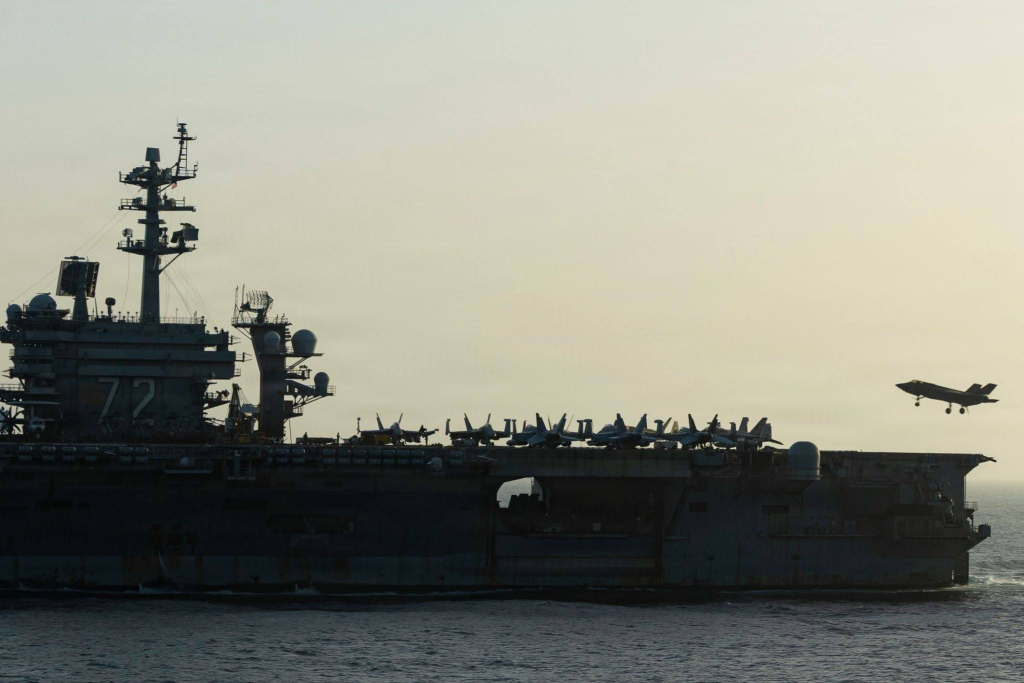
– The U.S. and Iran on April 7 reached a two-week ceasefire deal brokered by Pakistan, under which the U.S. and Israel will suspend bombing Iran in exchange for Iran reopening the Strait of Hormuz, though the sides offered conflicting accounts of the agreement’s scope, including whether the ceasefire extends to Lebanon.
– China’s Foreign Ministry on April 14 acknowledged playing a role in brokering the U.S.-Iran ceasefire, confirming Beijing made “its own efforts” toward a truce, including 26 phone calls by Foreign Minister Wang Yi and shuttle diplomacy by a special envoy, after Trump credited China with persuading Iran to negotiate.
– Vice President JD Vance on April 12 returned from Islamabad without a breakthrough after a 21-hour peace talk with Iran, with key issues including Iran’s nuclear program, Strait of Hormuz access, and proxy group funding left unresolved.
– The U.S. on April 13 enacted a naval blockade of Iranian ports in the Strait of Hormuz after peace talks collapsed.
– On April 14, China condemned the U.S. naval blockade of Iranian ports as a “dangerous and irresponsible act,” calling for a full ceasefire and diplomatic resolution.
– The U.S. military on April 19 seized an Iranian cargo ship, the Touska, in the Gulf of Oman after disabling it with gunfire, prompting Iran to denounce the act as “piracy” and cast doubt on its participation in a new round of peace talks in Pakistan.
– Oil prices surged 5% in response to the incident.
– As the two-week ceasefire deal comes to an end on April 21, President Trump threatened Iran with more military strikes on April 20.
– Vice President Vance is set to lead a second round of U.S.-Iran negotiations in Islamabad, though Iran has not confirmed its participation. The two sides remain divided on nuclear enrichment timelines and Strait of Hormuz access.
– President Xi later on April 20 called Saudi Crown Prince Mohammed bin Salman to urge that the Strait of Hormuz remain open to normal passage and push for a comprehensive ceasefire, as China stepped up diplomatic efforts amid fresh strain on the U.S.-Iran truce.
Associated News References:
“China’s Xi, in call with Saudi crown prince, calls for Strait of Hormuz to remain open,” Reuters, April 20
“Trump tells PBS News that ‘lots of bombs start going off’ if Iran ceasefire expires,” PBS News, April 20
“Oil prices jump after U.S. seizes Iranian vessel, imperiling ceasefire,” The Washington Post, April 20
“Vance Heads to New Talks With Iran. At Stake: Peace and His Own Standing.,” The New York Times, April 20
“China calls U.S. blockade of the Strait of Hormuz ‘dangerous and irresponsible’,” CNBC, April 14
“U.S. begins blockade in Strait of Hormuz; Trump warns Iran ‘attack ships’ to stay away,” CNBC, April 13
“Twenty-one hours of back and forth leave US and Iran far apart,” BBC, April 12
“Vance heads back to the U.S. without striking a deal with Iran to bring an end to the war,” CNBC, April 11
“U.S. and Iran agree to 2-week ceasefire, suspending Trump’s threat to annihilate Iran,” NPR, April 8
“Trump says he believes China got Iran to negotiate, AFP reports,” Reuters, April 8
“China Trumpets ‘Own Efforts’ in Pushing For US-Iran Ceasefire,” Bloomberg, April 8
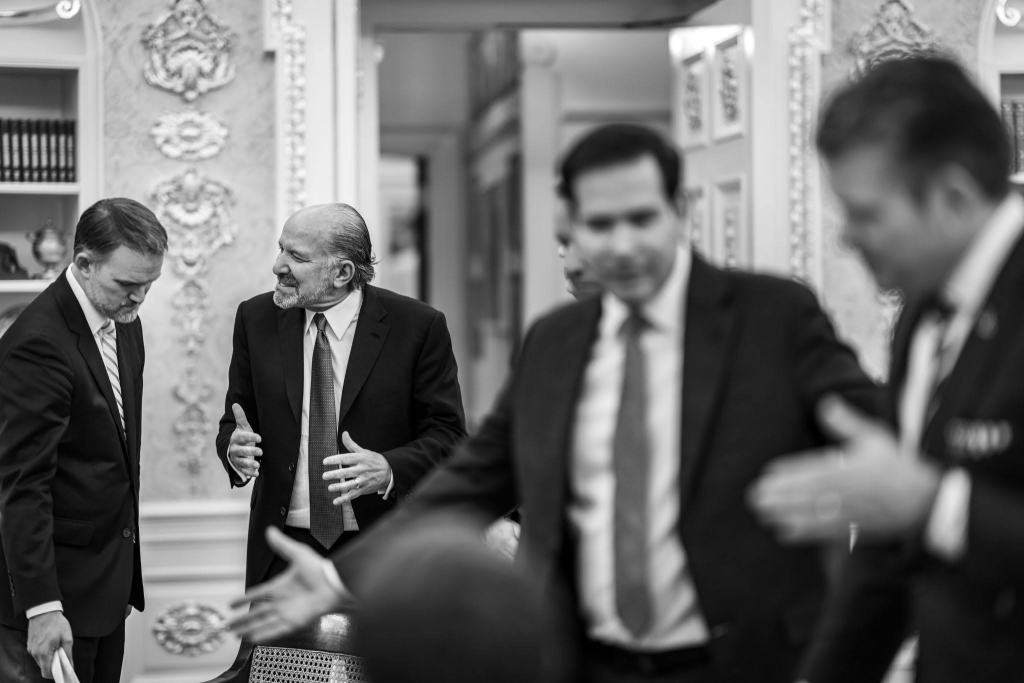
– U.S. Trade Representative Jamieson Greer on April 10 warned that Chinese involvement in Iran contrary to U.S. interests would complicate bilateral relations, while expressing optimism about President Trump’s upcoming meeting with President Xi.
– It was reported on April 14 that President Trump’s son, Eric Trump, will accompany President Trump on his May 14-15 visit to China in a personal capacity. The move has drawn conflict-of-interest concerns given Eric’s management of the family business and his ties to Chinese cryptocurrency firm Bitmain.
– U.S. Trade Representative Jamieson Greer said on April 9 that existing rules banning Chinese vehicle software and hardware make it unlikely Chinese automakers can establish a foothold in the U.S. market, and added that the administration is still examining whether Chinese-made EVs should even be permitted to cross the border for personal use.
– President Trump on April 8 threatened a new 50% tariff with no exemptions on all goods from any country supplying military weapons to Iran.
– Later on April 13, President Trump specifically warned China of the 50% tariff if caught supplying military aid to Iran.
– It was reported on April15 that Chinese officials have held preliminary talks with solar panel equipment manufacturers about potentially restricting exports of advanced solar cell technology to the U.S.
– According to data released on April 14, China’s exports grew just 2.5% in March, a six-month low that missed analyst forecasts by a wide margin, while imports surged 27.8%, their strongest growth in over four years, as the Middle East conflict weighed on global demand and drove up commodity import costs.
– According to data released on April 16, China’s GDP grew 5% in the first quarter of 2026, up from 4.5% in the prior quarter, driven largely by exports, though weak consumer spending, a persistent property slump, and rising energy costs from the Iran war cloud the outlook for the rest of the year.
Associated News References:
“Exclusive: China weighs curbs on exports of solar manufacturing equipment to US,” Reuters, April 15
“China’s Economy Starts Year on Strong Footing, but Iran Risks Loom,” The Wall Street Journal, April 15
“Exclusive: Trump’s son Eric to join father’s state visit to China,” Reuters, April 14
“Trump warns China of ‘staggering’ 50% tariff if caught supplying military aid to Iran,” Fox News, April 13
“China exports growth in March misses estimates, imports surge most in over four years,” CNBC, April 13
“USTR: China involvement in Iran would complicate matters,” Reuters, April 10
“US Trade Chief Says Tech Restrictions to Block Chinese Autos,” Bloomberg, April 9
“China warns against joint US, Philippines and Japan drills eroding regional trust,” Reuters, April 20
“China Imposes New Rules to Block Foreign Companies From ‘Decoupling’,” The New York Times, April 14
“NASA Welcomes Record-Setting Artemis II Moonfarers Back to Earth,” National Aeronautics and Space Administration, April 10
“Exclusive: Chinese business hired lobbying firm with ties to Don Jr, then scored a win in Washington,” Reuters, April 9
“Trump vented at Rutte over NATO inaction on Iran during turbulent meeting,” Politico, April 9
“Dongfeng Nissan Launches the All-New NX8 in China,” Nissan Motor Corporation, April 9
“More Europeans see US as threat than China,” Politico, April 8
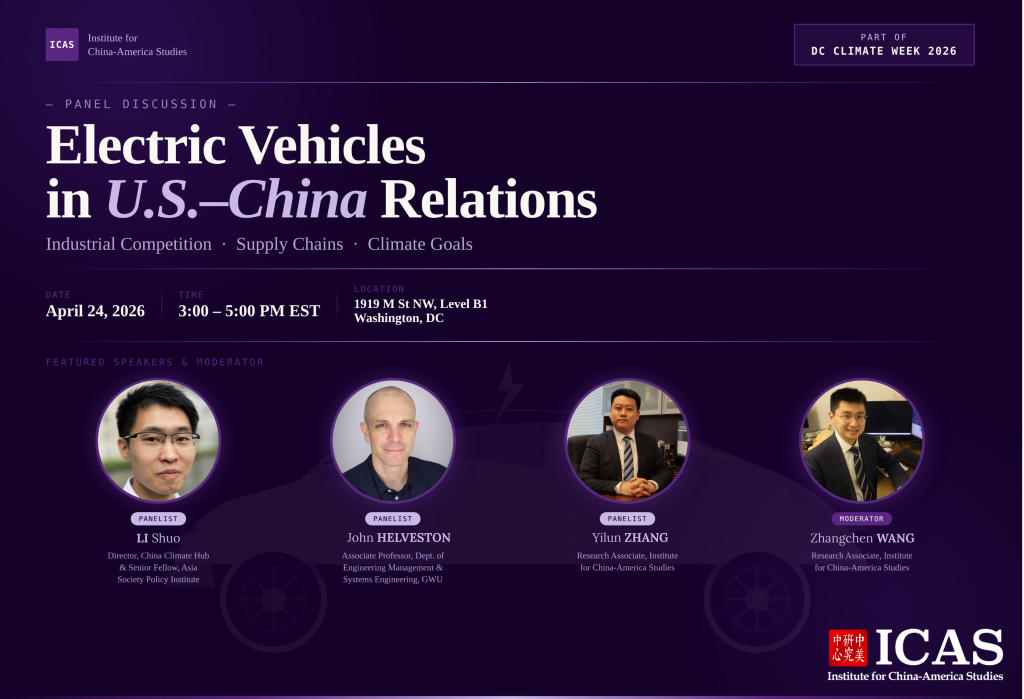
Electric Vehicles in U.S.–China Relations: Industrial Competition, Supply Chains, and Climate Goals
Hosted by ICAS, Part of DC Climate Week
April 24, 2026
3:00 PM – 5:00 PM EST
Electric vehicles are widely seen as essential to reducing transportation-related emissions and advancing global climate goals. At the same time, U.S.–China relations have entered a period of strategic competition, reshaping trade policy, industrial strategy, and global supply chains. In recent years, China has rapidly expanded its EV manufacturing capacity and supply chain integration, while the United States has sought to strengthen domestic production through industrial policy measures.
The speakers on this panel will be LI Shuo (Director of China Climate Hub & Senior Fellow at Asia Society Policy Institute), John HELVESTON (Associate Professor, Department of Engineering Management and Systems Engineering, George Washington University), and Yilun ZHANG (Research Associate, Institute for China-America Studies). Moderator of the panel will be Zhangchen WANG (Research Associate, Institute for China-America Studies).
Strategic Adjustment and High-Quality Development: Toward a New Framework for U.S.-China Relations
Hosted by ICAS, ACCWS, and The Carter Center
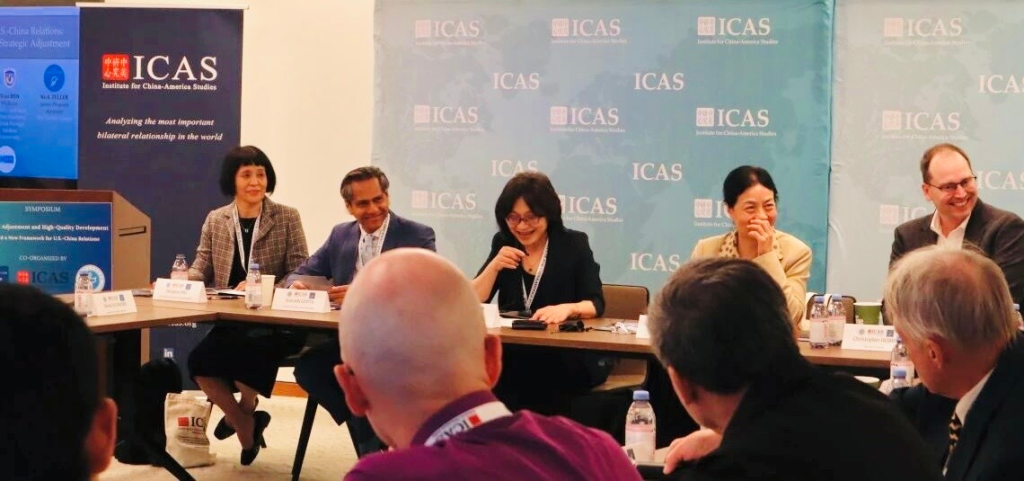
ICAS was proud to present this symposium in Washington, D.C. on April 17, 2026 in collaboration with the Academy of Contemporary China and World Studies and the Carter Center to discuss frameworks for managing U.S.-China relations.
Featured speakers included scholars from Tsinghua University, George Washington University, Fudan University, Beijing International Studies University, and the Chinese University of Hong Kong (Shenzhen), alongside researchers from the Cato Institute, the American Enterprise Institute, and the Asia Society Policy Institute, with additional contributions from APCO Worldwide and Canadian Solar, Inc. The symposium was opened with welcome remarks by Dr. Nong Hong, Executive Director of ICAS, opening remarks from Yafang Li, President of the Academy of Contemporary China and World Studies, and Christopher Hobbs, Deputy Director for Peace Strategy and Operations at the Carter Center…
Why Maritime Strain Is Becoming a Global Governance Problem
By Nong Hong
April 22, 2026
Recent developments from the Arctic to the South China Sea, from the South Pacific to the Gulf, suggest that the world’s oceans are entering a period of unusual strain. Climate disruption, gray-zone competition, chokepoint vulnerability and infrastructure rivalry are no longer separate trends. They are converging in ways that increasingly shape regional stability, global markets and the wider international order. The central challenge is no longer simply how states compete at sea, but whether maritime spaces can still be governed effectively under layered pressures.
On Friday, April 17, 2026, Senior Fellow Sourabh Gupta was interviewed by Dragon Television on U.S.-China relations.
On Thursday, April 16, 2026, Senior Fellow Sourabh Gupta was quoted by South China Morning Post on India’s ruffled feathers.
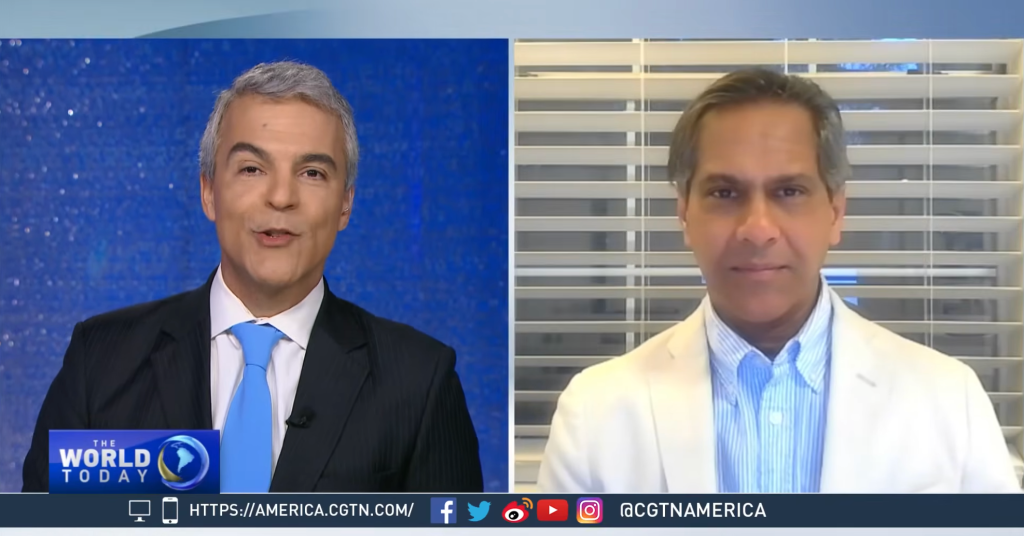
On Saturday, April 11, 2026, Senior Fellow Sourabh Gupta was interviewed by CGTN America’s The World Today on the 55th anniversary of Ping Pong Diplomacy.
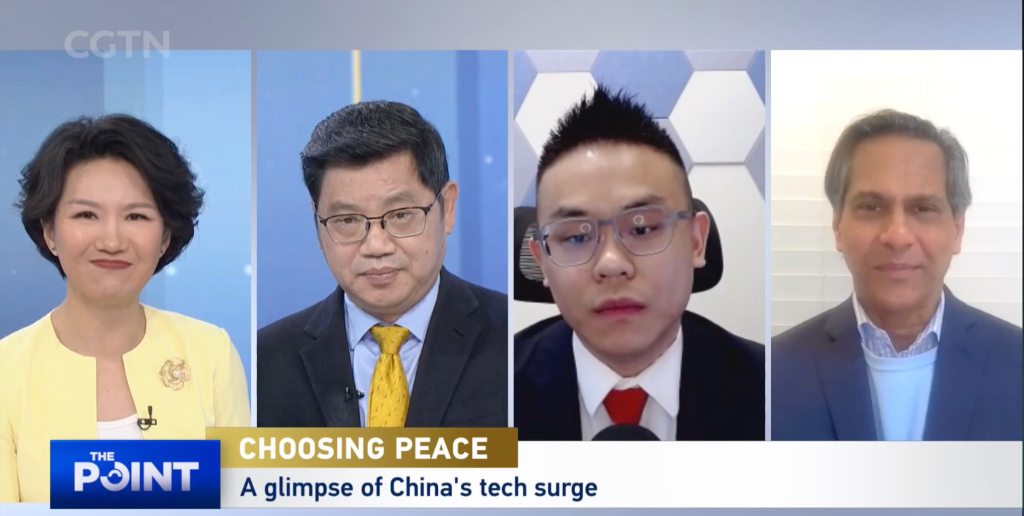
On Friday, April 10, 2026, Senior Fellow Sourabh Gupta was interviewed by CGTN The Point with Liu Xin on CCP-KMT Relations.