

ICAS Bulletin (online ISSN 2836-3418, print ISSN 2836-340X) is published every other week throughout the year at 1919 M St NW, Suite 310, Washington, DC 20036.
The online version of ICAS Bulletin can be found at chinaus-icas.org/bulletins/.
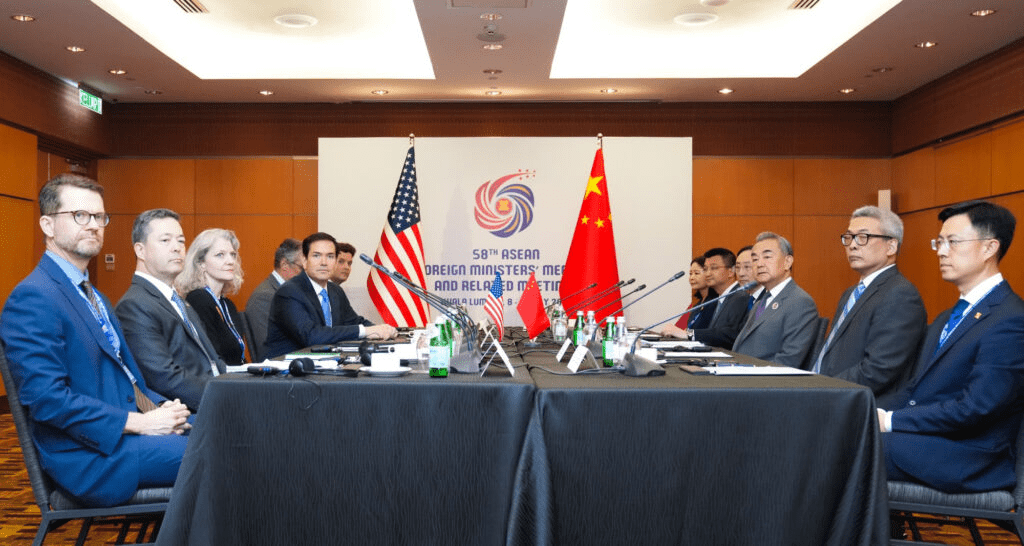
– Chinese Foreign Minister Wang Yi met in-person with U.S. Secretary of State Marco Rubio for the first time on the sidelines of the Association of Southeast Asian Nations (ASEAN) regional forum in Kuala Lumpur on July 11.
– The two sides agreed to explore “areas of potential cooperation” between Washington and Beijing and stressed the importance of managing differences between the two countries.
– Following the meeting, Secretary Rubio said that both sides are working on finding the “right date” for President Trump to visit China in the near term per President Xi’s invitation and suggested that “deliverables” are needed to make the visit happen.
– However, during the main forum both countries have contested each other for influence over other Asian countries. Rubio called for ASEAN to align with Washington to restrict trade with Beijing and Wang called neighbors to resist U.S. pressure amid tariff threats.
– Following the forum on July 12, Wang Yi announced that China and ASEAN have agreed to upgrade their free trade areas in October to deepen collaboration between the two sides in over 40 fields in the coming years.
– As Secretary Rubio conducted his first trip to Asia, the State Department fired about 1,300 employees including those who are involved in crafting the U.S. policy on the South China Sea and on the tech competition with China.
– The ASEAN forum was held in the shadow of President Trump sending a renewed threat of tariffs through letters to nations that have not yet concluded its negotiation with the U.S. on July 7. Six out of the 14 nations are ASEAN members.
Associated News References:
“State Department cuts China policy staff amid major overhaul,” The Washington Post, July 14
“China, ASEAN to submit upgraded free trade deal to leaders in October, says China’s foreign minister,” Reuters, July 12
“Wang Yi hails China-ASEAN cooperation, calls for openness amid U.S. tariffs,” CGTN, July 12
“Rubio meets China’s Wang amid trade tensions, says good chance of Trump-Xi talks,” Reuters, July 11
“Rubio and Wang stress cooperation after talks in Malaysia as US-China tensions simmer,” AP News, July 11
“Rubio says ‘odds are high’ for Trump-Xi meeting this year,” The Washington Post, July 11
“Rubio and China’s Top Envoy Vie for Influence in Asia Over Trump’s Tariffs,” The New York Times, July 11
“’Shock. Frustration. Anger.’ Trump’s tariff letters roil Asian allies,” POLITICO, July 8
– On July 14th, despite rising fears triggered by mounting tariffs, the White House economic advisor Kevin Hassett downplayed the concern, and suggested that “patriotism buying” for made-in-America products will prevent tariffs from stoking price inflation.
– As the U.S. aims to wrap up its negotiations with other trade partners and threatens more tariffs in the upcoming months, Chinese exporters have increased their shipments to 10 ASEAN countries, mostly for transshipment purposes, by 16.8% in June.
– China’s exports in June rose surprisingly amid rising uncertainties as the Trump administration’s tariff deadline approaches.
– While China’s exports jumped 5.8% in June, its exports to the U.S. dropped for a third month despite showing signs of easing following the tariff truce by the two countries.
– In line with China’s trade increase in 2024, China’s export to the rest of the world in the first half of 2025 rose 5.9%, which signals stable trade relations with the rest of the world.
– On July 14, despite the decline in overall exports, America’s busiest port – the port of Los Angeles- reported a rebound of Chinese shipment June following the tariff truce.
– Amid rare earth shortages and limited supply from China, the U.S. Department of Defense increased its share in MP Materials, the only operational rare earth mine in the U.S., to become its largest shareholder.
– Despite ongoing trade turbulence, China’s GDP growth, which is due to release on July 15, is likely to grow above the government’s 5% growth target in the second quarter of 2025 to 5.1%.
– China’s steel exports reached 30.7 million tons in the second quarter, up 11% from a year earlier, defying expectations for volumes to fade under trade measures.
Associated News References:
“Trump tariffs don’t cause inflation because of ‘patriotism’ buying: WH advisor,” CNCB, July 14
“China’s Rare-Earth Metal Exports Spike to Highest Since 2009,” Bloomberg, July 14
“China’s Economy Gets Surprise Lift from Trump’s Trade War,” Newsweek, July 14
“China’s exporters rush to beat Trump’s next big tariff deadline,” Reuters, July 14
“China’s GDP Seen Outpacing Target, Easing Stimulus Pressure,” Bloomberg, July 14
“China’s Exports Beat Expectations After Trade Truce with U.S.’,” The Wall Street Journal, July 14
“Busiest US port says June imports rebound after China tariffs reduced,” Reuters, July 14
“China’s exports growth tops expectations in June; rare earth shipments surge 60% to record high,” CNBC, July 13
“China’s Steel Exports Defy Protectionist Wave to Hit Record,” Bloomberg, July 13
“Pentagon to become largest shareholder in rare earth miner MP Materials; shares surge 50%,” CNBC, July 10
– On July 14, the U.S. Air Force confirmed that the U.S. has sent advanced versions of the F-15 fighter jet to Kadena Air Base in Japan to “conduct integration and familiarization training.”
– In a report released on July 14, Senate Democrats warned about China’s increasing diplomatic reach as the Trump administration pares back U.S. international presence.
– A July 14 report revealed that the Philippines, a U.S. treaty ally, is seeking to play a bigger role in a potential Taiwan conflict.
– On the same day, China accused Japan, a U.S. treaty ally, of sending spy planes to its Air Defense Identification Zone over the East China Sea.
– The U.S. kicked off a series of new exercises aimed at protecting the Panama Canal on July 13, amid tensions over alleged Chinese influence along the prized trade route.
– Chinese Foreign Minister Wang Yi restated Beijing’s rejection of the South China Sea arbitration ruling at the ASEAN forum in Malaysia.
– Adm. Stephen Koehler, commander of the U.S. Pacific Fleet, reassured Manila during a forum on July 11 that the U.S. will further boost deterrence against Beijing in the South China Sea.
– U.S. Under-Secretary of Defense for Policy Elbridge Colby is pushing U.S. allies such as Japan and Australia to clarify their role in a potential conflict with China over Taiwan.
Associated News References:
“China Steps in as US Pulls Back From Diplomacy, Report Says,” U.S, News, July 14
“US Sends Advanced F-15 Jets To Frontline Air Base Near China,” Newsweek, July 14
“The Philippines is quietly working with Taiwan to counter China,” The Washington Post, July 14
“China Blasts US Ally Over Spying in Air Defense Zone,” Newsweek, July 14
“US conducts military drills in Panama Canal amid Trump’s China influence concerns,” South China Morning Post, July 13
“US demands clarity from allies on their role in potential war over Taiwan, FT reports,” Reuters, July 12
“Wang Yi underlines Beijing’s rejection of 2016 South China Sea ruling,” South China Morning Post, July 12
“US commander says China has failed to coerce rival states in South China Sea,” AP News, July 11

– China’s biotech advance, especially in drug development for cancer, weight-loss, and more, has surpassed the EU and has nearly caught up to the U.S.
– China faces significant challenges advancing its semiconductor lithography, a key hurdle for its drive toward technological self-sufficiency and superiority in the trade war with the U.S.
– On July 14, China’s market regulator conditionally approved U.S. chip design software provider Synopsys’ acquisition of engineering design firm Ansys.
– China is accelerating its satellite launches and commercial deals in the low Earth orbit broadband to race American competitors such as SpaceX’s Starlink.
– General Motor said on July 14 that it is working with joint venture partner LG Energy Solution to upgrade its Ultium battery factory to make lithium-iron-phosphate cells, a product that has been dominated by Chinese production, for the automaker’s low-cost EVs.
– On July 13, Nvidia CEO Jensen Huang downplayed U.S. fears that China’s military will use his firm’s chips just days ahead of another trip to Beijing.
– Earlier, a bipartisan pair of U.S. senators sent a letter to Jensen Huang on July 11 to warn the CEO to refrain from meeting with companies that are suspected of undermining U.S. chip export controls.
– On July 11, Chinese artificial intelligence startup Moonshot AI released a new open-source AI model as it seeks to reclaim its position in the competitive domestic market.
– Between July 2 and July 6, two remote-controlled Chinese satellites docked in high orbit to allow refueling and servicing for the first time, an achievement that has yet to be matched by the U.S.
Associated News References:
“China Lags in Chip Lithography, Influential DC Think Tank Says,” Bloomberg, July 14
“China enters race for LEO broadband dominance,” SPACENEWS, July 14
“China gives conditional nod to Synopsys-Ansys deal, removing last major hurdle,” Reuters, July 14
“Nvidia’s Jensen Huang brushes off U.S. fears that China’s military will use his firm’s chips,” CNBC, July 14
“GM to challenge China’s LFP monopoly with upgraded battery factory,” TechCrunch, July 14
“China Appears to Pull Off Satellite Feat That NASA Has Never Achieved,” Newsweek, July 14
“China Biotech’s Stunning Advance Is Changing the World’s Drug Pipeline,” Bloomberg, July 13
“China’s Moonshot AI releases open-source model to reclaim market position,” Reuters, July 11
“US senators warn Nvidia CEO about upcoming China trip,” Reuters, July 11

– On July 14, President Trump laid out steps intended to pressure Russia to end its war in Ukraine, including funneling new weapons to Kyiv and threatening economic punishment on Moscow if peace isn’t reached in 50 days.
– Chinese Foreign Minister Wang Yi met with his Russian counterpart Sergei Lavrov on July 13 to discuss “relations with the United States and prospects for resolving the Ukrainian crisis.”
– It was reported that U.S. Under-Secretary of Defense for Policy Elbridge Colby has prioritized countering China over supplying Ukraine, which prompted the U.S. to temporarily suspend its weapon shipments to Ukraine.
– On July 10, President Trump claimed that he struck a deal with NATO for the U.S. to send weapons to Ukraine through the alliances and NATO will pay for those weapons “a hundred percent”.
– Secretary of State Marco Rubio expressed frustration with his Russian counterpart Sergei Lavrov over the lack of progress in peace talks on Ukraine on July 10 as the two sides met at the side line of the ASEAN summit in Kuala Lumpur.
– It was reported that during his visit to Europe on July 3, Chinese Foreign Minister Wang Yi told his European counterpart that Beijing cannot accept Russia losing its war against Ukraine as this could allow the United States to turn its full attention to China.
– On July 2, it was reported that the U.S. has stopped the delivery of air defense interceptors and other weapons intended for Ukraine and is using them instead to beef up Pentagon stocks.
Associated News References:
“Trump announces novel plan to send weapons to Ukraine and gives Russia new deadline to make peace,” CNN, July 14
“Russia, China discuss Ukraine war and ties with the United States,” Reuters, July 13
“Pentagon Official at Center of Weapons Pause on Ukraine Wants U.S. to Focus on China,” The Wall Street Journal, July 13
“Trump says he struck deal to send US weapons to Ukraine through NATO,” CNN, July 11
“Rubio Tells Top Russian Diplomat of Trump’s Frustration Over Putin’s War,” The New York Times, July 9
“China tells EU it can’t accept Russia losing its war against Ukraine, official says,” CNN, July 4
“U.S. Halts Key Weapons for Ukraine in New Sign of Weakening Support for Kyiv,” The Wall Street Journal, July 2

“China Credit Growth Tops Forecasts as PBOC Watches Easing Impact,” Bloomberg, July 14
“Buckle up: China unveils maglev marvel, redefining the future of high-speed rail,” South China Morning Post, July 14
“China-based Hesai appeals ruling over US linking firm to Chinese military,” Reuters, July 14
“Chinese Students Flocked to Central Illinois. Their Food Followed.,” The New York Times, July 14
“‘Jurassic World Rebirth’ Leads China Box Office Again as ‘Superman’ Debuts at No. 4,” Variety, July 13
“Kanye “Ye” West Struggles Through Chaotic, Rain-Soaked Shanghai Concert,” The Hollywood Reporter, July 12
“Chinese scientists create first cyborg bee with world’s lightest brain controller,” South China Morning Post, July 10
Bangladesh’s Foreign Policy and US, China and India in a Fluid Indo-Pacific July 2 hosted by the East-West Center
Romain Chuffart on the Arctic: Denmark
Hosted by ICAS
July 15, 2025
ICAS conducted its sixth Arctic-focused ICAS Expert Voices Initiative (EVI) interview series with Dr. Romain Chuffart, President and Managing Director of The Arctic Institute. The discussion focused on Denmark’s Arctic strategy and policy, highlighting the perspectives of both Denmark and Greenland, Denmark’s evolving relationship with Russia and the United States within the context of Arctic security, Denmark’s broader engagement with other Arctic states, how Denmark and Greenland view China’s growing presence and interests in the region, and the geopolitical and environmental factors shaping their approach to Arctic affairs.
The full recording of the interview will be released shortly, stay tuned.

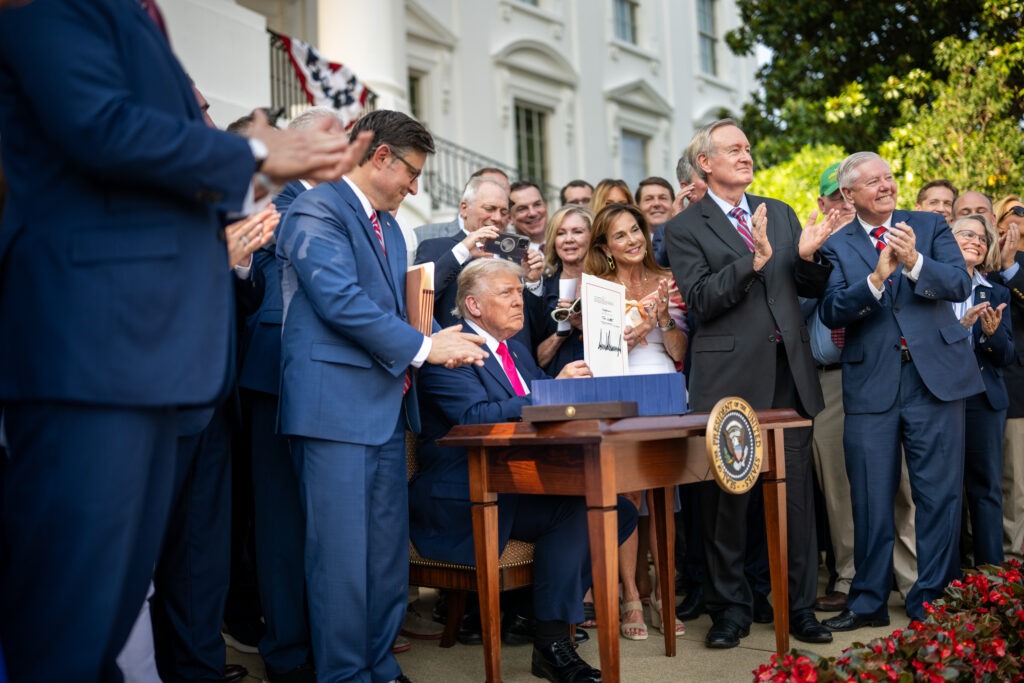
The Big Beautiful Bill Signals Congress Taking the Wheel on U.S.–China Trade
By Yilun Zhang
July 14, 2025
The repeal of de minimis may be just one element of the broader institutional reset now underway in U.S.–China relations. But what this means for Beijing is clear: there is no going back to a time when economic pragmatism could override political antagonism. The idea that trade can once again anchor bilateral relations is no longer sustainable. If stabilization is to be achieved, it will have to come through channels yet unknown—because the familiar mechanics of trade and capital diplomacy no longer apply..…
Deep Waters, High Stakes: U.S. Policy Reform for Offshore Critical Minerals
By Dr. Nong Hong
July 14, 2025
Credibility as a global leader in responsible seabed governance will necessitate not only robust domestic oversight but also transparent engagement in international dialogues, demonstrating a commitment to responsible resource stewardship that extends beyond its own borders. The world is watching whether the U.S. can truly lead not only in extracting essential minerals, but in setting and adhering to high standards for responsible resource governance in the deep sea for generations to come.…


Securing China-U.S. Relations within the Wider Asia-Pacific
By Sourabh Gupta
July 14, 2025
The United States and China must craft a durable consensus that prioritizes regional stability and coexistence, keeps tensions within a manageable range, encourages communication, and privileges a constructive working relationship in areas of common interest without trampling on the other party’s system, values, and regional commitments.…
This chapter was published in Can Asians Think of Peace? Essays on Managing Conflict in the Asian Century found here.
Tariff deadline extends as Trump’s trade talks falter
By Sourabh Gupta
July 8, 2025
Trump’s enthusiasm for striking deals is tempered by his lack of enthusiasm for compromise. Quick ‘wins’ to calm financial markets and ensure business certainty are good — trade deficit reduction and reshoring of industrially salient industries is even better. When push comes to shove, the latter will not be substantially traded off for the former. Trump’s personal investment in deficit reduction and local production should not be underestimated, with his second term a last opportunity to leave an enduring mark. Japan, in particular, appears to have misjudged his relative disinterest in compromise..…

Ethan Guo’s Antarctic Landing: What a Teen Pilot’s Flight Reveals About Law and Governance at the South Pole
By Dr. Nong Hong
July 3, 2025
When 19-year–old American pilot Ethan Guo landed at Chile’s Lieutenant Rodolfo Marsh Base in Antarctica, ostensibly deviating from his flight plan, it immediately made headlines. Guo was attempting a record-setting solo flight to all seven continents to raise funds for childhood cancer. But rather than global applause, he was met with detention by Chilean authorities in Punta Arenas and charged under civil aviation and Antarctic regulations for submitting a false flight plan and illegally entering Antarctic airspace.…
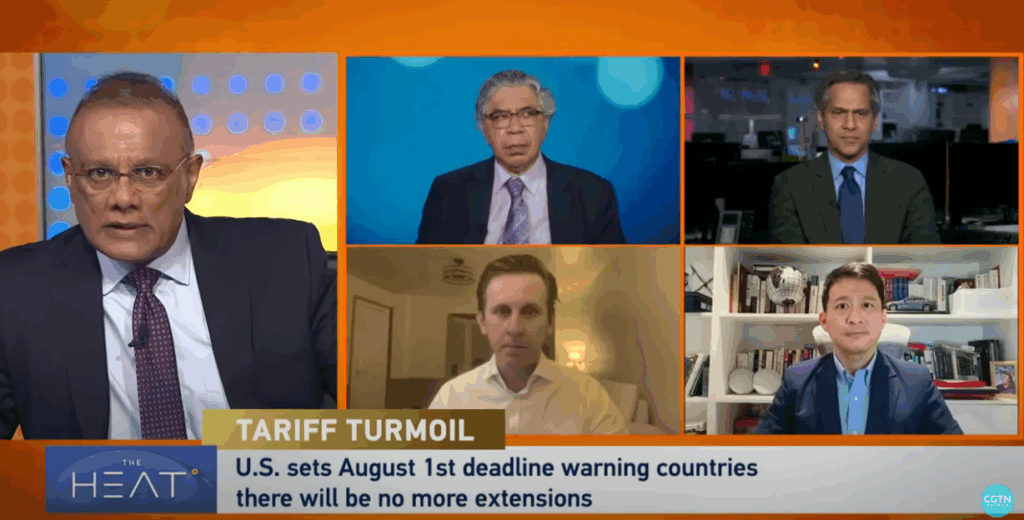
On Wednesday, July 9, 2025, Senior Fellow Sourabh Gupta discussed the extension of the deadline of President Trump’s liberation day tariffs on The Heat by CGTN.
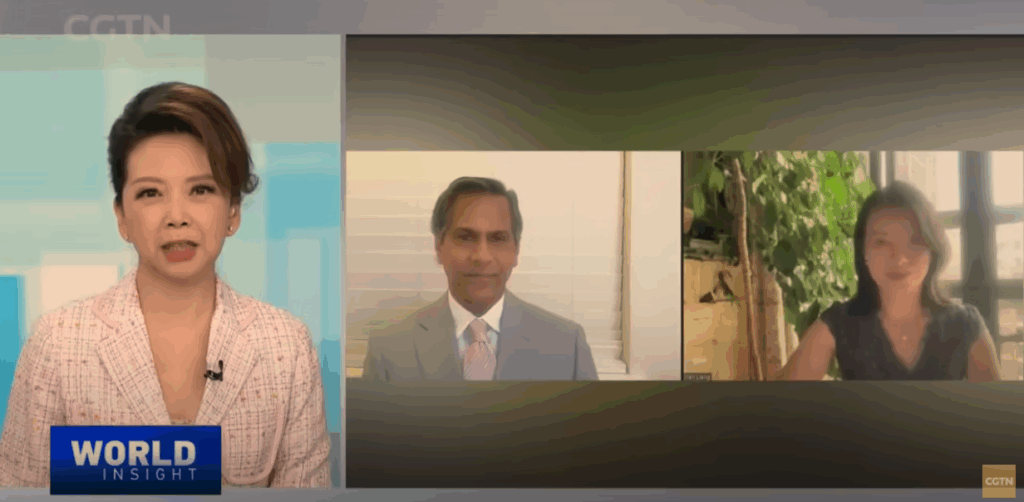
On Wednesday, July 9, 2025, Senior Fellow Sourabh Gupta discussed the extension of the U.S. tariff deadline on World Insight by CGTN.
On Monday, July 7, 2025, Distinguished Fellow Denis Simon was interviewed in depth by South China Morning Post on the U.S.-China S&T agreement and the outlook for U.S.-China science and tech cooperation.
On Friday, July 4, 2025, Senior Fellow Sourabh Gupta was quoted by China Daily on the passage of the Big Beautiful Bill.
On Wednesday, July 2, 2025, Senior Fellow Sourabh Gupta discussed the China-EU Strategic Dialogue Meeting on CGTN America.

The Institute for China-America Studies is an independent nonprofit, nonpartisan research organization dedicated to strengthening the understanding of U.S.-China relations through expert analysis and practical policy solutions.
1919 M St. NW Suite 310,
Washington, DC 20036
icas@chinaus-icas.org
(202) 968-0595
© 2026 INSTITUTE FOR CHINA-AMERICA STUDIES. ALL RIGHTS RESERVED.