
ICAS Bulletin (online ISSN 2836-3418, print ISSN 2836-340X) is published every other week throughout the year at 1919 M St NW, Suite 310, Washington, DC 20036.
The online version of ICAS Bulletin can be found at chinaus-icas.org/bulletins/.
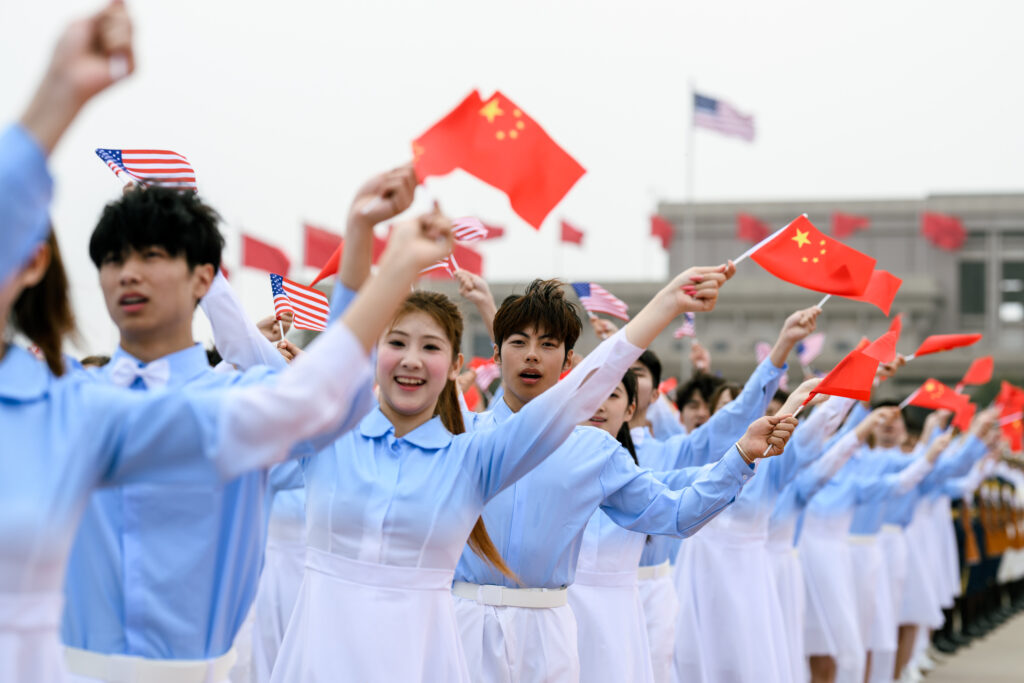
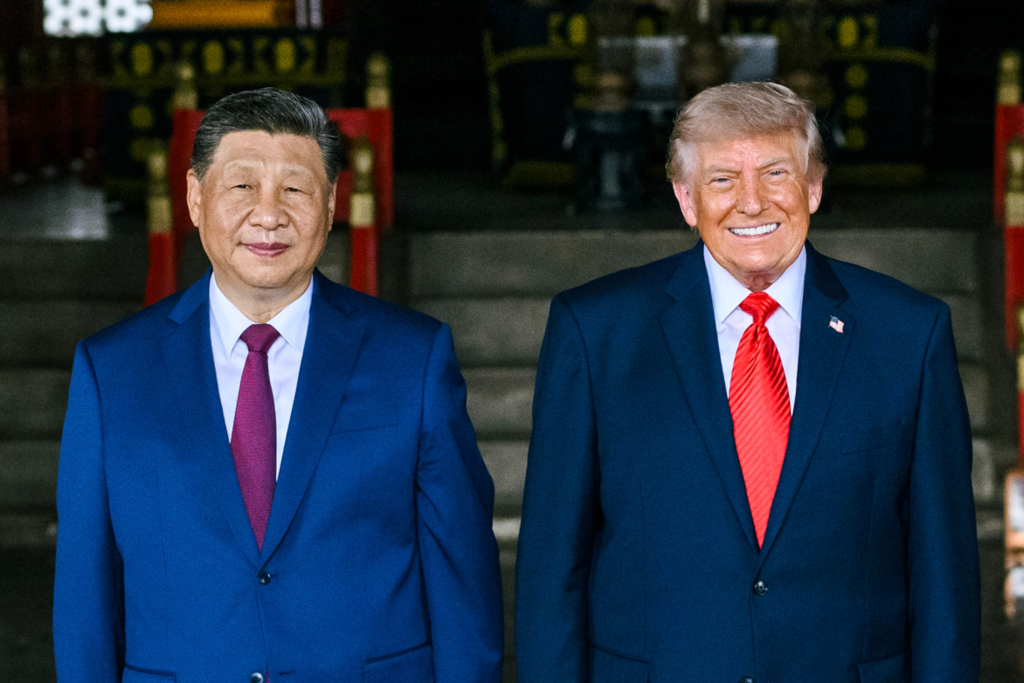
– President Donald Trump traveled to China from May 13-15, the first state visit of a U.S. President to China since 2017, and held talks with Chinese President Xi Jinping as both sides reached consensus on enhancing stability of the bilateral relationship.
– The White House highlighted consensus over the opening of Strait of Hormuz, denuclearization of North Korea, and building confidence for businesses and consumers around the world.
– The Chinese side emphasized the importance of realizing peaceful coexistence and win-win cooperation through contributing to each other’s development and revitalization.
– The state visit concluded in a friendly atmosphere as both sides sought stabilization while details of tangible outcomes remain limited.
– President Trump invited President Xi to visit the U.S. in September. The two countries will also host the G20 (Miami, Florida) and APEC (China) later this year.
– Following an extensive talk with President Xi about Taiwan, President Trump cautioned the self-ruling island against formally declaring independence from China by the end of his trip.
– U.S. lawmakers criticized the White House for appearing “too accommodating towards Beijing” and that “economic engagement with China should not come at the expense of deterrence in the Taiwan Strait.”
– Secretary of State Marco Rubio, who was sanctioned by Beijing when serving as Senator in 2020, also traveled with the President to Beijing and expressed the need to sustain a stable relationship with Beijing.
Associated News References:
“Trump’s China trip highlights bipartisan shift in Washington’s approach to Beijing,” SCMP, May 19
“Trump returns from China with stability and a stalemate,” Reuters, May 17
“Trump Calls Xi a ‘Friend.’ But He Left China Without Any Breakthroughs,” The New York Times, May 16
“Key takeaways from Trump’s China trip,” NPR, May 15
“Trump leaves China after talks dominated by trade, oil and Taiwan,” CNBC, May 15
“China offers Trump grand welcome, but issues warning on Taiwan,” PBS, May 15
“Trump warns Taiwan against declaring independence, hours after summit with China’s Xi,” BBC, May 15
“Read the full transcript: Secretary of State Marco Rubio interviewed by ‘NBC Nightly News’ anchor Tom Llamas,” NBC, May 14
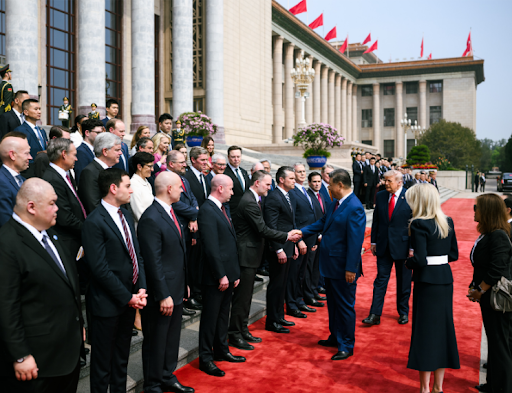
– The Trump-Xi summit yielded limited relief for markets as both countries reached preliminary agreement to mutually lower some tariffs on a range of products.
– On May 18, the White House announced that China will buy $17 billion of U.S. agricultural products, particularly soybean and beef, each year through 2028.
– The White House also announced 200 Boeing jet purchases from China, with a possibility of expanding the deal to 750.
– Prior to the President’s trip to China, Secretary of the Treasury Scott Bessent led a trade negotiation group to meet with Chinese counterpart led by Vice-Premier He Lifeng in Seoul on May 12.
– On May 16, China said it had agreed to establish the Board of Trade and Board of Investment with the U.S., a major discussion point between the two countries’ trade representatives in recent trade talks.
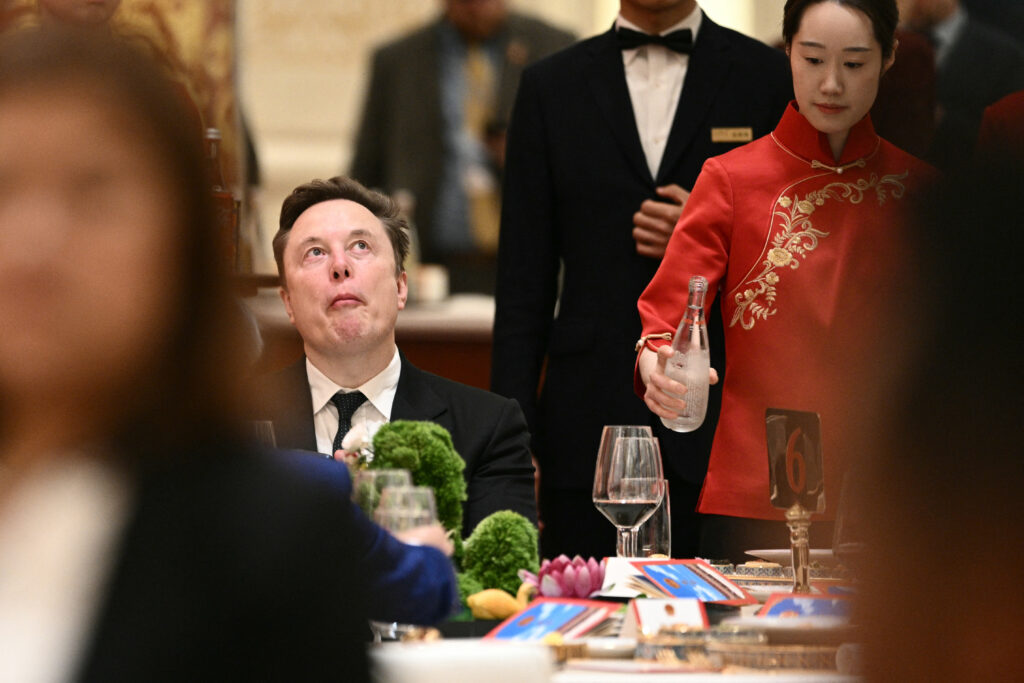
– President Trump also brought a group of U.S. CEOs, including Tesla’s Elon Musk and Nvidia’s Jensen Huang, as a last-minute addition to the delegation.
– President Xi told U.S. CEOs that the door to business in China will “open wider,” echoing earlier calls from President Trump to further open the Chinese market.
– On May 18, it was reported that Nvidia’s Huang expects China to allow the imports of AI chips from the U.S. Earlier statements specified that the U.S. has cleared the way for H200 chips export to 10 Chinese firms, despite no deliveries being made yet.
– U.S. Trade Representative Jamieson Greer said that U.S. export controls on semiconductor chips were not a major topic of discussion between the two leaders.
Associated News References:
“China agrees to boost trade for US beef and poultry following Trump-Xi summit,” AP News, May 18
“China Will Open Its Market to AI Chips From US, Nvidia’s CEO Says,” Bloomberg, May 18
“China Says It Has Agreed With U.S. to Set Up Trade and Investment Bodies,” The Wall Street Journal, May 17
“China says preliminary agreement reached with US to lower some tariffs,” POLITICO, May 17
“Trump says China will buy 200 planes from Boeing, with a possibility of expanding the deal to 750,” PBS, May 15
“Xi tells Musk, Tim Cook and other CEOS on Trump’s trip: China will ‘open wider’,” CNBC, May 14
“Chip export controls not major topic in China talks, US trade rep Greer says,” Reuters, May 14
“US and China Wrap Up Trade Talks With Trump En Route to Beijing,” Bloomberg, May 12
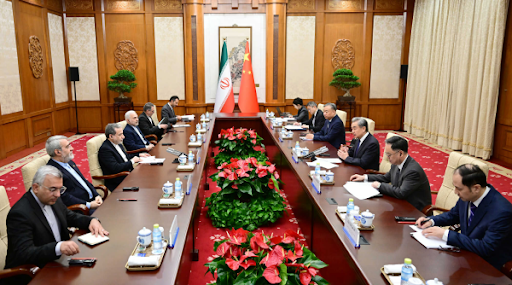
– On May 18, President Trump called off a scheduled attack amid “serious negotiations” towards a peace deal a day after he threatened to renew war with Iran as Tehran continues to resist U.S. demand over halting uranium enrichment and the blockade of the Strait of Hormuz.
– U.S. Trade Representative Greer said on May 17 that China committed to not “provide material support to Iran,” but that the U.S. did not seek China’s direct help to reopen the Strait of Hormuz.
-On May 16, Iran seized a support vessel owned by a Chinese security firm near the Strait of Hormuz.
– On May 15, U.S. Trade Representative Jamieson Greer said that China wants to see the Strait of Hormuz reopen without curbs or tolls, echoing Treasury Secretary Bessent and State Secretary Rubio’s statements that China will use its influence on Iran to help reopen the Strait of Hormuz on May 14.
– On the same day, the Chinese Foreign Ministry said it saw “no point” for the U.S. conflict with Iran to continue.
– On May 9, the U.S. imposed sanctions on three Chinese firms for providing satellite imagery to Iran, in its latest move to pressure Tehran’s trade partners.
– The U.S. and Iran exchanged fire on May 7 as peace talks continued in stalemate.
-Earlier on May 6, Chinese Foreign Minister Wang Yi met with Iranian Foreign Minister Abbas Araghchi in Beijing and called for a “comprehensive ceasefire.”
– As President Trump departed China, he said he discussed lifting sanctions on Chinese companies that buy Iranian oil with President Xi in Beijing.
Associated News References:
“Trump calls off scheduled attack on Iran amid “serious negotiations” toward peace deal,” CBS News, May 18
“Trump Threatens Iran as Tensions Surge Again in Middle East,” The New York Times, May 18
“China committed to not ‘provide material support to Iran,’ US trade rep says,” ABC News, May 17
“Iran’s Seizure of Chinese Security Ship Shows Its Favors for Friends Have Limits,” The Wall Street Journal, May 16
“Trump: spoke with Xi about lifting sanctions on Chinese companies that buy Iranian oil,” Reuters, May 15
“China: ‘No point’ in continuing Iran war,” The Hill, May 15
“China wants Strait of Hormuz open free of curbs, USTR Greer tells Bloomberg News,” Reuters, May 14
“China will work behind the scenes to help reopen the Strait of Hormuz, Bessent says,” CNBC, May 14
“Rubio Says U.S. Hopes China Can Play ‘More Active Role’ in Resolving Iran Conflict,” The Wall Street Journal, May 13
“US Sanctions Chinese Satellite Imagery Companies Over Iran War,” Bloomberg, May 9
“U.S. and Iran Exchange Fire Amid a Declared Truce,” The New York Times, May 7
“Chinese foreign minister tells his Iranian counterpart that a ‘comprehensive ceasefire’ in the war is needed,” ABC News, May 6
“Grains Jump After US Says China to Buy Billions in Farm Goods,” Bloomberg, May 18
“Global banks raise yuan forecasts, fuelled by China’s export strength and stable US ties,” Reuters, May 18
“China’s economy loses steam in April as retail sales hit 40-month low,” CNBC, May 18
“U.S. Amb. to China David Perdue on Trump-Xi summit: Pres. Trump stood up for American workers,” CNBC, May 18
“Xi prepares to welcome Putin to China four days after hosting Trump,” The Guardian, May 18
“Brazil may re-route farm export flows amid US-China deal,” Reuters, May 18
“US, China and Russia prefer a divided Europe, Kallas warns,” POLITICO, May 17
“Trump and South Korea’s Lee discuss outcome of US-China summit,” Reuters, May 17
“Top US tech CEOs leave China with little to show,” DW, May 16
“U.S. and China Will Start Discussing A.I. Safety, Bessent Says,” The New York Times, May 15
“Trump weighs Taiwan arms package after summit aimed at steadying US-China ties,” PBS, May 15
“Penalized by China, Rubio Enjoys a Trip to Beijing,” The New York Times, May 15
“President Trump visits Temple of Heaven following historic U.S.-China summit,” NBC News, May 14
“U.S. can hold AI talks with China because ‘we are in the lead,’ Bessent tells CNBC as nations plan safety protocol,” CNBC, May 14
“Who Attended the U.S.-China State Banquet in Beijing?,” The New York Times, May 14
“IMF says constructive US-China dialogue, reduced tensions good for world economy,” Reuters, May 14
“Asia-Pacific stocks trade mixed as Trump lands in Beijing for high-stakes Xi meeting,” CNBC, May 14
“China tweaks Rubio’s name to bypass travel ban for Trump-Xi meeting,” The Hill, May 13
“U.S. and China Pursue Guardrails to Stop AI Rivalry From Spiraling Into Crisis,” The Wall Street Journal, May 6
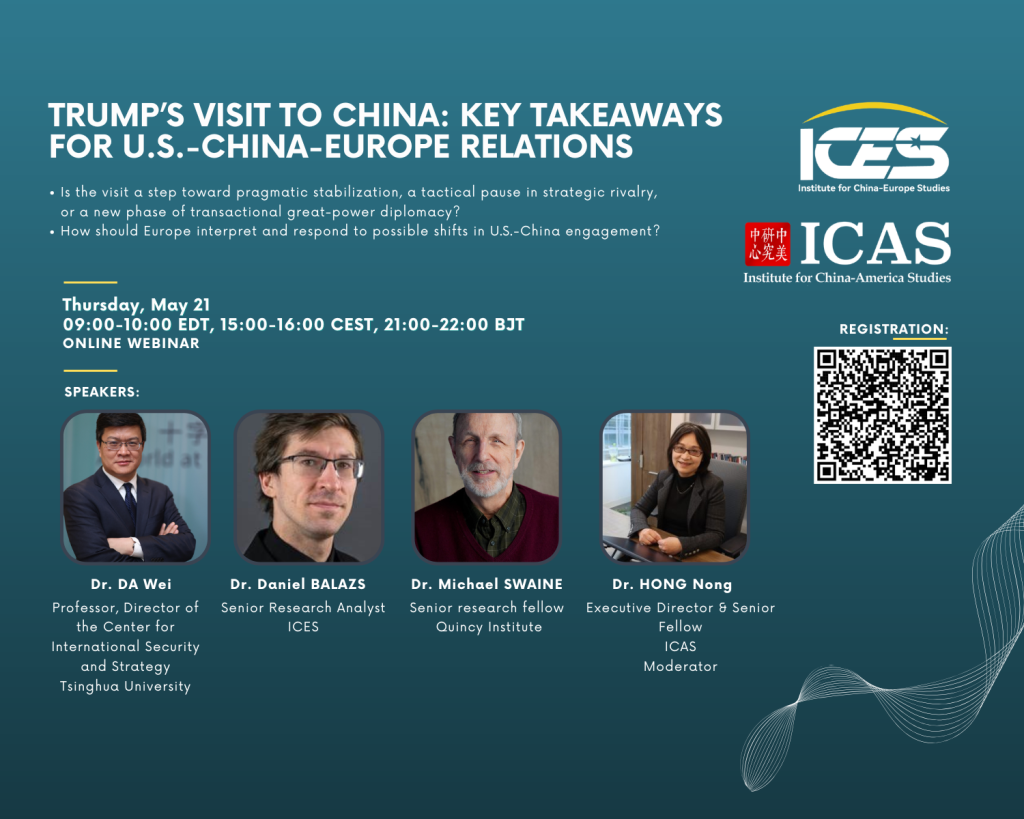
Trump’s Visit to China: Key Takeaways for U.S.-China-Europe Relations
Hosted by ICAS & ICES
Thursday, May 21, 2026
9:00am – 10:00am ET
ICAS and the Institute for China-Europe Studies will jointly hold a webinar via ZOOM on Thursday, May 21, 09:00-10:00 ET (15:00-16:00 CEST, 21:00-22:00 BJT) with speakers Dr. Michael SWAINE (Senior research fellow, Quincy Institute), Dr. DA Wei (Professor, Director of the Center for International Security and Strategy, Tsinghua University), and Dr. Daniel BALAZS (Senior Research Analyst, ICES). Dr. HONG Nong (Executive Director & Senior Fellow, ICAS) will serve as moderator and YANG Li (Executive Director, ICES) will deliver opening remarks.
This webinar will examine the major takeaways from Trump’s China visit and explore what they mean for the future of U.S.-China-Europe relations. By bringing together expert perspectives, the webinar aims to provide a timely assessment of the visit’s significance and its implications for U.S.-China relations, transatlantic coordination, and Europe’s strategic positioning between Washington and Beijing.
The Arctic Enters a New Phase of Competition
By Nong Hong
May 19, 2026
Recent developments in the Arctic point to a subtle but important shift. The region is no longer defined only by who is present but, increasingly, by who has the capacity to operate, govern, finance and shape outcomes there.
This shift has important implications for China, which is not a polar state. But it is a legitimate stakeholder in Arctic shipping, climate research, energy transition and global maritime governance. Its Arctic interests do not rest on sovereignty claims, but on interdependence. For China, the most prudent path is responsible participation grounded in public goods rather than claims of geopolitical entitlement. That offers a more credible foundation for long-term influence than presence alone…
This commentary was originally released on the China US Focus website on May 19, 2026.
Xi-Trump summit: what ‘strategic stability’ means for US-China ties
By Nong Hong
May 17, 2026
One formulation emerging from the summit between President Xi Jinping and US President Donald Trump in Beijing merits particular attention: the reference in China’s official readout to a “constructive China-US relationship of strategic stability” that should guide ties “over the next three years and beyond”.
That formulation should not be overstated. A phrase in a summit readout does not by itself create a durable framework. Washington did not publicly adopt the formula in equivalent terms, and there is little reason to assume the US foreign policy bureaucracy will internalise it simply because Beijing has proposed it. Even so, the formulation is not without significance…
Trump’s visit ‘may help set the groundwork for both sides to identify areas of common interest’
By Sourabh Gupta
May 13, 2026
US President Donald Trump’s ongoing state visit to China from Wednesday to Friday has drawn significant international attention. In an interview with Global Times (GT) reporter Su Yaxuan, Sourabh Gupta (Gupta), a senior fellow at the Washington-based Institute for China-America Studies, noted that what China and the US are doing now is groping toward finding a new intermediate strategic equilibrium based on which they can engage each other. “The visit may help set the groundwork for both sides to identify areas of common interest,” Gupta said.…
This article was originally released in Global Times on May 13, 2026.
Trump’s China visit is more than diplomacy – it is a contest to define the relationship
By Nong Hong
May 12, 2026
US President Donald Trump’s upcoming visit to China is more than a high-level diplomatic meeting. It is also about who gets to shape the next phase of US-China relations and on what terms.
China’s Foreign Ministry has confirmed that Trump will pay a state visit to China later this week, at the invitation of President Xi Jinping. The agenda could include trade, rare earths, Iran, Taiwan, artificial intelligence and nuclear issues. That breadth alone shows this is not simply another trade negotiation, nor a return to the old era of engagement. It is a test of whether the world’s two largest economies can impose some order on a relationship still defined by strategic rivalry…
The Strait of Malacca: Conditionality Contained?
By Nong Hong
May 11, 2026
Author’s note: Malacca is the second case in the “Strategic Waterways Under Pressure” series because it offers an instructive contrast. Unlike Hormuz, it does not show passage under acute coercive strain. Instead, it shows how a heavily used strategic waterway can face sustained pressure while remaining broadly open and facilitative—and why that distinction matters for understanding conditional passage.
The Strait of Malacca shows how a strategic waterway can remain legally open while operating under real and sustained pressure. Its challenge is not formal closure or acute coercive disruption, but the gradual accumulation of operational, security, environmental, and political constraints. Heavy traffic, piracy and sea robbery risks, environmental vulnerabilities, and coastal-state sensitivities all shape how passage is managed.
From exports to investment: Chinese firms need a dual strategy for European and U.S. markets
By Yilun Zhang
May 8, 2026
The ongoing restructuring of global supply chains is no longer centered on trade flows, but increasingly on the movement of capital. Under this evolving framework, the interaction between the United States, Europe, and China is being reshaped less by short-term policy shifts and more by structural economic constraints. For China, this shift carries a clear implication: outward investment is no longer optional—it is becoming a strategic necessity.
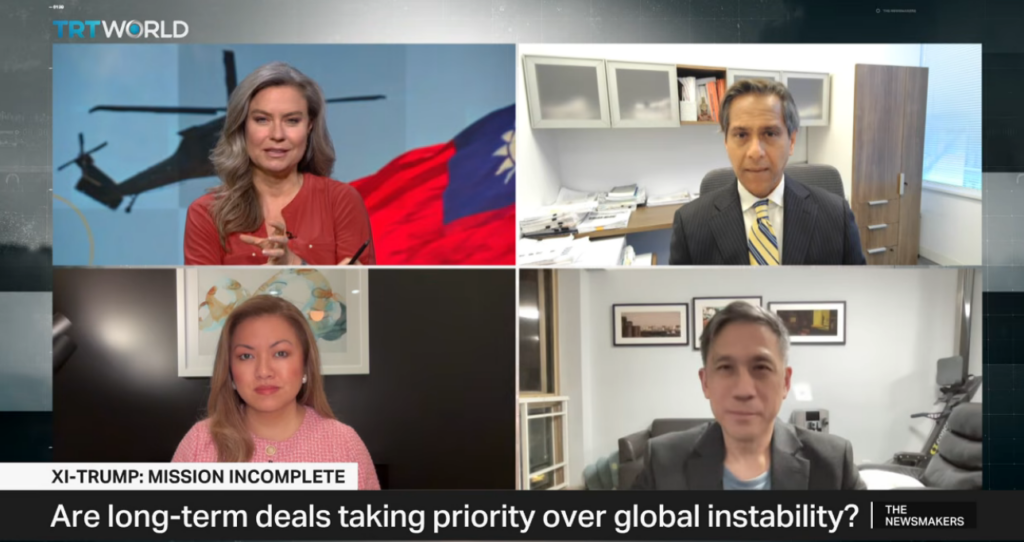
On Monday, May 18, 2026, Senior Fellow Sourabh Gupta appeared on TRTWord’s The Newsmakers to discuss the outcomes of the Trump-Xi Summit.
On Sunday, May 17, 2026, Senior Fellow Sourabh Gupta appeared on i24NEWS’s Global Eye live to discuss the U.S.-China competition and the Taiwan Question.
On Friday, May 16, 2026, Senior Fellow Sourabh Gupta quoted in Xinhua on Xi’s calling for U.S.-China coexistence.
On Thursday, May 15, 2026, Senior Fellow Sourabh Gupta appeared on CGTN’s Dialogue to discuss the Xi-Trump summit in Beijing.
On Thursday, May 15, 2026, Senior Fellow Sourabh Gupta appeared on CGTN’s The Hub to discuss strategic stability between China and the U.S.
On Wednesday, May 14, 2026, Senior Fellow Sourabh Gupta quoted in SCMP Series Trump’s 2026 Trip to China.
On Sunday, May 10, 2026, Research Associate Yilun Zhang was quoted by South China Morning Post on the Seoul trade talks ahead of Trump-Xi summit.
On Saturday, May 9, 2026, Research Associate Yilun Zhang was quoted by South China Morning Post on the ICT Ruling of the Section 122 Tariffs.
On Wednesday, May 6 2026, Senior Fellow Sourabh Gupta was interviewed by CGTN The Point on Japan in the Indo-Pacific.