
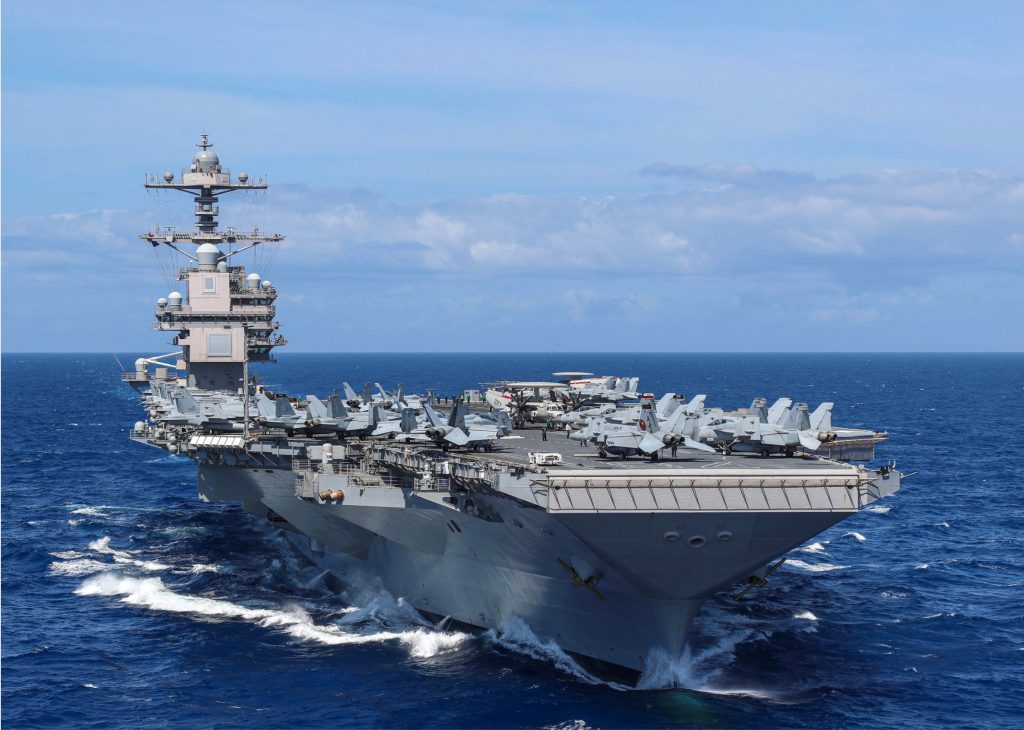
Cover Image Source: “190208-A-WO440-0071” by National Museum of the U.S. Navy, Public Domain Mark
Author’s Note: The Strait of Hormuz serves as the opening case study in the Strategic Waterways Under Pressure series because it concentrates, in a single waterway, many of the pressures now reshaping international passage. It is where strategic importance, legal dispute, and practical vulnerability are most clearly intertwined.
The present predicament in the Strait of Hormuz is no longer captured by the simple question of whether the waterway is formally open. In March and April 2026, the crisis surrounding the strait drew renewed warnings from the International Maritime Organization, sharp concern over threats to civilian shipping, extensive Global Navigation Satellite Systems (GNSS) interference, mounting insurance and routing pressures, and open legal argument over whether passage could be burdened by payments or other discriminatory conditions. These developments show how a strait may remain open in formal legal terms while becoming markedly thinner, riskier, and more contingent in practice. That is the wider question raised by this series: whether international passage remains genuinely open or is instead becoming progressively more conditional under pressure.
The strategic significance of Hormuz is difficult to overstate. According to the U.S. Energy Information Administration (EIA), total oil flows through the strait averaged 20.9 million barrels per day in the first half of 2025, equivalent to about 20 per cent of global petroleum liquids consumption and roughly one-quarter of total global maritime traded oil. The same assessment estimated that more than one-fifth of global LNG trade also transited the strait. If those figures capture Hormuz in normal strategic terms, the crisis of March-April 2026 revealed the scale of disruption when passage came under acute pressure. On 7 April 2026, EIA estimated that production shut-ins linked to restricted Hormuz traffic had reached 7.5 million barrels per day in March and would rise to 9.1 million barrels per day in April. On 24 April 2026, the IMO Secretary-General stated that there was no safe transit anywhere in the Strait. Hormuz is not simply a busy sea lane; it is one of the principal arteries of the global energy economy.
That strategic reality gives the strait unusual legal and policy weight. Disputes over Hormuz are rarely confined to the interests of the bordering States. They immediately raise wider questions about security of supply, the reliability of maritime circulation, and the resilience of the legal order governing international navigation. If passage in Hormuz becomes unstable, the consequences are registered not only in naval planning and diplomatic signalling, but also in freight markets, insurance pricing, production decisions, and the broader political economy of energy security.
Legally, the Strait of Hormuz is governed by Part III of the United Nations Convention on the Law of the Sea (UNCLOS), which establishes the regime of transit passage for such straits. This point matters because discussion of Hormuz often drifts into the looser vocabulary of innocent passage or general navigational freedom. In legal terms, however, the starting point is not ordinary innocent passage through the territorial sea. It is transit passage through an international strait.
That distinction is fundamental. Transit passage is broader and more protective than innocent passage. It is intended to secure continuous and expeditious transit through straits that are indispensable to international navigation, and UNCLOS makes clear that States bordering straits may not suspend it. At the same time, Part III does not displace coastal-State sovereignty. States bordering straits retain sovereignty and jurisdiction over the territorial sea, but those powers must be exercised subject to the strait regime and other applicable rules of international law. Certain forms of regulation remain permissible, including laws and regulations relating to navigational safety, pollution control, fishing, and customs or sanitary matters. The core legal premise, however, is that such regulation may not have the effect of denying, hampering, or impairing transit passage.
This is where Hormuz becomes especially contentious. Oman is a party to UNCLOS. Iran signed the Convention in 1982 but has not ratified it, and upon signature made an interpretative declaration suggesting that some provisions, including those concerning straits, reflected treaty bargains binding only on States parties rather than rules automatically opposable to all States. The United States, meanwhile, also remains outside the Convention as a non-party. One of the central legal controversies surrounding Hormuz therefore concerns the status of the transit-passage regime itself: whether it binds the principal actors here as treaty law, as customary international law, or as some combination of the two.
That question is not merely theoretical. If the core rules of transit passage are understood to have crystallized into customary international law, the practical significance of non-participation in UNCLOS is sharply reduced. If, by contrast, those rules are treated as more closely tied to the treaty bargain itself, arguments based on non-opposability, persistent objection, or the limits of treaty consent acquire greater force. Much of the legal friction surrounding Hormuz turns precisely on this point. The issue is not only what UNCLOS provides on its face, but whether the transit-passage regime can be treated as binding on States that have not accepted the Convention as parties.
Iran’s 1993 Act on the Marine Areas of the Islamic Republic of Iran in the Persian Gulf and the Oman Sea illustrates the tension. The Act framed passage largely in terms of innocent passage and, in Article 9, subjected the passage of warships, submarines, nuclear-powered ships, and vessels carrying dangerous or noxious substances to prior authorization. In 1996, UN-circulated documents and the Law of the Sea Bulletin recorded objections by several Gulf States, including Saudi Arabia, Qatar, Kuwait, and the United Arab Emirates, to aspects of Iran’s Marine Areas Act that they viewed as inconsistent with international law and as affecting navigation in the Gulf, including passage through the Strait of Hormuz. The significance of these positions lies not in novelty, but in persistence. Hormuz has long been a site where the formal architecture of transit passage meets more restrictive coastal-State claims that narrow the practical space of navigation.
None of this means that every exercise of coastal-State authority in or around Hormuz is legally suspect. The law of the sea plainly permits substantial forms of regulation. Traffic-separation schemes, navigational safety measures, anti-pollution rules, and other operational controls may all be compatible with the applicable passage regime. Nor is every navigational difficulty in Hormuz attributable to unlawful conduct by a bordering State. Weather, regional conflict, intelligence concerns, commercial caution, and the broader securitization of the maritime environment all contribute to operational strain.
The sharper issue is one of boundary-drawing. Coastal States may regulate, but they may not convert transit passage into something that functions, in substance, as prior permission, selective screening, discretionary military coordination, or politically contingent approval. That boundary is where the real controversy lies. Safety, environmental protection, infrastructure security, and emergency management can all be invoked in terms that appear facially legitimate. Yet the cumulative effect of such measures may still be incompatible with a passage regime whose essential promise is continuity.
The institutional significance of that pressure became particularly clear in March 2026. On 18-19 March 2026, the Council of the International Maritime Organization met in extraordinary session to address the situation in and around the Strait of Hormuz. The Council condemned threats and attacks against vessels and the purported closure of the strait, reiterated that navigational rights and freedoms exercised in accordance with international law must be respected, and called for a safe maritime framework to protect civilian shipping and seafarers. Just as importantly, the IMO pointed to extensive GNSS jamming and spoofing, pressure on crews, and the practical difficulty of moving vessels safely out of the Gulf region. These are not merely operational details. They go directly to the question whether passage remains continuous, predictable, and usable in practice.
The present Hormuz debate is legally so sharp because it no longer turns only on the dramatic question of closure. It also turns on whether a bordering State may attach tolls, charges, or other discriminatory conditions to passage through an international strait. What might initially appear to be a technical commercial measure would, in fact, cut directly into the structure of the strait regime itself. If passage through a strait used for international navigation can be made contingent on unilateral tolls, politically contingent charges, or other conditions unrelated to specific services rendered, the distinction between navigational entitlement and controlled access begins to erode.
That concern was stated with unusual clarity in April 2026. In remarks delivered at the France-UK Summit on Freedom of Navigation in the Strait of Hormuz, the IMO Secretary-General stated that, in accordance with UNCLOS and customary international law, straits used for international navigation cannot be closed by bordering States and that there is no legal basis for introducing payments, tolls, fees, or discriminatory conditions for passage through such straits. He further called on States to reject tolls, fees, or discriminatory transit measures and to restore practical assurances, including access to insurance at reasonable cost, so that normal operations could resume. The European Union similarly urged the full assurance of freedom of navigation and free and safe passage through the strait in line with international law as reflected in UNCLOS.
The economic effects underline why this matters. In an EIA press release of 7 April 2026, the agency reported that oil flows through the Strait of Hormuz remained limited and estimated that Iraq, Saudi Arabia, Kuwait, the United Arab Emirates, Qatar, and Bahrain collectively shut in 7.5 million barrels per day of crude oil production in March, with shut-ins projected to rise to 9.1 million barrels per day in April. Even if temporary, those figures illustrate an important point. A strait does not need to be formally and durably closed in order to generate global effects. The legal category of closure is too blunt to capture the range of burdens now capable of degrading the practical value of passage.
This is where the distinction between formal closure and de facto obstruction becomes analytically indispensable. The most consequential legal danger may not be an openly declared shutdown of Hormuz. It may instead lie in the accumulation of threat, delay, screening demands, military coordination, insurance costs, risk pricing, crew concerns, and commercial avoidance that progressively hollow out the route’s usability. Article 44 of UNCLOS prohibits bordering States from hampering transit passage and from suspending it. But the practical threshold of that prohibition is often difficult to identify in real time. At what point do risk, delay, cost, and coercive uncertainty become legal impairment rather than harsh but still tolerable operating conditions? That grey zone is now one of the most important legal issues in Hormuz.
The Corfu Channel case is often invoked in discussions of Hormuz, and not without reason. It remains an important background authority because it affirmed, in peacetime, a right of passage through an international strait used for navigation between two parts of the high seas, and rejected the idea that such a waterway could be subjected wholly to unilateral political control. But Corfu Channel cannot carry the contemporary argument on its own. It was decided before UNCLOS codified the more developed regime of transit passage, and it articulated a right of innocent passage rather than the broader strait regime later reflected in Part III. Its value is therefore real but limited. It helps anchor the general proposition that international straits are not simply at the mercy of coastal-State discretion, but it does not provide a complete legal answer to the present controversy over Hormuz.
These disputes show why Hormuz is best understood not primarily as a closure scenario, but as a case of mounting legal and operational impairment. The central danger lies in the emergence of an operating environment so burdened by risk, cost, interference, and discretionary control that passage remains open in law while becoming progressively thinner in practice. In that setting, the language of transit passage still governs, but the lived experience of navigation begins to resemble something narrower and more contingent.
Hormuz also raises a wider institutional problem. Even where the legal position appears relatively clear, the law of international straits has no automatic enforcement mechanism in moments of acute crisis. Judicial settlement remains possible in principle, but fast-moving maritime confrontations are rarely resolved on judicial timelines. The question, then, is not only what the rules require, but whether those rules can still exert meaningful discipline when geopolitical pressure is at its highest. For that reason, Hormuz is an especially fitting opening case study for this series: it brings legal doctrine, strategic consequence, and operational vulnerability into unusually direct alignment.

US and China must team up to keep maritime trade routes free and safe