

Executive Summary
Evergrande's 2021 default tested a securities market that Beijing's derisking campaign was already rebuilding, and the two together, not the default alone, explain how Chinese securities have developed since. Derisking from 2016 shrank shadow banking and ended implicit guarantees on wealth management products (WMPs). Evergrande then showed what remained exposed, and the policy response reshaped bonds, funds, and derivatives around it. The result is a market that is more regulated, selectively more open, and still limited by opacity and state intervention. Beijing opened the instruments it wants foreign capital to use (sovereign and quasi-sovereign bonds, panda and dim sum bonds, derivatives) and tightened the perimeter around those tied to systemic risk (WMPs, local government financing vehicles (LGFVs), and perpetual bonds).
Chinese securities grew through off-balance-sheet credit that hid risk behind implicit government guarantees (IGGs). After the CNY 4 trillion stimulus of 2008, WMPs, LGFVs, and perpetual bonds expanded to finance real estate and work around capital controls and lending limits. Almost 70% of the stimulus went to LGFVs, favoring state-owned firms, and shadow banking has been estimated at roughly one-third to over 100% of GDP.
Retail investors bought WMPs distributed by state banks and assumed a guarantee that did not formally exist. Evergrande used perpetual bonds, booked as equity, to lower its reported leverage as its perps grew from about CNY 25 billion in 2013 to over CNY 100 billion in 2017. Early reforms were partial: Document No. 43 barred local governments from guaranteeing LGFV debt, a 2015 debt swap began converting that debt into local government bonds (LGBs), and foreign access ran through narrow channels such as QFII, Stock Connect, and, from 2016, the China Interbank Bond Market (CIBM).
From 2016, regulators turned to deleveraging, and by 2020 the rules had cut off the funding model Evergrande relied on. The 2018 New Rules on Asset Management restricted maturity mismatches, capped leverage, banned implicit and explicit guarantees on WMPs, and curtailed channel business, followed by wealth management subsidiaries and cash management WMP rules. The rules contracted shadow banking and improved capital allocation, but cut credit for firms in regions with little banking competition. On local debt, the 2015–2018 swap replaced about CNY 12.2 trillion of liabilities with formal LGBs, which reached CNY 15 trillion by 2017. LGFV debt still rebounded to near its pre-reform share of GDP within three years, and LGFV spreads narrowed after the reforms, which shows investors kept pricing in guarantees. The Three Red Lines then capped developer leverage, and the resulting liquidity crunch led to Evergrande's defaults in 2021.
Evergrande's default exposed the shadow banking structures but stayed largely inside the property sector, unlike 2008, and the policy response rebuilt instruments around it. Authorities completed unfinished projects and let weaker firms default, while capital controls, state influence over the major banks, and IGGs limited contagion. Equity shocks around Evergrande events stayed under 4%. Property remains the drag: the downturn could last until 2030, and the last third-party view of it closed when data providers were told to stop publishing home sales data in November 2025.
The most defensible entry points are sovereign and quasi-sovereign bonds (CGBs, PBBs) paired with derivatives for hedging, selective panda and dim sum exposure, and passive vehicles in place of active equity or fund selection. Four constraints recur across nearly every instrument:
- Capital controls that limit cross-border flows, including Connect schemes run as closed loops.
- Thinner disclosure: foreign bond transaction data stopped in 2022, the Stock Connect flow feed ended in 2024, and home sales data was cut off in 2025.
- State intervention and IGGs that blur credit pricing and mask stress behind restructurings.
- Parallel infrastructure: products such as AI-token futures use structures incompatible with U.S. equivalents.
Liberalization remains a stated priority, but Beijing is opening selectively and keeping the insulation that contained Evergrande, which limits efficiency and foreign participation. Four developments will decide how far the market matures: how long the property downturn lasts, whether official support steadies equities after the 2026 decline, whether the CNY 10 trillion debt swap cuts hidden local liabilities to the targeted CNY 2.3 trillion by 2028, and whether disclosure improves or keeps shrinking. Evergrande is a cautionary tale that Chinese leadership has used to justify risk control, and that same caution now shapes what foreign investors can access.
Introduction
On January 31, Qiushi, a Chinese Communist Party flagship journal, published a speech by President Xi Jinping reaffirming the country’s commitment to becoming a global financial power through the “acceleration of a modern financial system with Chinese characteristics.”1 Although originally delivered in January 2024, the republication arrives at a moment of declining global confidence in Western financial institutions, the U.S. dollar's largest decline since 2022, and heightened scrutiny of China’s domestic economic vulnerabilities. President Xi’s vision emphasizes a strong currency, a capable central bank, resilient financial institutions, abundance of caution regarding risk, and above all, a system oriented toward public welfare rather than speculative capital.
China’s monetary policy since the Evergrande crisis has been shaped by two competing priorities: stabilizing growth amid a property downturn and preventing renewed financial excess. Although the People’s Bank of China (PBOC) has reduced lending rates, analysts argue that easing measures have lagged behind the pace of deflation, limiting impact.2Between 2015 and 2021, interest rates in China reached highs of 5.4%, prompting many to move savings into housing as bank deposits which have interest rates hovering around 1%, carried an implicit tax (if a bank deposit has an interest rate of 3% and real inflation is 5%, there is an implicit loss in purchasing power of 2%).3 Post Evergrande, real inflation is less than 1%, and in the case of the producer price index, negative. As a result, bank deposits in China have almost doubled in the last five years.4
Banks are set up to be acutely affected by real estate woes as the real estate industry accounts for 25% of bank assets in China, following directions to roll over loans and lower interest rates.5 Rather than providing blanket bailouts, regulators have focused on ensuring the completion of unfinished housing projects while allowing weaker firms to default. In many cases, securities and quasi-securities are protected by an implicit government guarantee (IGG), or the assumption that the state will “bail out” failing state owned enterprises (SOEs) and make investors whole. This is a primary source of concern for Chinese authorities who must force the market to accept government help is no longer on the way. While authorities appear more willing to allow market discipline to operate within real estate, at the same time they instruct banks to limit purchases of U.S. government bonds and pare down exposure to U.S. Treasuries.6
Due to China’s insulation from outside influence, monetary policy operates within a relatively closed financial system. Capital controls, state influence over the five major banks (Industrial and Commercial Bank of China (ICBC), China Construction Bank (CCB), Agricultural Bank of China (ABC), Bank of China (BOC), and Bank of Communications (BCOM)), and the PBOC allow authorities to manage credit flows more directly than in liberalized markets. This structural feature has played a key role in limiting contagion from the property crisis to broader financial markets. President Xi’s emphasis on “common prosperity” and financial stability has encouraged a shift away from property-driven growth toward exports, robotics, renewable energy, and electric vehicles.7This transition requires maintaining sufficient liquidity to support economic activity, meaning the unintended consequence of the property crash causing household wealth to be hoarded in Chinese banks ultimately benefits the party.
In the 2008 Great Financial Crisis (GFC), about 47% of the previous decade's value in home prices was wiped out. In the 2021 Evergrande crash, that number is 87%.8The collapse of the world’s most indebted property developer exposed structural weaknesses in China’s shadow banking system—particularly wealth management products (WMPs), perpetual bonds (perps), and local government financing vehicles (LGFVs)—while testing the resilience of Chinese monetary policy and securities markets. Unlike the 2008 financial crisis which spread rapidly through interconnected global markets, the Evergrande collapse remained largely contained within the Chinese property sector, in part due to the IGGs provided by the Chinese government. Government intervention helps mitigate the negative reaction so there are no abrupt crashes, but an increasingly drawn out sense of malaise hovering over inflation, GDP, and of course, property.9
The following examines the role of certain securities in the Evergrande crisis and analyzes how these have impacted greater bond markets, stock markets, mutual funds, and derivatives. Key sectors impacted have been in policy bank bonds, local government bonds, panda bonds, and the implementation of a comprehensive derivatives framework mostly affecting futures and forwards. Other securities, such as the stock market, corporate bonds, and Chinese government bonds have faced little impact from the Evergrande crisis, while areas such as dim sum bonds have been heavily affected, yet these are not quite an attractive option to investors in their current state. While WMPs, LGFVs, and perps significantly exacerbated systemic risk in China’s real estate sector, strong state intervention and capital controls limited spillover into these certain securities markets, leaving opportunities for investment open.
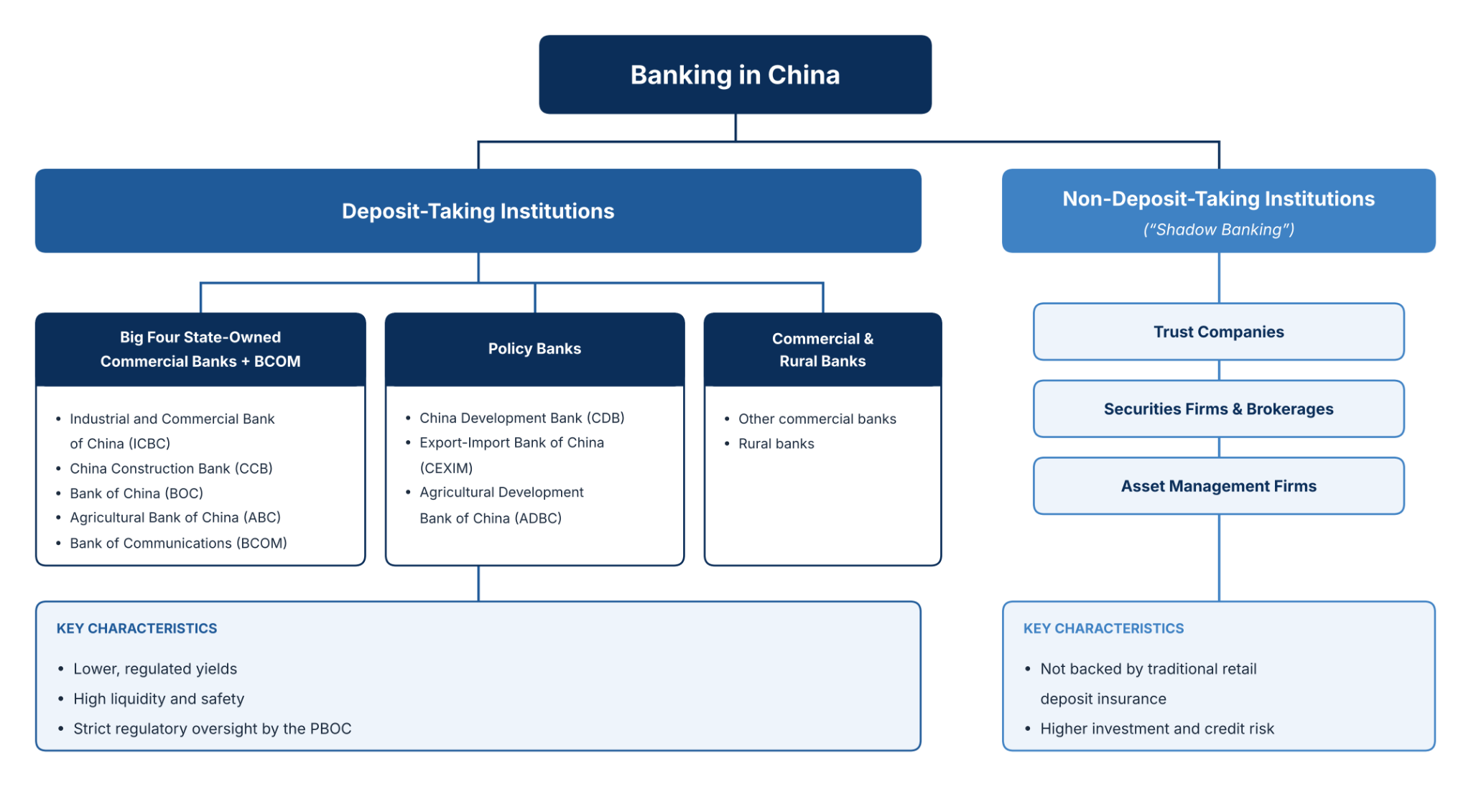
Shadow banking has long played a central role in China’s rapid economic expansion. Although its emergence as a particularly sensitive area began after the 4 Trillion Yuan Stimulus package amid the GFC of 2008, shadow banking is not unique to China, nor as dubious as the name implies. Still, the scale and structure of its shadow banking system are distinctive. Estimates suggest China’s shadow banking sector has ranged from roughly one-third to over 100% of GDP.10China’s shadow banking differs from the U.S. and Europe in that: instead of relying on non-bank intermediaries, China relies on traditional commercial banks amid intense governmental supervision; other securities markets tend to focus on financial innovation, while in China it is primarily driven by regulatory arbitrage; shadow banking is notably more prevalent in coastal and southern provinces with weaker enforcement and more private sector activity, whereas northeast and central provinces tend to access credit formally; but all securities markets often weaken the effectiveness of monetary policy.11
In the case of WMPs, LGFVs, and perps all three expanded in the last two decades to combat capital controls and provide more financing to real estate firms. All three are off-balance-sheet or in the case of perps, on-balance-sheet but skewed to hide debt, meaning potential issues are kept hidden until too late. The PBOC began tightening policy and addressing shadow banking risks around 2016 as part of a broader effort to reduce systemic leverage.12Banks and non-bank financial institutions became deeply exposed to real estate anyway, creating a complex web of leverage tied to property values.
WMPs
WMPs emerged as a crucial financing mechanism for real estate developers such as Evergrande and are the most important aspect of China’s shadow banking system. Typically offering returns between 3-5%, WMPs pool investor funds into a variety of assets including property developments, corporate loans, and equities.13Because these products were often kept off banks’ balance sheets, they allowed institutions and corporations to circumvent regulatory lending limits and capital requirements. Many WMPs were distributed by state-owned banks, which led retail investors to assume an IGG without the presence of formal guarantees. Prospective homeowners and retail investors were frequently encouraged to purchase Evergrande WMPs under the impression that returns were guaranteed. This created a feedback loop: investor funds financed new projects, which in turn supported Evergrande’s ability to issue additional WMPs and sustain high leverage.
Regulatory arbitrage was the main driver of WMPs.14WMPs had been a regular thorn in Chinese economists' sides as the government’s deleveraging campaign beginning in the mid-2010s sought to curb these excesses to little success.15As early as 2016, economists warned that WMP exposure to real estate could trigger a systemic crisis. An investigation from that year described China’s WMP sector as notoriously “murky,” noting that they masked risk and interconnected banks, investors, and property developers in ways that were difficult to track.16It concluded with a warning that defaults could spread rapidly through the financial system due to these opaque linkages and lack of data oversight.
Some of the most significant measures enacted on WMPs were collectively known as the “New Rules on Asset Management” (hereafter New Rules). First drafted in February 2017 and finalized as “Guiding Opinions on Regulating Asset Management Business of Financial Institutions” in April 2018, these rules targeted nearly all investment and funding products across the financial system, covering both on-balance-sheet and off-balance-sheet activities.17 The unified asset management rules served as the primary regulatory instrument of the deleveraging campaign by directly addressing shadow banking and WMPs. They restricted maturity mismatches, capped leverage, prohibited cash pooling, eliminated multilayer nesting behavior, and limited regulatory arbitrage across banks, trust companies, and other financial institutions. Critically, the rules banned implicit or explicit guarantees on WMPs, forcing investors to bear risk and undermining the assumption that banks or the state would absorb losses. They also curtailed “channel business”, in which banks routed funds through third-party asset managers and non-bank financial institutions to bypass lending restrictions.
The 2018 “Administrative Measures for Wealth Management Subsidiaries of Commercial Banks,” adopted by the China Banking and Insurance Regulatory Commission (CBIRC), formalized the separation of wealth management subsidiaries and introduced a new framework for bank-affiliated asset-management entities.18Banks were required to house WMP businesses in independently managed subsidiaries subject to stricter risk controls, disclosure standards, and investment limits. In May 2021, “Notice by the China Banking and Insurance Regulatory Commission and the People’s Bank of China on Matters Concerning Regulating the Administration of Cash Management-based Wealth Management Products” was issued to tighten oversight of cash management WMPs and limit the mixing of liquidity products with other higher-risk or long-term investments.19Institutions were explicitly prohibited from using cash management WMPs to finance credit or lending activities that would bypass regulatory leverage and capital controls. By restricting the permissible investments for cash management WMPs and closing loopholes for regulatory arbitrage, the policy forced banks to internalize risk on their balance sheets and slowed the expansion of hidden credit, contributing directly to systemic deleveraging efforts.
The effects of the New Rules are vast and conflicting. The rules have successfully contracted the shadow banking market.20Yet for areas without much banking competition and enterprises with low cash holdings, credit availability decreased significantly, driving firms to obtain funds elsewhere such as private lending, which has higher costs.21However, for firms with high marginal output of capital, the impact of the rules is negligible. In this way, the New Rules were a success. While the contraction of shadow banking generated economic losses in the short term, capital allocation in the market vastly improved. In short, overleveraged firms who relied on shadow banking to survive simply will not, but the strongest firms will, directing more capital to more efficient firms.
All previous deleveraging policy culminated in the introduction of the Three Red Lines in 2020, which imposed strict limits on property developers’ debt ratios.22Developers exceeding these thresholds faced restrictions on new borrowing. For highly leveraged firms like Evergrande, the policy triggered a severe liquidity crunch. Unable to access new financing while burdened with enormous existing debt, Evergrande struggled to meet obligations to suppliers, creditors, and WMP investors. By 2021, the company began defaulting on its obligations, setting off a crisis that spread across China’s property sector.
The human impact of these policies was significant. September 2021 saw many citizens gathered outside Evergrande offices demanding their cash back. One told Reuters “The investors trusted Evergrande and bought Evergrande’s WMPs out of our love for and faith in the Party and government.”23Briefly in 2022, some stopped paying mortgages on apartments they suspected of never being finished. Tens of thousands of retail investors who purchased Evergrande WMPs lost savings, and many homebuyers who paid for apartments before construction faced uncertain futures. With roughly 70% of urban household wealth tied to real estate, the crisis eroded confidence in property as a primary store of value.24Local governments, heavily reliant on land sales for revenue, also experienced fiscal strain as property transactions slowed.
Perpetual Bonds
Another key component in Evergrande's meteoric rise and subsequent fall are perpetual bonds. Perps, first introduced to the Chinese market in 2013, are securities with no maturity date and higher coupon rates.25Instead of repaying principal at a set time, issuers pay interest indefinitely, with many including call options allowing redemption or a reset of interest rates after a specified period (usually 5 years). Classified as equity or debt, perps significantly influence companies financial leverage, risk exposure, and capital structure, suggesting these bonds can offer a more stable financing option compared to traditional debt, without diluting shareholder control. While it technically appears on the balance sheet as equity leaving leverage ratios unaffected, this can be done to appear more financially stable, skewing the picture of a firm's overall financial health.26The number of perps in 2014 was 50 with an issuance size of CNY 80 billion; by 2017, that number was over 300 worth CNY 385 billion.27
Chinese banks began issuing significant volumes of perps and Tier-2 capital bonds in the late 2010s as regulators pushed for stronger capital adequacy and loss-absorbing capacity. These instruments allowed banks to raise long-term funding while complying with stricter regulatory standards introduced during the deleveraging campaign. By increasing their capital cushions, banks were better positioned to withstand rising non-performing loans from property developers and mortgage borrowers while continuing to lend to priority sectors.
Evergrande used perps to finance much of their early expansion, with some suggesting Evergrande solved its financing issues through perp usage. In 2013, Evergrande reported an issuance size of about CNY 25 billion, surpassing 100 billion in 2017. Evergrande classified their bonds as equity, allowing them to defer interest payments unconditionally and indefinitely, take the right to redemption away from bond holders, and reduce its net debt ratio. Evergrande initially had no problem repaying its perpetual loans, repaying 25 billion in 2015 and immediately issuing 40 billion in new bonds. In mid-2017, Evergrande redeemed CNY 112.9 billion in perps.28 While viewed as a strong positive and vehicle for Evergrande’s massive expansion, the same research warns that perps could potentially obscure Evergrande’s true financial position, which is what ultimately occurred.
Issuance patterns shifted noticeably following the real estate downturn. Chinese banks issued significantly fewer perpetual and Tier-2 capital bonds in 2024 as weak credit demand, narrowing margins, and uncertainty surrounding the property sector reduced the urgency of aggressive capital raising.29Lower issuance reflects broader caution within China’s financial system and reduced appetite for riskier forms of capital expansion, as regulators balance the need for bank stability against concerns about excessive leverage and rising debt levels. Then, by the end of 2025, Chinese banks issued record volumes of Tier-2 and perps to replenish capital amid a large volume of existing bonds entering redemption periods, driving banks' demand to "roll over" high-cost debt through new issuances.30
Some distressed developers and state-linked firms have incorporated perpetual or quasi-perpetual securities into debt-restructuring plans to extend maturities and reduce immediate repayment pressure. These instruments allow issuers to defer principal repayment while maintaining access to financing, effectively spreading losses over a longer time horizon. This feature is particularly significant where authorities aim to maintain financial stability while avoiding large-scale taxpayer-funded rescues of private firms. By encouraging banks to raise capital through instruments such as perps, policymakers can distribute risk across investors rather than concentrating it within the state.
From a systemic perspective, the growth of perps reflects China’s broader strategy of strengthening financial resilience while maintaining credit flows to the real economy. By bolstering bank capital through hybrid instruments, authorities have sought to ensure that banks can continue supporting infrastructure projects, local governments, and households even as property-sector risks persist. At the same time, Evergrande’s reliance on these very same instruments underscores the challenges facing China’s financial system, including rising debt levels and slowing growth.
LGFVs
Local government financing vehicles are a securitization mechanism by which Chinese local governments issue bonds that are not local government bonds, occupying a middle ground between sovereign and corporate debt, often trading at yields above those of central or policy bank bonds (PBBs) but below those of private corporate issuers. Local governments finance through municipal corporate bonds that are issued by the LGFVs, meaning this debt is regarded as corporate debt as opposed to government debt. LGFVs are under the dual umbrella of onshore hard currency and offshore yuan denominated ‘Dim Sum’ bonds, with the vast majority being issued under the former. The widespread assumption of government backing made LGFV issued bonds attractive to investors seeking higher returns than central government securities but with limited perceived risk.
First appearing in the late 90s, they emerged as a workaround after fiscal reforms prohibited local governments from directly borrowing or running budget deficits. In 2009, they again gained a foothold through the 4 Trillion Yuan stimulus package, with almost 70% of the package going to LGFVs, disproportionately favoring state-owned firms.31By establishing corporate vehicles able to borrow from banks and issue bonds, local governments gained access to financing outside formal budget constraints. As issuance increased, LGFVs became deeply embedded within China’s domestic bond ecosystem.
As China’s urbanization drive accelerated, LGFVs became key intermediaries between local governments and capital markets, channeling funds raised through bond issuance into infrastructure, transportation, and urban development projects. Land finance played a central role in this system.32Local governments transferred land-use rights to LGFVs, which then used these assets as collateral to obtain loans from banks or issue bonds. Revenues from land sales and property development helped service the debt, creating strong linkages among LGFVs, property developers, and local banking systems. In 2014, at the direction of the State Council issued through Document No. 43, local governments were barred from explicitly guaranteeing repayment of LGFV debt. In 2015, after “Opinions on Strengthening the Administration of Local Government Debts", the first large scale debt swap was introduced, allowing debts previously financed through LGFVs to be traded into local government bonds.
Nonetheless, LGFVs grew rapidly. LGFVs are unique compared to other municipal bonds; municipal bonds are held by financial institutions, not individual investors and China’s municipal corporate bond market was previously extremely resistant to default. Typically when SOEs default, bond spread narrows as investors flock to the safety of government bonds. As investors closely associate the worthiness of LGFVs with local government, a default on one LGFV significantly increases bond spreads across the region.33In other words, one SOE going bottoms up is not a cause for major concern, yet one LGFV default does cause spillover into others, causing capital flight. Across multiple studies, default risk and bank stress is consolidated in small to medium sized firms and regions with less bank competition and lower income.
Many LGFVs face weak profitability and heavy reliance on continued borrowing. In numerous cases, operating revenues are insufficient to cover interest expenses as the funds are used for non revenue generating projects such as infrastructure, requiring new debt issuance or government support to maintain solvency. Local government debt tied to LGFVs has become a major constraint on regional growth and financial stability. Since land transfers have historically provided a major revenue source for local governments and LGFVs alike, falling property demand has reduced a key pillar supporting LGFV debt repayment. LGFVs now represent one of the largest sources of quasi-public debt in China.
In 2016, the “Notice by the General Office of the State Council of Issuance of the Emergency Response Plan for the Risks in Local Government Debts” had a verifiable impact on LGFVs. The notice created accountability mechanisms, risk response, and urged financial discipline by discouraging reliance on bailouts while the 2018 New Rules prohibited asset-management funds from investing in restricted sectors such as LGFVs. Many LGFVs are now under pressure to deleverage, restructure liabilities, and transition toward more commercially viable business models. At the end of 2022, local debts soared to 44.9 trillion CNY, which accounts for about 32% of the overall debt market.34
A dual factor in the restructuring of LGFVs is the persistence of IGGs. IGGs are harmful to fair market competition, yet it is impossible to reduce them completely as their existence does lower the funding cost of LGFVs.35Restructuring LGFVs means turning them into commercial entities, bringing debt on-balance-sheet, and changing operations to be more similar to SOE’s. After Document No. 43 imploring local governments to swap debt initially raised by LGFVs, the expectation would have been a weakening of the IGG, however the spread of municipal corporate bonds actually decreased after the policy change, illustrating that the market will chase implicit guarantees even under tighter government scrutiny.36Post Document No. 88 in 2016 and Document No. 50 in 2017, which demanded clear separation of powers between government finance and corporate entities, there is also a reduction in yield spread.37
While restructuring is essential to mitigating implicit government debt, the process of restructuring can raise internal costs, reduce efficiency, and enhance the expectation of IGGs. Post restructuring, bond risk and debt financing cost is reduced, local fiscal revenues are optimized, and access to additional funding channels and credit ratings increase. Counterintuitively, there is a credit effect by which restructured LGFVs receive an increased expectation of bailout which increases investor confidence. Bond yields are considerably smaller on those issued by restructured LGFVs compared to non-restructured firms. However, with firms that possess no guarantee (such as POEs) and in cities with better economic conditions, there is little effect post restructuring.38For bond issuers who do possess IGGs, there is a stronger alleviating effect on debt financing, reducing overall costs. The existence of IGGs remains a sore spot for the central government whilst clever usage of such can bring down financing costs.
In 2024, LGFVs showed signs of tightening financing conditions and policy-driven deleveraging, even as systemic risks remained contained. Early in the year, issuance increasingly shifted toward debt rollover rather than new investment: in January, about 97% of LGFV bonds that disclosed their use of proceeds were earmarked for refinancing or repayment of existing obligations, and total bond issuance fell to CNY 781 billion, roughly 4.6% lower year-on-year.39By mid-year, the sector experienced its largest quarterly financing outflow in years, contributing to a contraction in the roughly CNY 11.5 trillion LGFV bond market.40
Despite mounting fiscal strain and rising defaults in other parts of China’s municipal debt ecosystem, publicly traded LGFV bonds recorded no defaults. However, there were many bonds that were paid at the last minute or well into their grace period, signaling distress. While international investors are not typically exposed to LGFV debt, the global economy is exposed to the potential impact of capital misallocation due to mis-priced risk.41Policymakers simultaneously intensified efforts to manage the broader debt burden: authorities launched another large-scale debt swap program in 2024 to bring hidden local government debt—estimated at CNY 14.3 trillion by officials and CNY 60 trillion from the IMF—onto official balance sheets, tighten borrowing controls, and increase transparency requirements to contain risks.42
More than 80% of the funds raised by LGFVs have been used to repay existing debts.43 Investors have therefore become more sensitive to regional fiscal conditions and the varying strength of implicit government support across provinces and municipalities. LGFV bond sales have fallen to their lowest point since 2020, marking a shift towards repayment rather than new issuance.44Nonetheless, LGFVs remain deeply intertwined with local governments. In the aftermath of the property-sector downturn and broader economic slowdown, LGFV bonds have become a focal point for assessing China’s fiscal and financial resilience and represent a key arena for ongoing financial reform.
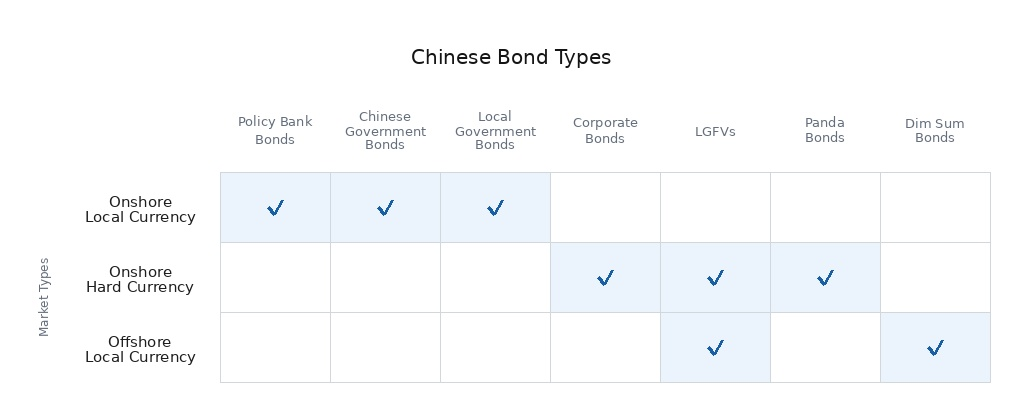
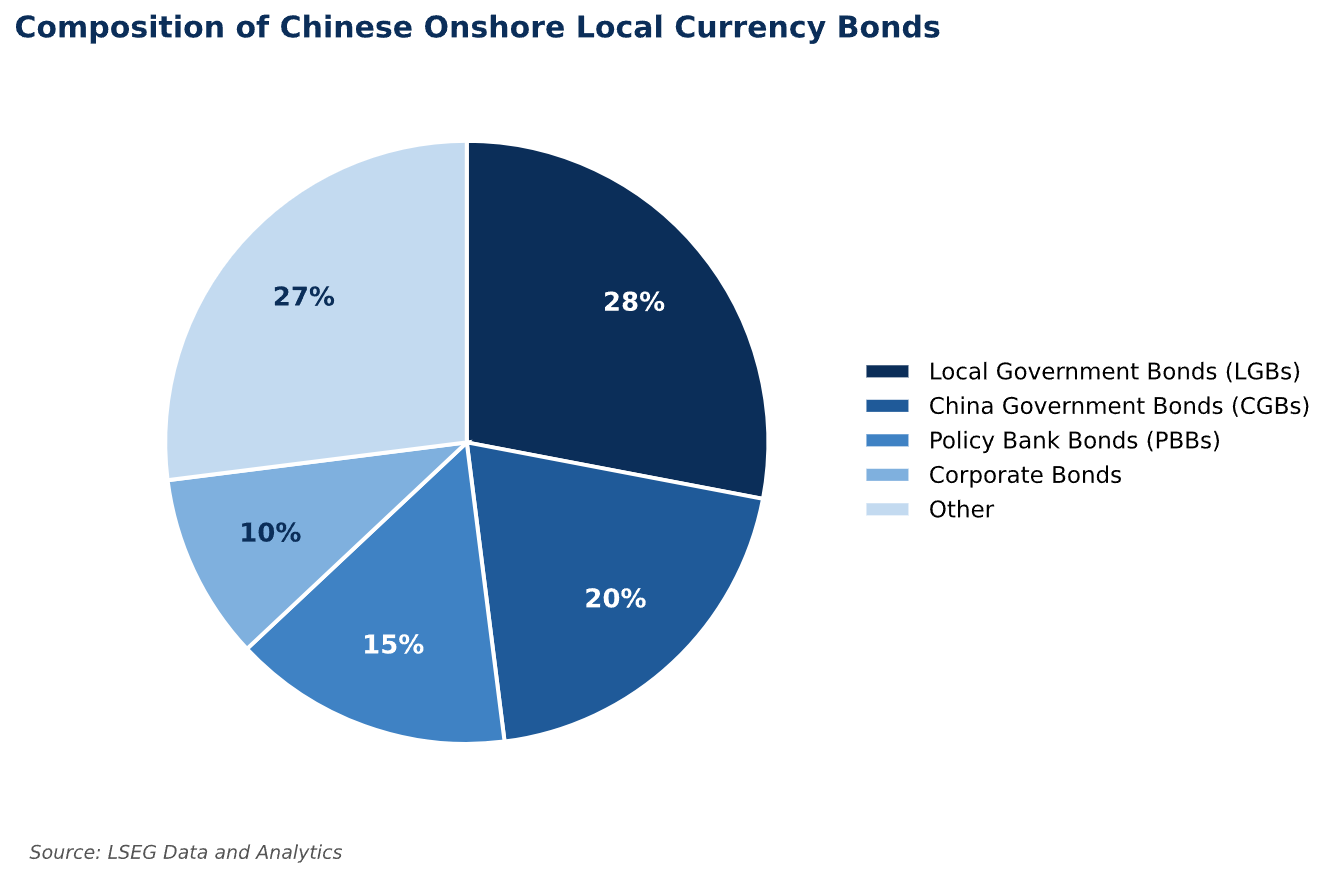
China’s bond market has undergone significant transformation in the years following the Evergrande crisis, reflecting both the structural damage caused by the property downturn and the evolving stance of Chinese monetary policy. The bond market is of most importance, given that the Chinese corporate bond market is more than three times that of the domestic stock market.45There are three main markets in China; Chinese onshore local currency market containing mostly Chinese government bonds (CGBs) and PBBs which are used by quasi-government entities and are generally higher yield, lower risk; Chinese onshore hard currency bonds are a majority of the corporate bond market and where LGFVs and Panda Bonds typically reside; then offshore local currency bond market, usually issued in Hong Kong in RMB (where Dim Sum Bonds live).46
On Shore Local Currency Market
Despite its size, foreign participation remains extremely limited—under 3% in onshore bonds—reflecting capital controls, regulatory opacity, and concerns about credit transparency.47 This limited foreign ownership has historically insulated China’s bond market from sudden global capital flight but has also reduced market discipline and transparency relative to Western credit markets.
Policy Bank Bonds
Beginning in 1994, PBBs are primarily issued by the China Development Bank (CDB), the Agricultural Development Bank of China (ADBC) and the Export-Import Bank of China (CEXIM) in the onshore RMB market. Often referred to as "quasi-sovereign" debt, they are considered to have a very low-risk profile close to that of CGBs, with an outstanding volume of over three trillion USD. These PPB issuing banks are state-owned and their objectives typically include providing social benefits such as infrastructure, agriculture, or foreign trade, supporting growing local industries.48
Prior to the Evergrande crisis, PBBs occupied a well-established and relatively stable niche in China's fixed income market, functioning as instruments of directed credit rather than conventional sovereign debt. The PBB market is roughly the same as the Chinese Treasury bond market, but PPBs are more liquid.49In February 2014, the FTSE Chinese Policy Bank Bond Index was introduced, and PBBs could then be accessed via Bond Connect or through specialized ETFs for foreign investors. In April 2021, the CDB and ADBC piloted a direct bidding program for interbank bond issuance, removing underwriters and allowing investors — including foreign institutions from Hong Kong, Southeast Asia, the Middle East, and Europe — to bid directly in primary auctions, a liberalization intended to reduce intermediation costs and deepen overseas participation ahead of the property sector's deterioration.50
The Evergrande default in late 2021 and the property sector contagion that followed triggered the most significant expansion of policy bank lending capacity since the 2008–2009 stimulus cycle, with PBB issuance serving as a primary funding mechanism. In a June 2022 cabinet meeting, authorities granted policy banks CNY 800 billion in new credit quotas specifically to fund infrastructure projects.51Since mid-2022, measures including increased lending quotas and financial bond issuance by policy banks were implemented across fields including infrastructure, scientific and technological innovation, and industrial chain stabilization, with the CDB and ADBC together establishing policy-backed developmental financial instruments totaling CNY 300 billion to supplement capital for major projects.52
The post-Evergrande period has thus seen PBBs evolve from instruments of routine developmental finance into active macroprudential tools, with their issuance volumes, mandates, and funding mechanisms explicitly calibrated to compensate for the contraction in private real estate investment. Through the crisis period, CGBs and PBBs both attracted sustained safe-haven buying as the renminbi demonstrated resilience against the US dollar, with the PBOC continuing independent policy easing while G7 central banks remained on hold, a monetary policy divergence that supported PBB valuations and compressed yields even as credit stress mounted elsewhere in the Chinese fixed income universe.53
The recent August 2026 decision to allow the housing provident fund's management center to purchase PBBS for the first time is significant on two levels.54First, it introduces a large, structurally captive institutional buyer whose sustained demand will support PBB prices and put further downward pressure on yields. Second, it reflects Beijing's continued pattern of using PBBs as a policy instrument beyond conventional infrastructure finance, enlisting them to shore up the provident fund's returns amid falling deposit rates and a still-fragile housing market and further cementing the asset class's role at the intersection of monetary policy, social policy, and capital market development. The sectoral reorientation of policy bank mandates has deepened. Whereas pre-crisis PBB proceeds were directed predominantly toward physical infrastructure and agricultural finance, post-crisis issuance has increasingly funded green development, new energy supply chains, and scientific & technological innovation — reflecting Beijing's use of policy banks as financing vehicles for the industrial policy priorities of the 14th and 15th Five-Year Plans.
Local Government Bonds
Carrying slightly more perceived risk than CGBs and PBBs, LGBs are issued by provincial and municipal governments under central government oversight; these bonds represent explicit liabilities of local governments.55On average, LGBs offer higher yields than CGBs, making them attractive to investors seeking enhanced returns. As the concerns regarding China’s local government debt largely stem from a slowing real estate sector due to LGFV’s, it is imperative to distinguish LGBs and bonds issued by LGFVs. While LGFVs often receive strong local government support, their debts are not considered direct government obligations and local governments are not required to repay their debts. As a result, LGBs have historically shown a stronger credit track record.
The modern LGB market was largely a product of regulatory reform rather than organic development. The original 1994 Budget Law prohibited local governments from issuing bonds directly, driving subnational borrowing underground through LGFVs and other off-budget channels that accumulated rapidly after the 2008 GFC.56The revised Budget Law of 2014, accompanied by the State Council's “Opinions on Strengthening the Administration of Local Government Debts”, or Document No. 43, fundamentally restructured this landscape. Document No. 43 prohibited local governments from providing guarantees for LGFV bond issuance or raising new debt through LGFVs, and ordered local governments to restructure existing obligations into formal municipal bonds.57The immediate consequence was a large-scale debt swap: beginning in 2015, the central government coordinated the issuance of replacement bonds to convert existing government liabilities into formal LGBs, with the program ultimately replacing approximately CNY 12.2 trillion in debt between 2015 and 2018.58This swap rapidly transformed LGBs from a negligible segment of China's bond market into its largest, with outstanding LGB balances reaching CNY 15 trillion — nearly 20% of GDP — by 2017.59The swap also significantly lengthened average maturities and lowered borrowing costs, as LGFV bonds yielding 6-8% were replaced by refinancing bonds carrying coupons of around 3%.60
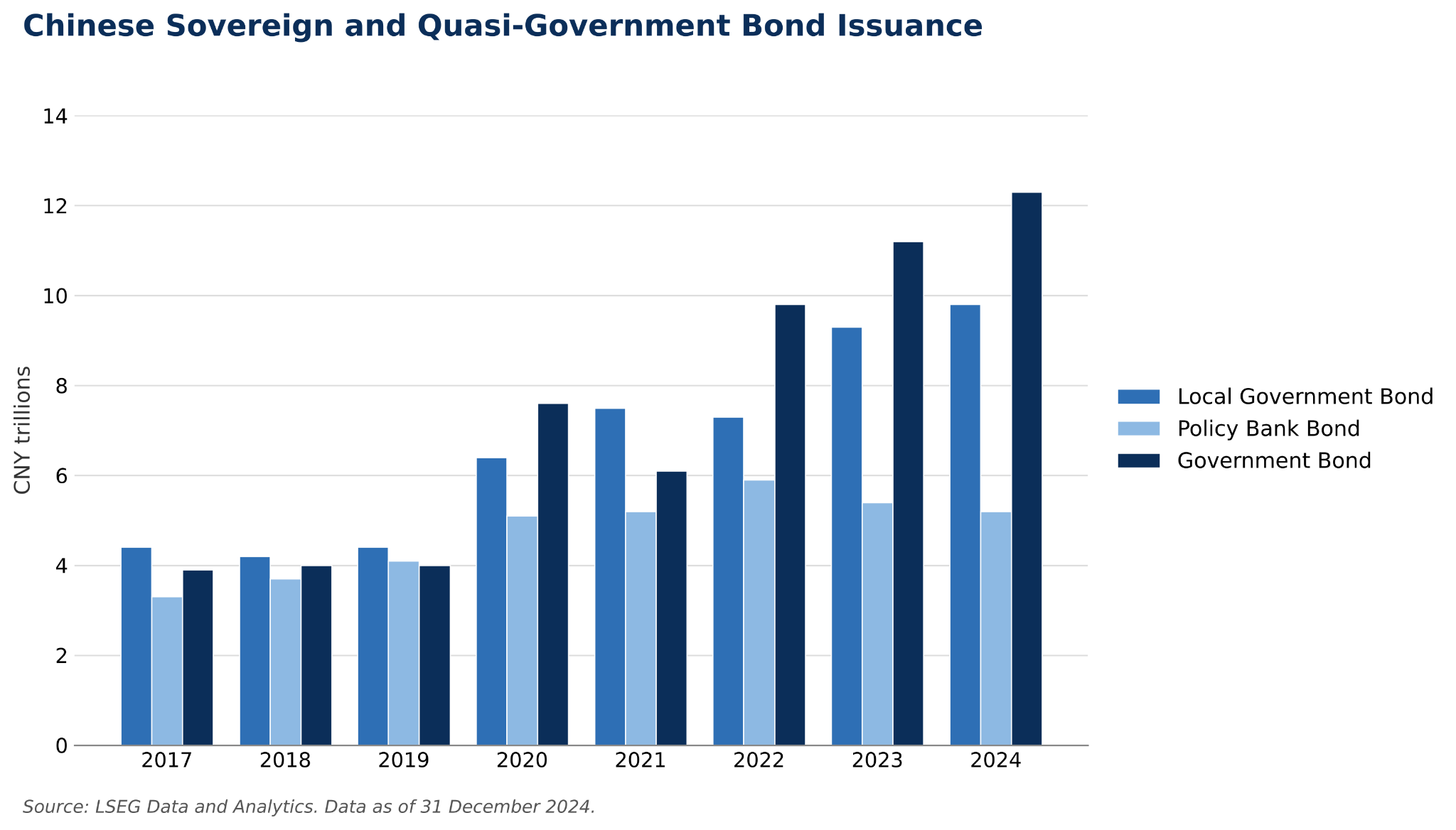
Despite the scale of the 2015–2018 restructuring, LGFV debt rebounded to near its pre-reform share of GDP within three years, partly because Beijing itself reversed course in May 2015 with Document No. 40, which urged financial institutions to continue lending to LGFVs.61 The underlying fiscal pressures were never resolved, and by the end of 2023 hidden local government debt still stood at approximately CNY 14.3 trillion. The most recent iteration of the debt swap program, announced by Finance Minister Lan Foan in November 2024, is considerably more ambitious: the central government approved CNY 6 trillion in new local government special bonds to be issued over three years through the end of 2026 to replace hidden debt, alongside CNY 800 billion per year in special bond allocations for five consecutive years, for a combined total of CNY 10 trillion aimed at reducing hidden liabilities from CNY 14.3 trillion to CNY 2.3 trillion by 2028.62The LGB market itself continues to expand rapidly alongside these restructuring efforts: as of February 2025, the outstanding face value of LGBs reached CNY 48.1 trillion — 32.1% of the total onshore Chinese bond market, surpassing both CGBs and PBBs — with annual issuance growing from CNY 7.4 trillion in 2022 to CNY 9.8 trillion in 2024, a 32.4% increase that has also contributed to improved secondary market liquidity.63In May 2026, the State Council reaffirmed its commitment to advancing this program, calling for stronger policy execution to ensure debt obligations are resolved on schedule and announcing the establishment of long-term mechanisms to prevent the reemergence of new hidden borrowing.64While remaining cautious about the fiscal health and repayment capacity of China’s local governments, increasing issuance, policy support, and improving market infrastructure are gradually transforming the investment environment positively for LGBs.
On Shore Hard Currency Bonds
Panda Bonds
Panda bonds are renminbi-denominated debt instruments issued within China's domestic bond market by entities domiciled outside of mainland China, with issuers including Chinese-owned companies incorporated in offshore financial centers with primary operations in mainland China, as well as foreign corporations, financial institutions, and sovereign entities.65 Because the instruments are settled in RMB but issued onshore, they occupy a distinctive niche: foreign borrowers raise local-currency funding inside China's capital account rather than in offshore RMB markets, insulating them from exchange-rate dislocations and the liquidity premiums that accompany offshore issuance. For international companies with operations in mainland China, this structure allows them to finance domestically without exposure to FX risk, functioning as an organic currency hedge.66Panda bonds therefore operate at the core of China's deepest fixed-income pool, giving foreign issuers access to an onshore investor base that remains largely unavailable through any other cross-border instrument.
The regulatory architecture governing panda bonds has been built incrementally through a series of notices and measures issued primarily by the PBOC and the Ministry of Finance. The market debuted in 2005 under the “Provisional Administrative Rules on the Issuance of RMB Bonds by International Development Institutions”, which permitted only multilateral bodies such as the Asian Development Bank and the International Finance Corporation to issue; amended provisional rules in 2010 expanded the pool of eligible issuers and for the first time permitted proceeds to be used overseas. The most significant acceleration came in 2016, when a PBOC Notice allowed foreign issuers to on-lend panda bond proceeds to mainland China subsidiaries without drawing on those subsidiaries' foreign debt quota, greatly enhancing international companies' ability to finance their China operations.
In September 2018, the PBOC and MoF jointly published “Interim Measures for the Administration of Bonds Issued by Overseas Issuers on the China Interbank Bond Market”, providing binding guidance on application, registration, and disclosure requirements for CIBM issuers while simultaneously abolishing the earlier 2010 provisional rules. Under this framework, financial institution issuers must apply to the PBOC for vetting and approval, satisfying conditions including paid-in capital of no less than CNY 10 billion, sound corporate governance, stable financial results for the most recent three years, and compliance with the regulatory requirements of their home jurisdiction. Non-financial corporations issuing publicly must submit applications to the National Association of Financial Market Institutional Investors (NAFMII).
A pivotal subsequent step came in December 2022, when the PBOC and the State Administration of Foreign Exchange (SAFE) issued a notice removing the mandatory requirement for offshore institutions to retain bond proceeds within China — a clarification whose removal became one of the most consequential single regulatory actions for the market's post-2022 trajectory.67In early 2024, NAFMII revised its guidelines for bond issuance by international development institutions and foreign government agencies, simplifying the directed issuance process and enhancing financing efficiency.
The Evergrande crisis that erupted in 2021 tested the resilience of China's onshore bond market but also illuminated a structural distinction that ultimately worked in the panda bond market's favor. The panda bond segment, whose issuers are predominantly foreign corporates, financial institutions, and sovereigns rather than domestic property developers, was largely insulated from direct credit contagion. Issuance volumes did slow during the 2021–2022 period of heightened uncertainty, with full-year 2022 panda bond issuance reaching CNY 80.5 billion— a level that would be decisively surpassed once regulatory clarity and macro conditions improved.68
Issuance in the first nine months of 2023 alone reached CNY 111.7 billion, a record for the period that had already exceeded the full-year 2022 total, according to NAFMII data.69The PBOC's 2022 proceeds-repatriation liberalization was cited by market participants as the single most important regulatory driver of this surge.70Gross issuance reached CNY 155 billion in 2023 and CNY 195 billion in 2024, with record issuance driven by factors including U.S.-China monetary policy divergence and geopolitical considerations that encouraged a "China for China" financing strategy. Purely foreign issuers nearly tripled their issuance from around CNY 27 billion in 2023 to more than CNY 75 billion in 2024, rising from roughly 17% to almost 40% of total panda bond volume.71The momentum has extended into 2026: the outstanding size of panda bonds surged 65% year-on-year in 2025, and in the first quarter of 2026 foreign-issued panda bond volume hit a record high, with the share held by overseas investors continuing to rise.72Deutsche Bank's May 2026 issuance of a CNY 3.5 billion multi-tranche panda bond, following a record-breaking CNY 5.5 billion issuance in March, set the lowest coupon on record for a foreign panda issuer in both the three-year and five-year tenor buckets.73The trajectory suggests that the Evergrande episode, rather than durably damaging panda bond demand, accelerated the regulatory reforms and issuer-strategy shifts that made the instrument markedly more accessible and attractive to international capital.
Dim Sum Bonds
Dim sum bonds are the offshore counterpart to panda bonds: renminbi-denominated instruments issued and settled outside mainland China, with Hong Kong serving as the dominant market. Where panda bonds require issuers to operate within China's domestic regulatory perimeter, dim sum bonds can be issued by multinational corporations with or without a China presence and without seeking prior approval from either PRC or Hong Kong authorities.74This structural openness has made dim sum bonds an attractive vehicle for a wider range of issuers, and the market has evolved from a niche product primarily used by Chinese financial institutions into a key pillar of Beijing's broader effort to internationalize the renminbi.75 The same macro drivers that propelled panda bond growth, China's sustained low interest rate environment, widening U.S.-China yield differentials, and geopolitical incentives urging movement away from dollar-denominated debt, have also animated the dim sum market. Annual dim sum issuance tripled between 2022 and 2024, reaching approximately CNY 1.4 trillion in 2024.76
The regulatory framework governing dim sum bonds is considerably lighter than that for panda bonds and is shaped primarily by Hong Kong's Securities and Futures Ordinance rather than by mainland Chinese law. Issuers are subject to Hong Kong's disclosure and prospectus requirements, and dispute resolution clauses in dim sum bond prospectuses typically specify New York or English courts, reflecting growing alignment with global capital market conventions. One notable policy development affecting the dim sum market came in November 2024, when Chinese regulators moved to restrict the flow of certain LGFV bond proceeds through offshore channels. The CSRC instructed domestic funds to stop purchasing short-tenor LGFV bonds via Bond Connect as interest rates continued to fall.77This intervention reflected a broader official concern that LGFV issuers were using the offshore market to circumvent tightening domestic constraints on local government debt. On the investor access side, Hong Kong's Monetary Authority broadened the Southbound Bond Connect program in July 2025, explicitly extending participation rights to non-bank investors, deepening liquidity and supporting demand for longer-dated paper.78
The LGFV restrictions produced a visible compositional shift in the dim sum market. Issuance showed softness in the first half of 2025 but the market recovered in the third quarter, with issuance growing 9.3% year-on-year as other issuer categories expanded.79The share of LGFV issuances fell sharply, from 62.6% of total dim sum volume in 2024 to 35.4% in 2025, while the share from financial institutions rose to 43%.80The gap was filled in part by Chinese technology majors issuing at scale to fund global expansion and long-term investment in areas such as artificial intelligence, as well as by international corporations including Nestlé, PSA International, and Chubb Insurance tapping the offshore RMB market for the first time.81Foreign sovereigns have also become more prominent participants: Russia, Hungary, and the emirate of Sharjah all issued RMB-denominated bonds in 2025, while Brazil, Pakistan, and Slovenia announced plans to follow.82By the close of 2025, dim sum issuance had surpassed 2024 with the market increasingly serving not merely as a funding channel for Chinese entities but as a vehicle for RMB internationalization that is drawing in issuers and investors from across the Global South and Europe alike.83
Mutual Funds
China's mutual fund industry entered the Evergrande crisis period from a position of considerable momentum, but one built on structurally fragile foundations. From the end of 2016 to the end of 2021, total industry assets under management grew by approximately 160%, propelling China's mutual fund sector from ninth to fourth in global rankings.84This expansion was driven heavily by retail inflows in part due to household fund migration and decline in WMP yields. The Evergrande default in late 2021 hit China-focused and Asia-Pacific equity and high-yield bond funds directly, as many held Evergrande's offshore dollar-denominated bonds or equity stakes. The broader property sector contagion weighed on domestic equities through 2022, a year in which new mutual fund fundraisings slumped to less than one-third of their 2021 level in the first five months alone.85Foreign-invested funds faced additional headwinds unique to the Chinese context, including information asymmetries, the comparative advantage of domestic institutions with political relationships and local market knowledge, and the drag of institutional distance.
Confronting a combination of market losses, slumping retail sentiment, and structural overcapacity in active management, the CSRC enacted a series of targeted regulatory interventions beginning in 2022. In April 2022, amid equity benchmarks falling more than 20% year-to-date, the CSRC issued guidance directing fund managers to adhere to the principles of "long-term investment" and "value investment," explicitly asking the industry to act as a market "stabilizer" and "ballast stone."86Document No. 87 simultaneously pushed mutual funds to develop products for the newly launched private pension scheme — a program piloted in 36 cities in 2022 and formally expanded nationwide in December 2024.87The most consequential near-term regulatory action came in July 2023, when the CSRC issued a work plan for mutual fund fee reform, capping management fees for active equity funds. In early 2026, the average management fee rate was 0.69% and average custodian fee was 0.136%, showing a clear decline from 0.74% and 0.144% at the end of 2023 respectively.88
The cumulative effect of these regulatory interventions, combined with structural shifts in household savings behavior, produced a marked recovery in the mutual fund industry from 2023 onward. As deposit interest rates fell steadily, Chinese households began reallocating accumulated excess savings into higher-yielding alternatives. The sharp decline in WMP yields accelerated this shift, as households could no longer treat bank-distributed products as implicit deposit substitutes. Mutual funds were primary beneficiaries: total net assets in the industry reached CNY 26 trillion by end-2022, rose further through 2023 and 2024, and surpassed CNY 39.36 trillion for the first time in April 2026, a record driven by the rebound in domestic equities and sustained inflows.89The shift toward passive investing gathered speed as active managers struggled: only 13.4% of active equity funds outperformed passive peers in 2024, down sharply from 60% in 2021, reflecting both the structural difficulty of stock-picking in China's market environment and the regulatory pressure toward cost efficiency and performance accountability that the CSRC's post-Evergrande reform agenda had set in motion.90
Exchange Traded Funds
ETFs are a specific type of mutual fund, but they operate very differently. ETFs have no minimum investment and are traded on stock exchanges with prices that constantly fluctuate, as opposed to mutual funds which are a set price calculated once per day. Exchange-traded funds provide another lens through which to assess the impact of the Evergrande crisis and China’s monetary policy. Chinese ETFs, both domestic and internationally listed, offer diversified exposure to Chinese equities and sectors. Major China-focused ETFs track large-cap companies, technology firms, and broad market indices. Due to previously mentioned policy impacting mutual funds and the fact that ETFs are cheaper than other active counterparts, they now face even less competition.91
Regulatory developments in 2025 and 2026 have reshaped the environment for Chinese ETFs, and the overall direction has been more liberalizing than restrictive, though not uniformly so. In January 2026, the Shanghai- and Shenzhen-Hong Kong ETF Connect program underwent its largest expansion since launching in 2022, adding 54 Shanghai-listed and 44 Shenzhen-listed ETFs to the northbound trading roster for a total of 364 eligible products, with ETFs tracking the CSI A500 Index included for the first time.92In August 2026, regulators took a complementary step by permitting mainland insurers to invest in Hong Kong-listed ETFs through the southbound leg of Stock Connect for the first time, opening access to a pool of 31 eligible Hong Kong ETFs.93
Set against this opening, regulators have simultaneously tightened a separate cross-border channel. In the second half of 2025, the CSRC issued guidance raising diversification and risk-tolerance requirements for Hong Kong funds participating in the Mainland-Hong Kong Mutual Recognition of Funds program, and by mid-2026 was reported to be placing new limits on where mainland-raised capital in that program could be invested — a move aimed at curbing retail flows into popular overseas markets such as the United States.94 On the trading-mechanics side, new CSRC short-swing trading rules that took effect in April 2026 added ETF transactions to a list of thirteen exempted activities, reducing a compliance burden that had previously applied to short-term share transactions by large holders.95
The property crisis and subsequent economic slowdown affected ETF performance, particularly those heavily weighted toward real estate and financial stocks. Global investors reassessed exposure to Chinese assets amid concerns about regulatory uncertainty and economic growth. Some funds experienced outflows as investors shifted toward other emerging markets or domestic U.S. assets. Nevertheless, Chinese ETFs retained significant assets under management, reflecting continued interest in China’s long-term growth potential. Data indicates that ETFs remain among the most significant emerging market investment vehicles, with substantial capital allocated to sectors aligned with government priorities such as technology and consumer goods. However, persistent deflationary pressures and weak domestic demand limit the effectiveness of policy measures. As a result, ETF performance has been uneven, with some like YANG, FXP, MCHS, and YXI maintaining over 10% returns YTD while the vast majority have sustained losses, reflecting some broader uncertainty about China’s economic trajectory.96
Derivatives
While the Evergrande crisis and broader property downturn reshaped China’s bond markets, the country’s derivatives market has emerged as an increasingly important yet often overlooked component of China’s evolving financial system. Derivatives markets have been tightly regulated in China, but in the aftermath of the property sector crisis and amid ongoing financial reforms, these markets have gained strategic importance for risk management, price discovery, and broader monetary policy transmission. The government's policy response was to deepen and formalize the regulatory architecture rather than restrict the market.
The Futures and Derivatives Law (FDL), drafted as early as 2013 but long delayed, was adopted by the National People’s Congress Standing Committee on April 20, 2022 and entered into force on August 1 — the first comprehensive statutory framework for futures and derivatives trading in China's history.97Containing 155 articles across 13 chapters, the FDL established a unified legal basis for exchange-traded and OTC derivatives markets, introduced derivatives transaction reporting requirements, and notably asserted extraterritorial jurisdiction, prohibiting foreign institutions from conducting marketing or solicitation activities related to futures in China without prior CSRC approval.98The passage of a comprehensive derivatives framework established clearer legal definitions for derivatives contracts, standardized documentation practices, and improved protections for counterparties. This framework aimed to support the development of a robust derivatives market by reducing legal uncertainty and aligning Chinese practices with international standards.
Following the FDL's enactment, the CSRC issued a series of implementing regulations.99 Revised exchange rules taking effect in May 2023 codified central counterparty arrangements, margin enforcement, and programmatic trading requirements; a March 2023 consultation paper on derivatives trading supervision proposed a unified departmental framework covering both exchange-traded and OTC markets; Beijing opened its options market to international participants, allowing foreign institutional investors to trade certain commodity and financial futures in 2025, before finally in 2026, designating 14 futures contracts as Internationalised Futures Products eligible for direct foreign participation.100
As foreign participation increased, liquidity in China’s derivatives markets improved, further enhancing their usefulness for hedging and price discovery. This opening aligns with broader efforts to internationalize the RMB and enhance China’s influence over global commodity pricing. The expansion of these markets not only strengthens China’s financial infrastructure but also provides additional channels through which global investors can hedge exposure to China’s economy amid ongoing property-sector uncertainty.
Futures
China's futures market regulatory architecture was already undergoing significant development in the years preceding the Evergrande crisis, though the legal framework remained fragmented and incomplete. The development of China’s futures market is closely tied to Beijing’s long-standing efforts to strengthen financial regulation while maintaining economic growth. The PBOC and other regulatory authorities have also viewed the futures market as a key channel for transmitting monetary policy and stabilizing expectations, with futures trading volume in China in 2023 was CNY 568.51 trillion with commodity futures comprising the vast majority of the market (76%).101The market features five main exchanges: Shanghai Futures Exchange (SHFE), Dalian Commodity Exchange (DCE), Zhengzhou Commodity Exchange (ZCE), Guangzhou Futures Exchange (GFEX), and China Financial Futures Exchange (CFFEX).
The CSRC exercised unified supervision under a macro-prudential approach, but without a comprehensive statutory basis governing futures and OTC derivatives together. Foreign access was constrained: the 2020 New Qualified Foreign Institutional Investors (QFII) Measures, jointly issued by the CSRC, PBOC, and SAFE, consolidated the previously separate 2002 QFII and 2011 Renminbi Qualified Institutional Investors (RQFII) license requirements into a single application and expanded eligible investment scope to include commodity futures, but participation remained limited in practice.102As of early 2022, the margin held in China's futures market had reached CNY 1.29 trillion, having grown 33.85% year-on-year, and cumulative turnover in the first quarter of 2022 reached CNY 128.61 trillion — figures that reflected robust underlying hedging demand but also the speculative momentum dynamics that distinguished China's commodity futures from their US counterparts.103The real estate sector's outsized role in the broader economy meant that derivative instruments connected to construction inputs such as steel rebar, iron ore, or coking coal were among the most actively traded contracts, creating a channel through which the property sector's health was legible in futures pricing well before Evergrande's formal default in late 2021.
The broader property sector contagion that followed acted as a significant stress test and accelerated regulatory reform. The property slump exposed how deeply interconnected commodity futures markets were with real estate sector demand, making the absence of a comprehensive legal framework increasingly untenable. The FDL introduced a legal framework and also mandated the China Futures Market Monitoring Center (CFMMC) as the unified platform for margin surveillance and derivatives trade reporting, enabling what the CSRC termed "penetrating supervision" across both exchange-traded and OTC markets.104In April 2021, ahead of FDL’s passage, GFEX was established in Guangzhou as China's fifth futures exchange and its first with mixed ownership, incorporating Hong Kong Exchanges and Clearing as a founding shareholder alongside the four existing mainland exchanges and several state-backed financial institutions — a structural signal of Beijing's intent to deepen international linkages in the derivatives space.105
The post-Evergrande period has been defined by rapid product expansion, record trading volumes, and the extension of futures markets into strategically significant new asset classes. By the end of 2023, there were 68 commodity futures contracts and eight financial futures contracts.106As of end-2025, a total of 164 futures and options products are listed across domestic exchanges covering agriculture, metals, energy, chemicals, building materials, shipping, and financial derivatives, with notional turnover of roughly CNY 766.25 trillion.107 GFEX's product mix, concentrated in silicon metal, lithium carbonate, polysilicon, platinum, and palladium, reflects Beijing's post-crisis pivot toward embedding futures markets in the supply chains of technology such as electric vehicles and semiconductors rather than construction materials. Still, China’s commodity futures markets exhibit stronger price momentum and lower carry returns than U.S. markets, indicating a more trend-driven trading environment.
On the frontier of this expansion, as of May 2026, the SHFE is in preliminary product design for a futures market tied to AI tokens as China's daily token usage has surged approximately 1,000-fold between January 2024 and March 2026.108This initiative diverges deliberately from the GPU-compute-hour contracts being developed by CME Group and Intercontinental Exchange in the United States, with the structurally incompatible contract units reflecting a broader pattern of parallel but non-interoperable financial infrastructure that has characterized US-China financial decoupling in the post-Evergrande era.109
Forwards
China’s forward contract market—particularly in foreign exchange (FX) forwards—has undergone significant reform over the past decade as part of a broader effort to modernize financial markets, improve risk-management tools, and integrate with global capital markets. These changes have taken on added importance in the post-Evergrande environment, where financial volatility and capital-flow pressures have required more sophisticated hedging instruments.
One of the most significant reforms to China’s forward market has been the introduction of greater flexibility in settlement methods. Historically, Chinese foreign-exchange forwards were largely restricted to physical settlement, meaning counterparties had to exchange the underlying currencies at maturity. This structure limited liquidity and constrained the ability of firms to use forwards purely for hedging or speculative purposes. In 2018, Chinese regulators allowed both physical and cash settlement in FX forward contracts, enabling counterparties to settle gains or losses in cash rather than delivering the underlying currency.110This change aligned China more closely with international derivatives markets and improved the efficiency of currency risk management for corporations and financial institutions.
Another major development involved the introduction of netting mechanisms for FX forward contracts. Previously, many forward contracts required separate settlement for each transaction, increasing operational complexity and counterparty risk. Chinese authorities moved to permit netting arrangements, allowing counterparties to offset obligations and settle only the net difference between contracts. This reform reduced settlement risk and improved capital efficiency for financial institutions engaged in large volumes of FX derivatives trading.111By allowing netting, regulators also facilitated more active participation by foreign institutions and multinational corporations, which rely on such mechanisms in global derivatives markets. The introduction of netting was particularly important in the context of China’s efforts to internationalize the RMB and encourage cross-border financial activity. By improving hedging tools and market liquidity, regulators reduced the need for direct intervention in currency markets and allowed market mechanisms to play a larger role in exchange-rate adjustment. This approach aligned with China’s gradual transition toward a more market-oriented financial system while maintaining overall macroeconomic stability.
The reforms to China’s forward contract market therefore represent a critical component of the country’s financial modernization strategy. By introducing cash settlement options, permitting netting arrangements, and establishing a comprehensive derivatives framework, Chinese authorities have strengthened the efficiency and resilience of forward markets. These changes have not only improved risk management for domestic firms but also enhanced China’s integration into global financial markets. In the context of ongoing economic adjustments and evolving monetary policy, a more sophisticated forward market continues to play an essential role in stabilizing financial conditions and supporting cross-border economic activity.
Shortcomings of China’s Securities Market
Certain securities within China’s financial markets have not developed as robustly and uniformly as one might expect. An overarching feature of the market is that retail investors often suffer from information asymmetry and lack the sophisticated access that institutional investors enjoy through restricted or specialized channels such as QFII, the CIBM, Stock Connect, and Bond Connect. Both types of investors face capital controls that limit the amount of money that can be invested cross-border. Even the Connect schemes operate as closed loops, with northbound and southbound capital kept within separate settlement systems to preserve government control over cross-border flows. The market is also explicitly angled to support SOEs, leaving small, privately owned firms and POEs out of the loop.
While SOEs account for less than a third of listed companies, those firms represent a much larger share of the market by market cap, revenue, and earnings.112The tilt is historical. Chinese exchanges were set up primarily to channel household savings into SOEs and infrastructure rather than to deliver returns to investors, a bias that has left retail investors skeptical. Ownership structure compounds the problem. In 2015, institutional investors held only 11% of the market, retail investors held 22% but accounted for the majority of trading volume, and roughly 60% was held by state parents and other holders that do not typically trade.113 State-owned firms prioritize government goals over shareholder returns, while private firms are often accused of neglecting minority investors. This preference is reinforced by the IGG. Because investors assume the state will rescue failing SOEs and quasi-sovereign entities, risk is mispriced, and spreads on LGFV and other quasi-municipal bonds have at times narrowed even as the government tightened its stated policy. The assumption of a backstop distorts capital allocation, rewards borrowers with political ties rather than strong fundamentals, and leaves the market poorly prepared for the moment a guarantee is withdrawn.
Another overarching delinquency is the amount of fraud. Luckin Coffee, which fabricated $300 million in sales and drew $180 million in SEC fines, is the most prominent case but not an isolated one.114Part of the problem is structural. Because only profitable firms may list in China, companies of the kind that operate at a loss for years before turning a profit, as Amazon, Uber, and Airbnb did, would never be permitted to make a public offering at home. This incentivizes dishonesty among firms hoping to go public, and it pushes many toward U.S. exchanges, where success in a stricter regulatory environment signals quality. The same channel has been exploited by small-cap issuers. Since 2020, almost 60 China-based companies have conducted U.S. IPOs raising $15 million or less each, and more than one-third experienced one-day price drops of 50 percent.115The SEC has regularly delisted such companies for alleged pump-and-dump schemes, a pattern that has persisted since at least 2010. Trading mechanics and investor composition add further weaknesses to the equity market. Retail investors make up the bulk of trading, and their often irrational behavior amplifies volatility. Because dividends are low, many of them chase market moves rather than hold for income, which feeds the cycle.
Domestic enforcement data shows the scale of the problem. From 2021 to 2023, the CSRC handled 397 cases of illegal information disclosure, 203 of them involving fraud, and since 2021 more than 150 cases involving listed companies or bond issuers have been referred to public security organs.116The CSRC has since fined companies a total of 8.1 billion yuan across 111 administrative penalties since 2024.117In 2025, 13 companies triggered mandatory delisting for financial fraud, and the regulator has since lowered the thresholds for fraud-based delisting.118Regulators describe the crackdown as one of “zero tolerance,” and the intensifying enforcement is a positive sign. It also confirms that the problem was large enough to require it, and that 214 listed companies still received modified audit opinions on their 2025 annual reports.119
Credit markets suffer from related transparency problems. Credit ratings have often been artificially high because of administrative approval processes and limited disclosure requirements, which masks underlying financial fragility. The decline in first-time onshore bond defaults by 2025 does not necessarily indicate improved credit quality. Distressed firms have instead restructured loans or received indirect state support, moving stress away from publicly visible markets and making risk harder to assess.
Officials have also curtailed the data investors use to read the market. In May 2022, the main bond trading platform for foreign investors quietly stopped publishing data on their transactions after record outflows from the onshore debt market.120In 2024, the exchanges ended the real-time feed of foreign buying and selling through Stock Connect and then moved daily northbound flow figures to a quarterly release, at a time when foreign investors had withdrawn more than $12 billion from mainland equities in a matter of months.121Reduced transparency does not help attract foreign investment, particularly in an emerging market. Similar patterns appear in macroeconomic data. Authorities suspended publication of youth unemployment figures in August 2023 after record readings, and officials have stopped publishing hundreds of data series once used by researchers and investors.122In November 2025, data providers were instructed by Chinese officials to stop publishing home sales data, closing the last window into a third-party view of the property sector and making the true scale of losses difficult to gauge.123
Finally, the funds and derivatives markets show uneven maturity. Active fund managers have struggled, which points to the difficulty of stock-picking in this environment. Foreign-invested funds also face information asymmetries and institutional distance. In derivatives, foreign participation remains confined to a limited set of designated contracts, and the extraterritorial provisions of the FDL prohibit foreign institutions from soliciting futures business in China without CSRC approval. Commodity futures also show stronger price momentum and lower carry returns than their U.S. counterparts, which indicates a more trend-driven and speculative trading environment.
Implications for Foreign Investment
The preceding analysis suggests that Chinese securities markets, taken individually, offer differentiated and in some cases conflicting signals for foreign capital, but a common thread emerges: the Evergrande crisis accelerated liberalization in the instruments Beijing wanted foreign capital to enter (bonds, derivatives) while tightening the perimeter around instruments tied to systemic risk (shadow banking, LGFVs, U.S.-listed equities). The securities most changed by the crisis are PBBs, LGBs, panda bonds, and the derivatives framework, where policy has been used to widen access or absorb stress. CGBs, corporate bonds, and equities saw more limited direct impact from Evergrande, and dim sum bonds were affected mainly in their composition. None of these is unambiguously attractive. Each offers a specific entry point with specific costs, and four drawbacks recur across nearly all of them: capital controls that limit cross-border flows, thin and shrinking disclosure, state intervention that blurs pricing, and financial infrastructure that is increasingly parallel to, rather than interoperable with, that of the United States.
WMPs, LGFVs, and perps carry the least direct relevance for foreign portfolios, since foreign holders are rarely exposed to WMPs and international investors are not typically exposed to LGFV debt directly. The implication for foreign investors is therefore indirect rather than direct: mispriced risk in these instruments can distort capital allocation and regional bank stress in ways that eventually surface in the broader onshore credit and equity markets foreign investors do hold.
PBBs carry a risk profile close to that of CGBs and can be reached through Bond Connect, the FTSE Chinese Policy Bank Bond Index, and specialized ETFs. The 2021 direct bidding program allowed foreign institutions to bid in primary auctions, and new captive buyers such as the housing provident fund should support prices. The same features are the drawback. PBBs have evolved into active macroprudential and industrial-policy tools, so their pricing partly reflects social-policy objectives rather than pure credit and duration risk. Captive demand compresses yields, and shifting mandates toward green development, new energy, and technology make the exposure increasingly policy-driven.
LGBs are the largest and fastest-growing onshore segment, offer higher yields than CGBs, represent explicit government liabilities, and have a stronger credit record than LGFV debt. Annual quotas are approved by the NPC, liquidity is improving, and the CNY 10 trillion debt swap program, reaffirmed by the State Council in May 2026, is working to move hidden debt onto official balance sheets. The drawbacks center on the fiscal base. Hidden local debt is estimated at CNY 14.3 trillion by officials and CNY 60 trillion by the IMF, land-sale revenue has weakened with the property slump, and LGFV debt rebounded to near its pre-reform share of GDP within three years of the 2015 to 2018 swap. These facts should temper confidence in the narrative that local fiscal risk has been resolved.
Panda bonds are the clearest liberalization story, with record issuance, purely foreign issuers rising from roughly 17% to almost 40% of volume, and a rising share held by overseas investors. For foreign corporations with operations in China, they offer local-currency funding without FX risk and access to the deepest onshore investor base. The Evergrande episode accelerated this by pushing regulatory reforms such as the 2022 proceeds-repatriation notice, and Deutsche Bank set record-low coupons for a foreign issuer in 2026. The drawbacks are procedural and strategic. Issuers must clear PBOC or NAFMII approval, financial institutions must meet capital and track-record thresholds, and the segment’s growth is tied to a “China for China” financing strategy shaped by geopolitics. Its relevance is also greater to foreign issuers than to foreign portfolio investors.
Dim sum issuance tripled between 2022 and 2024, the Southbound Bond Connect expansion in 2025 deepened liquidity, and the issuer base broadened to multinationals, technology firms, and foreign sovereigns, extending tenors to 20 and 30 years. The drawback is policy sensitivity. When regulators restricted LGFV proceeds flowing offshore in November 2024, the LGFV share of volume fell from 62.6% to 35.4% in a year, which shows how quickly official intervention can reshape the market. Falling LGFV concentration in the dim sum market makes these instruments increasingly attractive for foreign entities seeking RMB-denominated funding or exposure without direct property-sector risk. Dim sum bonds also serve Beijing’s goal of RMB internationalization, so their growth may reflect policy support as much as organic demand.
ETF Connect expanded in January 2026 to 364 eligible products and new short-swing trading exemptions reduce compliance burdens for large holders. Performance, however, has been uneven. The vast majority of China-focused ETFs have sustained losses this year, and several of the funds with double-digit gains are inverse products that profit from declines rather than from Chinese growth. Funds weighted toward real estate and financials were most affected by the property crisis, so sector selection matters more than broad China exposure. The CSRC has also tightened the Mutual Recognition of Funds channel even as the connect schemes widen. Fee reform and the pension-driven inflow pipeline are structural positives for the mutual fund and ETF industry as a whole, but the collapse in active manager outperformance (60% of active funds beat passive in 2021 versus 13.4% in 2024) reinforces the same conclusion. Passive vehicles are the more defensible foreign entry point.
The 2022 Futures and Derivatives Law and subsequent Swap Connect and QFII expansions have meaningfully improved the legal and operational basis for foreign hedging of Chinese rate and commodity exposure, and this is arguably the most consistently liberalizing trend. Options opened to foreign institutions in 2025, and 14 futures contracts are designated for direct foreign participation in 2026. The futures market has pivoted toward lithium, silicon, and polysilicon tied to EV and semiconductor supply chains, offering commodity exposure beyond construction inputs. Forward reforms reduce settlement risk and make RMB hedging more practical. Swap Connect lets offshore investors hedge CGB and PBB interest rate exposure without full onshore access. The drawbacks are scope and strategy. Foreign access is limited to designated contracts, the FDL bars foreign institutions from soliciting futures business without CSRC approval, and commodity futures show a more momentum-driven, speculative environment than U.S. markets. Emerging products such as AI-token futures use contract structures deliberately incompatible with U.S. equivalents, so derivatives liberalization is proceeding in parallel with, not in place of, broader financial decoupling. These instruments also manage exposure rather than generate return, so their value depends on a foreign investor already holding something to hedge.
CGBs are the most straightforwardly appealing instrument for foreign diversification: low foreign participation (under 3%) and a PBOC easing cycle that has diverged from the G7 give CGBs a low correlation to Western rate cycles. The drawback is that the rally that makes them a stabilizer has pushed 10-year yields below 2% and 30-year yields to about 2.5%, which limits the return case. The rally also reflects deflation and economic pessimism more than strength. Capital controls and the 2022 decision to stop publishing foreign transaction data on the main bond trading platform further reduce visibility.
Chinese equities showed limited long-term reaction to Evergrande, and are driven mainly by domestic investors who are less of a concern regarding sudden capital flight. State support for technology, renewable energy, and advanced manufacturing contributed to a rally of more than 20% in 2025, however the 2026 decline calls resilience into question. The CSI 300 entered a bear market in October and is down about 13% for the year and official support has not reversed the selloff. Retail-driven volatility, price-limit mechanics that disadvantage small and medium investors, short-selling restrictions, fraud precedent, and the concentration of policy-favored sectors in AI argue for passive, index-level exposure over single-name stock-picking.
Taken together, the most accessible and defensible entry points are the sovereign and quasi-sovereign bonds (CGBs, PBBs) paired with derivatives for hedging, selective exposure to panda and dim sum bonds, and passive vehicles in place of active equity or fund selection. The overarching constraint is that insulation helps prevent crises from spreading while also limiting efficiency, transparency, and the scale at which foreign capital can participate.
Conclusion
The 2021 Evergrande crisis marked a turning point in China’s financial development. Its impact on Chinese securities has been uneven. Policy bank bonds, local government bonds, panda bonds, and the derivatives framework were reshaped most directly, while Chinese government bonds, corporate bonds, and equities saw more limited effects. Securities such as LGFVs, WMPs, and perps illustrate why Chinese regulators have sought to mitigate risks through position limits, margin requirements, and strict oversight of newly introduced trading platforms.
Even if cautiously, liberalizing markets in China remains a top priority, as markets function better with all aspects working in tandem and not individually. Beijing has opened the instruments it wants foreign capital to use, namely sovereign and quasi-sovereign bonds, panda and dim sum bonds, and derivatives for hedging, while tightening the perimeter around those tied to systemic risk. While insulation from global markets helps prevent crises from spreading, it can also reduce market efficiency and limit foreign investment. Capital controls, opaque pricing shaped by IGGs, and the pattern of parallel but non-interoperable financial infrastructure mean that no instrument is unambiguously attractive. The most defensible entry points for foreign investors are CGBs and PBBs paired with derivatives for hedging, selective panda and dim sum exposure, and passive vehicles in place of active equity selection.
Despite policy efforts, China’s property sector remains under pressure. Some suggest that the housing downturn could persist until 2030, reflecting structural oversupply, declining population growth, and changing consumer preferences.124The last window into a third party view of Chinese property was cut off as data providers were instructed by Chinese officials to stop publishing home sales data in November 2025.125In all likelihood, financial implications of the crash are likely still hidden. The government has introduced measures to support the sector, including easing purchase restrictions and providing financing to complete unfinished projects, but recovery is expected to be gradual. The stock market’s decline in 2026, with the CSI 300 entering a bear market despite official support, shows that the same weak consumer confidence, slow property recovery, and concentration in policy-favored sectors can still produce instability even in a market that appeared resilient after Evergrande.
President Xi’s emphasis on risk control reflects lessons learned from the crisis; strengthening regulation, enhancing transparency, and aligning financial development with national priorities are central to the government’s strategy. Xi’s emphasis on a system oriented toward public welfare rather than speculative capital is seen in policy, but has not advanced evenly to retail investors who are seeking better avenues to grow their wealth. Curtailed data on foreign bond and equity flows, home sales, and macroeconomic indicators make risk harder to assess, which limits the confidence that liberalization is meant to build. The legacy of Evergrande and its collapse serve as a cautionary tale, shaping the evolution and its approach to monetary policy.
Corporate Bonds
The Chinese corporate bond market is “diverse and fragmented”, dominated by SOEs.126 Corporate bond defaults in China were extremely rare until the mid-2010s. The first modern onshore corporate bond default did not occur until 2014, underscoring how strongly the state had previously suppressed credit events. For years, developers had relied heavily on bond markets to finance rapid expansion, especially after regulatory tightening limited access to traditional bank loans. Unlike corporate bond markets in liberalized financial systems, regulators tightly controlled which firms could issue bonds, favoring large SOEs with strong political backing and perceived stability. This structure produced a market where credit risk was often assumed to be implicitly backstopped by the state. Credit ratings were often artificially high due to administrative approval processes and limited disclosure requirements, further masking underlying financial fragility.
As developers faced tightening credit conditions, many turned to bond markets for financing, particularly in U.S. dollar–denominated debt. When Evergrande began missing payments in 2021, confidence in the entire property sector deteriorated rapidly. Defaults spread and the high-yield property bond market effectively collapsed. Both domestic and international investors realized that implicit government guarantees for large private developers could no longer be assumed. As a result, borrowing costs for property firms rose sharply, and access to new financing tightened.
However, the transformation of China’s ‘junk bond’ market since the crisis has been profound. Whereas high-yield issuance was once dominated by property developers, new issuance has increasingly come from industrial and non-real-estate firms with Chinese high-yield dollar bonds returning about 15% in 2024, which is the most in a decade.127Asia is once again expected to out perform the US and euro-denominated bonds, expecting default rates to remain below 1%.128
First-time defaults in the onshore corporate bond market fell sharply by 2025, even as underlying financial stress persisted in loan restructuring and delayed payments. This decline in visible defaults does not necessarily indicate improved credit quality; it reflects policy-driven efforts to maintain stability and investor confidence. Many distressed firms have restructured loans or received indirect state support rather than formally defaulting on bonds, shifting financial stress away from publicly visible markets. Government intervention helped stabilize onshore bond markets by facilitating debt restructurings and providing guidance, preventing panic selling and maintaining confidence in government-backed entities. As a result, while property developer bonds experienced severe stress, broader Chinese bond markets remained relatively stable.
Large, high-quality issuers—particularly SOEs and major technology firms—continue to access bond markets successfully. For example, Alibaba’s multibillion-dollar dual-currency bond issuance in 2024 attracted strong global demand, demonstrating that top-tier Chinese corporates retain access to international capital even amid broader market caution.129Limited transparency, inflated credit ratings, and strong state intervention complicate risk assessment and pricing. While the collapse of major developers initially triggered severe stress in corporate debt markets, subsequent policy adjustments and economic conditions have reshaped the bond landscape into one characterized by low sovereign yields, cautious credit allocation, and a restructured corporate bond sector. As a result, China’s corporate bond market functions not only as a financing mechanism but also as a policy tool of controlled liberalization.
Chinese Government Bonds
CGBs are sovereign debt instruments that have been accessible since 2002 through the QFII program. In 2016, they were added to the China Interbank Bond Market (CIBM), an over-the-counter wholesale market that accounts for over 90% of total bonds outstanding in onshore China and is composed mainly of financial institutions, easing access for foreign institutional investors. Pre Evergrande crisis, CGBs hovered around 3-5% for the 10 year and 30 year bond yields respectively.130Post crisis, CGB yields have steadily declined to sub 2% and 2.5%. In contrast to yields in the U.S., Japan, and the U.K., China’s CGB market has entered a sustained rally from 2024 on, driven by weak economic growth and expectations of monetary easing.131CGBs were not heavily impacted by the crisis, showing no ‘shock’ to the collapse of the world's largest property developer.
This rally reflects a combination of domestic economic conditions and structural changes in investment behavior. Persistent deflationary pressures and uncertainty in the property and equity markets have led investors to seek safety in government bonds. The decline in yields also highlights the limited availability of attractive alternative investments within China. With real estate no longer seen as a reliable store of value and equity markets experiencing volatility, both institutional and retail investors have increasingly allocated funds to fixed-income assets. This surge in demand for government bonds has reinforced downward pressure on yields, creating a feedback loop in which low yields signal economic pessimism while simultaneously supporting bond prices.
Chinese Stock Market
Any mention of the Chinese stock market should also include the caveat that it has never recovered from the GFC, and that there are undeniable market events correlating to the COVID pandemic. Due to Chinese policymakers learning from Western crises fueled by speculation, Chinese equity markets certainly felt the effects of the property downturn, though less dramatically than might have been expected. The CSI 300, the Chinese equivalent to the S&P 500, and other Asian stock markets show a strong anticipatory reaction pre Evergrande default, but quickly reverted to normal behavior.132This is concurrent with other findings that generally state that the broader stock market had little long term reaction to the Evergrande default, but saw short term shocks surrounding initial warnings from financial authorities, Evergrande’s default on interest payments, the bankruptcy declaration in the U.S., and the Hong Kong court notice of liquidation.133Other similar events such as the collapse of Credit Suisse and Silicon Valley Bank affected the U.S. stock market by over 10%, but the shock to all four examined Evergrande events was sub 4%.134Still, shares of property developers declined sharply following Evergrande’s collapse; construction firms, materials producers, and financial institutions with real estate exposure experienced volatility. Another factor is investor sentiment in China. As retail investors make up the bulk of the market and individuals often behave irrationally, the makeup of investment on the ground worsens market fluctuations.
China has three stock exchanges in the mainland: Shanghai (SSE), Shenzhen (SZSE), and Beijing (BSE). The Hong Kong Stock Exchange that is used as a gateway between foreign investors and the mainland. The SSE and SZSE operate in similar ways to other global markets, including a daily price cap of +/- 10% for most and +/- 5% for others. Once a stock hits the price limit, negative or positive, it can no longer be traded until the next day. The BSE has no limits for the first day of trading, and then a 30% cap thereafter. The SSE and SZSE are known for higher volatility amid changing regulations, and literature surrounding the BSE’s effectiveness is still blooming.
These price caps have a negative influence on stock prices and trading behavior. Research on the SSE illustrates when prices hit their 10% market cap for the day, stock price remains inflated before decreasing in the long run. Large investors often benefit by pushing stock up to 10% until close, and then selling on the next day. Small and medium sized investors do the opposite, selling on days when the price cap is hit and buying on the next day. Large investors buying stock on the limit-hitting day is an indicator of price reversal, typically within two days.135Price hitting the limit often leads to news coverage where interested investors begin to buy well performing stocks, without the knowledge that large investors are artificially pumping up prices and subsequently rugpulling.
One factor potentially contributing to this phenomenon is the regulation of short selling. In 2010, the CSRC began permitting short selling of about 90 stocks, which then quickly increased to the current number of 1600. After introducing measures to reign in short selling in 2024, short positions in China’s stock market shrank by a third in February 2024 to their lowest in more than three years.136In early stages of deregulating short selling, there is a negative impact on stock prices, causing default risk to temporarily increase in a two year period. After this two year period, short-selling improves the quality of information related to stocks and decreases default risk. Short-selling often means companies refrain from participating in financial fraud and reduce the severity of fraud.137Taken together, Chinese authorities have plenty of regulations that intend to protect retail investors and small to medium sized firms, yet in practice, those are exactly who is, well, shorted by short selling regulation and price hit limits.
Between April and September 2025, China’s major indexes gained more than 20%, with the CSI 300 Index surging more than 20% from 2024's low.138At the behest of the government, brokerages refrained from touting round-the-clock services to help open new stock accounts, as retail investors opened 166% more new accounts in August than the same month last year, with some characterizing it as another potential bubble.139The reversal since that peak has been sharp. By October 22, the CSI 300 had fallen 20% from its June high, entering bear-market territory after ten consecutive weekly declines.140The slide extended to twelve straight weeks, the longest losing streak since the index’s launch in 2005, and October’s decline of roughly 8.5% was the steepest monthly loss in more than a decade.141Technology shares led the drop. Estimates put the market value lost since the May peak at roughly $3.5 trillion, with third-quarter earnings falling short of already lowered expectations, turnover near its lowest level since July 2025, and margin financing at a one-year low.142As of early November, the CSI 300 was down about 13% for the year, making China the weakest-performing major stock market in the world in 2026.143
Swaps
China’s interest rate swap (IRS) market has emerged as an increasingly important component of its broader financial system, particularly in the years following the Evergrande crisis and the government’s ongoing monetary easing. Interest rate swaps allow financial institutions and investors to exchange fixed and floating interest rate payments, providing a mechanism to hedge interest rate risk and manage exposure to monetary policy shifts. The Chinese yuan swap market has expanded significantly over the past decade. China’s interest rate swap market has become one of the largest in Asia and seventh largest overall, with increasing liquidity and participation from both domestic and international institutions.144The development of standardized clearing, improved transparency, and stronger regulatory oversight has helped the market mature, making swaps an essential tool for risk management within China’s banking and investment sectors.
A major milestone in the evolution of China’s swaps market was the launch of the Swap Connect program between mainland China and Hong Kong. Announced in 2022 and implemented soon after, Swap Connect enables offshore investors to access China’s onshore interest rate swap market through Hong Kong’s financial infrastructure.145The program represents a significant step in China’s financial opening, allowing foreign institutions to hedge exposure to Chinese bond markets and interest rate fluctuations without needing full onshore access. At the time of its launch, the initiative was designed to strengthen financial integration between mainland China and Hong Kong.
By providing international investors with direct access to yuan-denominated interest rate derivatives, the program has increased liquidity and improved risk management capabilities for institutions holding Chinese bonds. Analysis one year after the program’s launch highlighted that Swap Connect allows foreign investors to hedge interest rate risks associated with CGBs and PBBs more effectively.146This has helped support continued foreign participation in China’s bond market despite concerns about economic slowdown and real estate sector instability. Increased trading volumes and participation from international financial institutions demonstrate the growing importance of China’s swaps market.
As the PBOC has pursued targeted easing measures to stabilize growth and support the financial system after the Evergrande crisis, fluctuations in interest rates have created both risks and opportunities for investors. Swaps enable banks, asset managers, and corporate borrowers to hedge against unexpected rate movements and adjust their portfolios accordingly. This risk management function has contributed to greater stability by allowing participants to manage duration risk and anticipate policy-driven changes in yields.
Glossary
Agricultural Bank of China (ABC) – One of China’s four largest state-owned commercial banks. Founded in 1951, it was originally tasked with financing rural and agricultural development. It still has the largest branch network in rural China.
Agricultural Development Bank of China (ADBC) – One of China’s three policy banks, established in 1994. It finances agricultural and rural development, including state grain and cotton purchasing, farmland infrastructure and rural poverty-alleviation projects, funding itself mainly by issuing bonds in the China Interbank Bond Market.
Bank of China (BOC) – One of China’s four largest state-owned commercial banks, founded in 1912. It historically specialized in foreign exchange and international trade finance, and it remains the most internationally active of the big four.
Beijing Stock Exchange (BSE) – China’s third mainland stock exchange, opened in November 2021. It serves small and medium-sized, innovation-oriented companies.
Bond Connect – A cross-border trading link between Hong Kong and the mainland. Northbound trading, launched in July 2017, lets overseas investors buy bonds in the China Interbank Bond Market through Hong Kong without opening onshore accounts. Southbound trading, launched in September 2021, lets eligible mainland institutions buy bonds in Hong Kong.
Bond Spread – The difference in yield between a bond and a benchmark, usually a China Government Bond of similar maturity. A wider spread signals that investors see more credit risk, while a narrower spread implies safety.
Capital Adequacy – A measure of whether a bank holds enough capital to absorb losses, expressed as a ratio of capital to risk-weighted assets.
Capital Controls – Restrictions on the movement of money into and out of a country.
Cash Pooling – The practice of combining money from multiple wealth management products into one shared pool. Funds raised from new products could then be used to repay investors in maturing ones, which hid losses and mismatches.
China Banking and Insurance Regulatory Commission (CBIRC) – Formed in 2018 by merging the China Banking Regulatory Commission (CBRC) and the China Insurance Regulatory Commission (CIRC). In 2023 it was replaced by the National Financial Regulatory Administration (NFRA), which took on broader supervisory powers.
China Construction Bank (CCB) – One of China’s four largest state-owned commercial banks, founded in 1954 to finance infrastructure and construction projects.
China Development Bank (CDB) – The largest of China’s three policy banks, established in 1994. It finances national development priorities such as infrastructure, urbanization, strategic industries and overseas projects, including many under the Belt and Road Initiative. CDB is one of the largest bond issuers in the China Interbank Bond Market.
China Futures Market Monitoring Center (CFMMC) – A body under the CSRC, established in 2006 to safeguard futures margin (collateral) deposits and monitor futures market risk.
China Interbank Bond Market (CIBM) – China’s largest bond market, where the large majority of Chinese bonds are issued and traded. It is an over-the-counter market for institutional investors, regulated by the PBOC. Foreign investors can access it directly through the CIBM Direct program or through Bond Connect.
China Securities Regulatory Commission (CSRC) – Established in 1992, it oversees the stock exchanges, futures markets, investment funds, securities firms and listed companies. In 2023 it also took over approval of enterprise bond issuance from the National Development and Reform Commission.
Contagion – The spread of financial distress from one institution, sector or market to others.
Convertible Bonds – Bonds that the holder can convert into a set number of the issuer’s shares.
Coupon Rate – The annual interest rate a bond issuer pays, stated as a percentage of the bond’s face value.
Daily Price Limits – Caps on how far a stock’s price may rise or fall in a single trading day relative to the previous close.
Debt Swap – A program that converts local government debt raised through LGFVs, often short-term and high-interest, into formal local government bonds with lower interest rates and longer maturities.
Deleveraging – Reducing debt relative to income or assets.
Delisting – The removal of a company’s shares from a stock exchange. Causes include regulatory breaches, financial distress, fraud or failure to meet listing standards.
Export-Import Bank of China (CEXIM) – One of China’s three policy banks, established in 1994. It supports foreign trade, Chinese exports and overseas investment. It does so through export credit, international loans and concessional lending, much of it tied to infrastructure projects abroad.
Great Financial Crisis (GFC) – The 2007–2009 global financial crisis, triggered by the collapse of the U.S. subprime mortgage market.
High-Yield (“Junk”) Bonds – Bonds rated below investment grade, which pay higher interest to compensate for higher default risk. Before 2021, China’s high-yield market, especially offshore U.S. dollar bonds, was dominated by property developers. That segment largely collapsed after the defaults of Evergrande and other developers in 2021–2022.
Implicit Government Guarantee (IGG) – The widely held market assumption that the Chinese state will step in to prevent defaults by state-owned enterprises, LGFVs, banks or other state-linked borrowers, even without a formal guarantee. It has historically kept borrowing costs and credit spreads for these entities low and encouraged excessive lending to them.
Industrial and Commercial Bank of China (ICBC) – China’s largest commercial bank and the world’s largest bank by total assets. Established in 1984, it is one of China’s four largest state-owned commercial banks.
Institutional Investor – An organization that invests on behalf of others or on its own balance sheet, such as a bank, insurer, mutual fund, pension fund or securities firm.
Leverage – The use of borrowed money to finance assets or investments, or the degree to which an entity relies on debt relative to its equity or income.
Liquidity Crunch – A sudden shortage of available cash or short-term funding in the financial system, which drives up borrowing costs and makes it hard for institutions to meet obligations.
Loss-Absorbing Capacity – A bank’s ability to absorb losses without collapsing or needing a taxpayer bailout.
Maturity Mismatch – A gap between the maturity of an institution’s funding and that of its assets, typically borrowing short-term to invest long-term.
Multilayer Nesting – The practice of investing through several layers of asset management products: for example, a bank wealth management product investing in a trust plan, which in turn invests in a securities firm’s asset management plan. Nesting was used to evade investment restrictions and obscure the underlying assets and risks.
National Association of Financial Market Institutional Investors (NAFMII) – A self-regulatory organization established in 2007 under the supervision of the PBOC. It registers and oversees debt instruments issued by non-financial companies in the China Interbank Bond Market, such as medium-term notes and commercial paper.
Non-Performing Loans (NPLs) – Loans that borrowers have stopped repaying, generally defined as loans 90 or more days overdue.
Over-the-Counter (OTC) Market – A market where securities are traded directly between parties rather than on a centralized exchange. China’s largest OTC market is the China Interbank Bond Market.
Paid-in Capital – The capital that shareholders have actually contributed to a company, as opposed to registered capital, which may only be pledged.
People’s Bank of China (PBOC) – China’s central bank. It sets monetary policy, manages the renminbi exchange rate and oversees the China Interbank Bond Market. It also supervises SAFE, which manages foreign exchange.
Perpetual Bonds (Perps) – Bonds with no fixed maturity date, usually with an issuer option to redeem after a set period and often with the right to defer interest payments. Because they can be booked as equity rather than debt, Chinese property developers, including Evergrande, used them to understate leverage. Chinese banks issue them to raise Additional Tier 1 capital.
Private-Owned Enterprise (POE) – A company owned by private individuals or non-state entities rather than by the government. Private firms account for most of China’s economic output, employment and innovation. However, they have historically faced harder access to bank credit and higher borrowing costs than state-owned enterprises.
Pump-and-Dump – A form of market manipulation in which promoters inflate a stock’s price through misleading promotion or coordinated buying, then sell their holdings at the inflated price. The price then collapses, leaving later buyers with losses.
Qualified Foreign Institutional Investor (QFII) – A program launched in 2002 that lets licensed foreign institutions invest in China’s domestic securities markets using foreign currency. Investment quotas were removed in 2020, when QFII was merged with RQFII into a single framework.
Regulatory Arbitrage – Structuring transactions to exploit differences or gaps between regulatory regimes, in order to avoid stricter rules or capital requirements. In China, banks routed lending through trusts, securities firms and other non-bank channels to get around restrictions on direct bank lending.
Renminbi Qualified Foreign Institutional Investor (RQFII) – A program launched in 2011 that lets licensed foreign institutions invest offshore renminbi in China’s domestic securities markets. It was merged with QFII in 2020.
Retail Investor – An individual who invests personal savings rather than on behalf of an institution. Retail investors account for a large majority of trading volume in China’s stock market.
Reverse Merger – A way for a private company to go public by acquiring an already-listed shell company, which avoids a traditional IPO.
Shadow Banking – Credit created outside the regulated banking system, or by banks through off-balance-sheet channels.
Shanghai Stock Exchange (SSE) – One of mainland China’s main stock exchanges, opened in December 1990. It lists many of China’s largest state-owned enterprises and financial institutions. It also hosts the STAR Market, launched in 2019 for technology and innovation companies.
Shenzhen Stock Exchange (SZSE) – One of mainland China’s main stock exchanges, opened in 1990. It has a higher concentration of private, mid-sized and technology companies than Shanghai. It hosts ChiNext, launched in 2009 for growth and innovative firms.
Short Selling – Selling borrowed shares in the expectation of buying them back later at a lower price.
Short-Swing Trading – Under China’s Securities Law, the purchase and sale of a listed company’s shares within six months by its directors, supervisors, senior executives or shareholders holding 5% or more. Profits from such trades must be returned to the company.
State Administration of Foreign Exchange (SAFE) – A government agency under the PBOC that administers China’s foreign exchange controls, oversees cross-border capital flows and manages China’s foreign exchange reserves, the largest in the world.
State-Owned Enterprises (SOEs) – Companies owned or controlled by the central or local government.
Stock Connect – Cross-border trading links between Hong Kong and the mainland exchanges: Shanghai–Hong Kong, launched in 2014, and Shenzhen–Hong Kong, launched in 2016. Through “northbound” trading, international investors can buy eligible mainland-listed shares. Through “southbound” trading, mainland investors can buy eligible Hong Kong-listed shares.
Tier 1 Bond – A bank capital instrument that counts toward Tier 1, or “going-concern,” capital. It absorbs losses while the bank is still operating, through write-down or conversion into equity.
Tier 2 Bond – A subordinated bond, with a maturity of at least five years, that counts toward a bank’s Tier 2, or “gone-concern,” capital. It absorbs losses if the bank fails, through write-down or conversion into equity.
Endnotes
- Xi Jinping, "走好中国特色金融发展之路,建设金融强国" [Follow the Path of Financial Development with Chinese Characteristics and Build a Strong Financial Power], Qiushi, January 31, 2026, https://www.qstheory.cn/20260131/487aa5b5e0804f7ea968118e541b4e91/c.html. ↩
- Milton Ezrati, “Evergrande’s Liquidation Order Means Little,” Forbes, February 19, 2024, https://www.forbes.com/sites/miltonezrati/2024/02/19/evergrandes-liquidation-order-means-little/. ↩
- “China Inflation Rate,” Trading Economics, accessed July 30, 2026, https://tradingeconomics.com/china/inflation-cpi; “China’s Major Lenders Lower Deposit Interest Rates,” Xinhua, State Council of the People’s Republic of China, May 20, 2025, https://english.www.gov.cn/news/202505/20/content_WS682c260ec6d0868f4e8f2b1c.html. ↩
- J. S. Cortesi, “China Housing Market Downturn and Its Impact,” GAM Investments, January 13, 2026, https://www.gam.com/en/our-thinking/investment-opinions/china-housing-market-downturn-and-its-impact. ↩
- António Martins and Nuno Moutinho, “Evergrande Short-Term Effect on Chinese Listed Financial Institutions,” International Review of Economics & Finance 105 (2025): 3. 104838, https://doi.org/10.1016/j.iref.2025.104838. ↩
- Bloomberg News, “China Urges Banks to Curb Exposure to US Treasuries,” Bloomberg, February 9, 2026, https://www.bloomberg.com/news/articles/2026-02-09/china-urges-banks-to-limit-holdings-of-us-treasuries-citing-market-volatility. ↩
- Paul Hoskins, “Evergrande: Why Should I Care about the Crisis-Hit Chinese Property Giant?,” BBC News, August 25, 2025, https://www.bbc.com/news/articles/cvgn39d878ro. ↩
- “China’s Property Woes Could Last until 2030,” Economist, December 30, 2025, https://www.economist.com/finance-and-economics/2025/12/30/chinas-property-woes-could-last-until-2030. ↩
- Martins and Moutinho, “Evergrande Short-Term Effect,” 8. ↩
- Douglas J. Elliott, Arthur R. Kroeber, and Qiao Yu, “Shadow Banking in China: A Primer” (Washington, DC: Brookings Institution, April 1, 2015), accessed June 9, 2026, https://www.brookings.edu/wp-content/uploads/2016/06/shadow_banking_china_elliott_kroeber_yu.pdf. ↩
- B. Sun et al., “Strict Financial Regulation and Corporate Credit Availability: Evidence from the New Asset Management Regulation in China,” International Review of Economics & Finance 105 (2025): 1. 104831, https://doi.org/10.1016/j.iref.2025.104831. ↩
- Logan Wright, “Timeline of China’s Deleveraging Campaign,” Center for Strategic and International Studies, May 31, 2023, https://features.csis.org/timeline-of-chinas-deleveraging-campaign/. ↩
- Bloomberg News, “How Wealth Products Helped Inflate China Real Estate,” Bloomberg, November 10, 2021, https://www.bloomberg.com/news/articles/2021-11-10/how-wealth-products-helped-inflate-china-real-estate-quicktake. ↩
- Y. Huang, B. Zhou, and L. Liu, “Regulatory Arbitrage, Bank Opacity and Risk Taking in Chinese Shadow Banking from the Perspective of Wealth Management Products,” China Economic Quarterly International 2, no. 1 (2022): 1–14, https://doi.org/10.1016/j.ceqi.2021.12.001. ↩
- "中共中央政治局召开会议" [Politburo of the CPC Central Committee Holds Meeting], Xinhuanet, July 26, 2016, https://www.xinhuanet.com/politics/2016-07/26/c_1119285168.htm. ↩
- Keith Bradsher, “Trillions in Murky Investments Could Rock China’s Economy,” New York Times, August 12, 2016, https://www.nytimes.com/2016/08/13/business/international/murky-investments-pose-china-risk.html. ↩
- People’s Bank of China, China Banking and Insurance Regulatory Commission, China Securities Regulatory Commission, and State Administration of Foreign Exchange, "关于规范金融机构资产管理业务 的指导意见" [Guiding Opinions on Regulating the Asset Management Business of Financial Institutions], April 27, 2018, State Council Gazette, no. 26 (2018), https://www.gov.cn/gongbao/content/2018/content_5323101.htm. ↩
- China Banking and Insurance Regulatory Commission, "商业银行理财子公司管理办法" [Administrative Measures for Wealth Management Subsidiaries of Commercial Banks], Order No. 7 (2018), December 2, 2018, State Council Gazette, no. 6 (2019), https://www.gov.cn/gongbao/content/2019/content_5368622.htm. ↩
- China Banking and Insurance Regulatory Commission and People’s Bank of China, “Notice on Matters Concerning Regulating the Administration of Cash Management-Based Wealth Management Products,” June 11, 2021, National Financial Regulatory Administration, https://www.nfra.gov.cn/cn/view/pages/governmentDetail.html?docId=989851&itemId=861&generaltype=1 ↩
- Z. Ji, N. Ye, and D. Kong, “The Contraction of Chinese Shadow Banking and Corporate Investment Behavior: Evidence from the Background of the ‘New Rules on Asset Management,’” China Economic Quarterly International 4, no. 2 (2024): 119–32, https://doi.org/10.1016/j.ceqi.2024.06.003. ↩
- Sun et al., “Strict Financial Regulation.” ↩
- EAC International Consulting, “Three Red Lines Policy – Regulating China’s Real Estate Developers,” August 22, 2024, https://eac-consulting.de/china-three-red-lines-policy/. ↩
- Reuters, “Lured by Promises of High Returns, Thousands Gave Evergrande Cash,” Al Jazeera, September 22, 2021, https://www.aljazeera.com/economy/2021/9/22/evergrande-turned-to-employees-clients-suppliers-for-cash. ↩
- Cortesi, “China Housing Market Downturn.” ↩
- Reuters, “Perpetual Bonds Arrive in China,” April 9, 2013, https://www.reuters.com/article/idUSL3N0CW1H5/. ↩
- Lu, Xinyong. 2025. “An Analysis of the Impact of Issuing Perpetual Bonds on Enterprises: A Case Study of Evergrande’s Perpetual Bonds”. Forum for Management 1 (1):2. https://www.esdpub.com/fm/article/view/v1-2. ↩
- Lu, “Impact of Issuing Perpetual Bonds,” 1. ↩
- Lu, “Impact of Issuing Perpetual Bonds,” 2. ↩
- F. Wang, “Chinese Banks Issue Much Less Perpetual, Tier-2 Capital Bonds This Year,” Yicai Global, February 19, 2025, https://www.yicaiglobal.com/news/chinese-banks-issue-much-less-perpetual-tier-2-capital-bonds-this-year. ↩
- “Commercial Banks Issue Record 1.73 Trillion Yuan in Bonds This Year, ABC Leads with Over 300 Billion,” Tiger Brokers, December 17, 2025, https://www.itiger.com/news/1159306370. ↩
- X. Zhang and Z. Wang, “Marketization vs. Market Chase: Insights from Implicit Government Guarantees,” International Review of Economics & Finance 69 (2020): 435–455, 438, https://doi.org/10.1016/j.iref.2020.06.021. ↩
- J. Schneider, “The Rise and Fall of LGFVs,” ChinaTalk, September 19, 2024, https://www.chinatalk.media/p/the-rise-and-fall-of-lgfvs. ↩
- Z. Zhang, “The Impact of SOE Defaults on Municipal Corporate Bond Spreads in China,” Finance Research Letters 75 (2025): 106819, https://doi.org/10.1016/j.frl.2025.106819. ↩
- Mingyan Xie, “The Influence of Implicit Guarantee on the Yield Spread of China’s Quasi-Municipal Bond,” Highlights in Business, Economics and Management 10 (2023): 57–63, https://doi.org/10.54097/hbem.v10i.7931. ↩
- Xie, “Implicit Guarantee,” 63. ↩
- Zhang and Wang, “Marketization,” 436. ↩
- Xie, “Implicit Guarantee,” 63. ↩
- Rui Wan, Wencheng Fan, and Xiaoping Wang, “Local Government Financing Vehicle Restructuring, Implicit Government Guarantees and Debt Financing Costs: Evidence from the Chinese Municipal Corporate Bond Market,” Economic Systems 48, no. 2 (2024): 101179, https://doi.org/10.1016/j.ecosys.2024.101179. ↩
- Bloomberg News, “China’s LGFVs Are Seeing Wave of Bond Plans Vetoed by Regulators,” Bloomberg, March 6, 2024, https://www.bloomberg.com/news/articles/2024-03-06/china-s-lgfvs-are-seeing-wave-of-bond-plans-vetoed-by-regulators. ↩
- Bloomberg News, “China’s $1.6 Trillion LGFV Bond Market Shrinks by Most in Years,” Bloomberg, July 8, 2024, https://www.bloomberg.com/news/articles/2024-07-08/china-s-1-6-trillion-lgfv-bond-market-shrinks-by-most-in-years. ↩
- Patrick Hendy, Elena Ryan, and Grace Taylor, “The ABCs of LGFVs: China’s Local Government Financing Vehicles,” Reserve Bank of Australia Bulletin, October 17, 2024, https://www.rba.gov.au/publications/bulletin/2024/oct/the-abcs-of-lgfvs-chinas-local-government-financing-vehicles.html. ↩
- Bloomberg News, “China Unveils $1.4 Trillion Debt Swap, Saves Stimulus for Trump,” Bloomberg, November 8, 2024, https://www.bloomberg.com/news/articles/2024-11-08/china-unveils-839-billion-debt-swap-to-rescue-local-governments. ↩
- Schneider, “Rise and Fall of LGFVs.” ↩
- Bloomberg News, “Chinese LGFV Bond Sales Slide to Five-Year Low on Risk Curbs,” Bloomberg, October 21, 2025, https://www.bloomberg.com/news/articles/2025-10-21/chinese-lgfv-bond-sales-slide-to-five-year-low-on-risk-curbs. ↩
- Zhang and Wang, “Marketization,” 438. ↩
- “China’s Bond Market: A Quick Primer,” Morningstar, November 29, 2021, https://global.morningstar.com/en-gb/bonds/china-s-bond-market-a-quick-primer. ↩
- UBS Asian Fixed Income Team, “China Bonds: Diversification Potential beyond the Dollar,” UBS Asset Management, August 19, 2025, accessed July 28, 2026, https://www.ubs.com/global/en/assetmanagement/insights/asset-class-perspectives/fixed-income/articles/china-bonds.html. ↩
- FTSE Russell, FTSE Chinese Policy Bank Bond Index Ground Rules, v1.6, February 2026, https://www.lseg.com/content/dam/ftse-russell/en_us/documents/ground-rules/ftse-chinese-policy-bank-bond-index-ground-rules.pdf. ↩
- Morningstar, “Quick Primer.” ↩
- Caixin Global, “China Policy Banks Test New Bond Issuance Program, Spelling Bad News for Middlemen,” April 30, 2021, https://www.caixinglobal.com/2021-04-30/china-policy-banks-test-new-bond-issuance-program-spelling-bad-news-for-middlemen-101704702.html. ↩
- Wei Zhao, Fei Yang, and Jieying Ma, “Policy Banks Key to Stable Credit Growth,” China Daily, August 29, 2022, https://www.chinadaily.com.cn/a/202208/29/WS630c1606a310fd2b29e74b09.html. ↩
- Zhao, Yang, and Ma, “Policy Banks Key.” ↩
- FTSE Russell, Fixed Income Insight Report – February 2024, 2024, https://www.lseg.com/content/dam/ftse-russell/en_us/documents/market-insights/fixed-income/china/fixed-income-insight-report-february-2024-china.pdf. ↩
- Bloomberg News, “China Widens Use of $1.6 Trillion Fund to Spur Spending on Homes,” Yahoo Finance, August 19, 2026, https://finance.yahoo.com/economy/policy/articles/china-widens-1-6-trillion-014500057.html. ↩
- Lily Chung and Ian Chen, “Unlocking the Potential Investment Opportunities in China’s Local Government Bonds,” LSEG, April 8, 2025, https://www.lseg.com/en/insights/ftse-russell/unlocking-the-potential-investment-opportunities-in-chinas-local-government-bonds. ↩
- W. Raphael Lam and Jingsen Wang, “Local Government Bonds,” in The Future of China’s Bond Market, ed. Alfred Schipke, Markus Rodlauer, Longmei Zhang. (Washington, DC: International Monetary Fund, 2019), 123-138, https://doi.org/10.5089/9781484372142.071. ↩
- Ge Gao, Jichang Dong, and Xiuting Li, “Local Government Debt, Real Estate Investment and Corporate Investment: Evidence from China,” Sustainability 14, no. 19 (2022): 12353, https://doi.org/10.3390/su141912353. ↩
- Jingjing Cui and Dongping Xiao, “Analysis of China’s Local Government Debt Risk Causes and Resolution Pathways,” Asia Pacific Economic and Management Review 2, no. 5 (2025): 2, https://doi.org/10.62177/apemr.v2i5.763. ↩
- Lam and Wang, “Local Government Bonds,” 123. ↩
- Samuel Shen and Vidya Ranganathan, “China’s Local Governments Face Opposition to Early Debt Redemptions,” Investing.com, January 4, 2024, accessed July 28, 2026, https://www.investing.com/news/economy/chinas-local-governments-face-opposition-to-early-debt-redemptions-3266987. ↩
- Schneider, “The Rise and Fall of LGFVs.” ↩
- Changhao Wei, “Translation: Finance Minister’s Explanation of China’s Local Debt Swap Plan,” NPC Observer, November 9, 2024, https://newsletter.npcobserver.com/p/translation-finance-ministers-explanation. ↩
- Chung and Chen, “Unlocking the Potential.”” ↩
- Bloomberg News, “China Vows to Advance Efforts to Defuse Local Government Debt,” Bloomberg, May 9, 2026, https://www.bloomberg.com/news/articles/2026-05-09/china-vows-to-advance-efforts-to-defuse-local-government-debt. ↩
- Deutsche Bank, “Panda Bonds Explained: Understanding China’s Growing Bond Market,” February 28, 2025, https://www.db.com/news/detail/20250228-panda-bonds-explained-understanding-china-s-growing-bond-market. ↩
- Deutsche Bank. “Why German Issuers Are Turning to China’s Panda Bond Market in 2026,” July 9, 2026. https://www.db.com/news/detail/20260710-why-german-issuers-are-turning-to-china-s-panda-bond-market-in-2026?. ↩
- Yan Wang and Zheng Zai, “The Potential Role of Panda Bonds in Development Finance,” Boston University Global Development Policy Center, February 11, 2025, https://www.bu.edu/gdp/2025/02/11/the-potential-role-of-panda-bonds-in-development-finance/. ↩
- Panda bonds see robust growth. (2024, January 8). International Financing Review. https://www.ifre.com/ifr-reports/39122/panda-bonds-see-robust-growth ↩
- “Panda Bonds See Robust Growth.” ↩
- Deutsche Bank, “Panda Bonds Explained.”” ↩
- Lanxu Zhou, “Panda Bonds Roar Back to Life in China,” China Daily (Hong Kong ed.), December 23, 2024, https://www.chinadailyhk.com/hk/article/600899. ↩
- “Global Capital Flows into RMB Bond Market, Panda and Dim Sum Bond Issuance Hit Record Highs,” BigGo Finance, April 2, 2026, https://finance.biggo.com/news/7dW2Tp0Bq7sy_YQMufmW. ↩
- Deutsche Bank, “Deutsche Bank Issues Second Panda Bond in 2026, Expanding Access to China’s Capital Markets,” media release, May 31, 2026, https://www.db.com/news/detail/20260601-deutsche-bank-issues-second-panda-bond-in-2026-expanding-access-to-china-s-rmb-capital-markets. ↩
- Deutsche Bank, “Raising Renminbi – Panda or Dim Sum?,” August 24, 2023, https://www.db.com/news/detail/20230825-raising-renminbi-panda-or-dim-sum. ↩
- Yulu Ao, “Hong Kong’s Dim Sum Bond Market Is on Track for Record Year of Issuances,” South China Morning Post, September 17, 2025, https://www.scmp.com/business/china-business/article/3325568/hong-kongs-dim-sum-bond-market-track-record-year-issuances. ↩
- Mandy Chiang, “China’s Dim Sum Bond Market Booms Again,” LSEG, July 18, 2025, https://www.lseg.com/en/insights/ftse-russell/chinas-dim-sum-bond-market-booms-again. ↩
- “China Tells Local Funds to Stop Buying LGFV Bonds via HK Link,” Bloomberg, November 19, 2024, https://www.bloomberg.com/news/articles/2024-11-19/china-tells-local-funds-to-stop-buying-lgfv-bonds-via-hk-link. ↩
- Julian West, “Dim Sum Bonds and Yuan Internationalization: A Defensive Investor’s Risk Lens,” AInvest, December 14, 2025, https://www.ainvest.com/news/dim-sum-bonds-yuan-internationalization-defensive-investor-risk-lens-2512/. ↩
- CSPI Ratings, “Non-Rating Action Commentary: Dim Sum Bond and Convertible Bond Issuance Surge in Q3 2025,” October 3, 2025, https://www.cspi-ratings.com/publications/publicationsDetail/Non-rating-Action-Commentary-Dim-Sum-Bond-and-Convertible-Bond-Issuance-Surge-in-Q3-2025.html. ↩
- CSPI Ratings, “Non-Rating Action Commentary.” ↩
- CSPI Ratings, “Research Publication: Dim Sum Bonds on Favourable Tailwinds,” October 15, 2025, https://www.cspi-ratings.com/publications/publicationsDetail/Research-Publication-Dim-Sum-Bonds-on-Favourable-Tailwinds.html. ↩
- Yingxin Angela Chen, “Dim Sum Bonds, Panda Bonds, and Dispute Resolution,” Transnational Litigation Blog, January 7, 2026, https://tlblog.org/dim-sum-bonds-panda-bonds-and-dispute-resolution/. ↩
- Jingyi Chi, “China’s Dim Sum Bonds Boom in 2025, a Vote of Confidence in China’s Economy and Yuan Stability: Analysts,” Global Times, December 15, 2025, https://www.globaltimes.cn/page/202512/1350641.shtml. ↩
- “China Mutual Funds Market Size, Forecast Report, Share Analysis 2026–2031,” Mordor Intelligence, August 12, 2026, https://www.mordorintelligence.com/industry-reports/china-mutual-funds-market. ↩
- Bloomberg, “China Cuts Stock Funds’ Management Fees to Bolster Market,” Gulf News, July 8, 2023, https://gulfnews.com/business/markets/china-cuts-stock-funds-management-fees-to-bolster-market-1.96851606. ↩
- Reuters, “China Nudges Mutual Funds to Offer Pension Products, Stabilise Markets,” Investing.com, April 27, 2022, https://www.investing.com/news/stock-market-news/china-nudges-mutual-funds-to-offer-pension-products-stabilise-markets-2811343. ↩
- State Taxation Administration, Shanghai Municipal Tax Service, “Notice on the Full Implementation of the Personal Pension System,” December 10, 2024, https://shanghai.chinatax.gov.cn/zcfw/zcfgk/sbf/202412/t474529.html. ↩
- Baidu Baike, “Fund Fee Rates,” accessed October 7, 2026, https://baike.baidu.com/en/item/Fund%20Fee%20Rates/1854004. ↩
- Yuhang Han, “China’s Mutual Fund Assets Hit Record 39 Trillion Yuan as Stocks Rebound,” Caixin Global, May 28, 2026, https://www.caixinglobal.com/2026-05-28/chinas-mutual-fund-assets-hit-record-39-trillion-yuan-as-stocks-rebound-102448486.html. ↩
- Market Pulse, “China’s Mutual Fund Fee Cuts: A Game Changer for Retail Investors and Asset Managers?,” AInvest, September 6, 2025, https://www.ainvest.com/news/china-mutual-fund-fee-cuts-game-changer-retail-investors-asset-managers-2509/. ↩
- Market Pulse, “Mutual Fund Fee Cuts.” ↩
- Teng Liu, “China’s ETF Connect Embraces the Largest Expansion in History as Offshore Investors’ Appetite Grows,” TechNode Global, January 19, 2026, https://technode.global/prnasia/chinas-etf-connect-embraces-the-largest-expansion-in-history-as-offshore-investors-appetite-grows/. ↩
- “China to Allow Insurers to Invest in Hong Kong ETFs via Stock Connect: Regulator,” Standard (Hong Kong), August 18, 2026, https://www.thestandard.com.hk/finance/article/340284/China-to-allow-insurers-to-invest-in-Hong-Kong-ETFs-via-Stock-Connect-regulator. ↩
- “China Tightens Cross-Border Fund Scheme, Bloomberg Reports,” Standard (Hong Kong), January 29, 2026, https://www.thestandard.com.hk/finance/article/323039/China-tightens-cross-border-fund-scheme-Bloomberg-reports. ↩
- China Securities Regulatory Commission, “Provisions on the Regulation of Short-Swing Trading,” April 23, 2026, https://www.csrc.gov.cn/csrc_en/c102034/c7628452/content.shtml. ↩
- ETFDB, “China ETF List,” accessed October 15, 2026, https://etfdb.com/etfs/country/china/#etfs&sort_name=ytd_percent_return&sort_order=asc&page=1. ↩
- National People’s Congress of the People’s Republic of China, “Futures and Derivatives Law of the People’s Republic of China,” adopted April 20, 2022, effective August 1, 2022, https://subsites.chinadaily.com.cn/npc/2023-04/20/c_910016.htm. ↩
- Giulia Interesse, “China’s Futures and Derivatives Law: An Explainer for Foreign Investors,” China Briefing, May 17, 2022, https://www.china-briefing.com/news/china-to-tighten-regulations-on-foreign-investments-through-its-historic-futures-and-derivatives-law/. ↩
- Kirsten Hyde, “China Progresses with Futures and Derivatives Law Implementing Rules,” Futures Industry Association, June 1, 2023, https://www.fia.org/marketvoice/articles/china-progresses-futures-and-derivatives-law-implementing-rules. ↩
- “CHINA: CSRC Expands the Range of Products Available for Futures Trading,” Global Exchanges, January 27, 2026, https://globalexchanges.com/latest-news/china-csrc-expands-the-range-of-products-available-for-futures-trading/143917/; “China Opens Stock Option Market to Foreign Investors,” Reuters, September 30, 2025, https://www.reuters.com/world/china/china-opens-stock-option-market-foreign-investors-2025-09-30/. ↩
- Yang Chen, Mengxia Xu, and Qing Liu, “Systemically Important Commodity Futures in China,” North American Journal of Economics and Finance 81 (2025): 102525, https://doi.org/10.1016/j.najef.2025.102525. ↩
- China Securities Regulatory Commission, People’s Bank of China, and State Administration of Foreign Exchange, “CSRC, PBC and SAFE Release the Measures for the Administration of Domestic Securities and Futures Investment by Qualified Foreign Institutional Investors and RMB Qualified Foreign Institutional Investors,” September 24, 2020, https://www.csrc.gov.cn/csrc_en/c102030/c1370479/content.shtml. ↩
- Laney Zhang, “China: Futures and Derivatives Law Adopted,” Library of Congress, Global Legal Monitor, June 30, 2022, https://www.loc.gov/item/global-legal-monitor/2022-06-30/china-futures-and-derivatives-law-adopted/. ↩
- Huatai Futures, “Overview of China’s Futures Market,” accessed October 15, 2026, https://www.htfc.com/main/ChinaMarket/ChinaFuturesMarketOverview/index.shtml. ↩
- Huatai Futures, “Overview.” ↩
- Chen, Xu, and Liu, “Systemically Important Commodity Futures.” ↩
- Huatai Futures, “Overview.” ↩
- “China Works on AI Token Futures Market, Sources Say, in Race with US,” Reuters, May 28, 2026, https://www.reuters.com/world/china/china-works-ai-token-futures-market-sources-say-race-with-us-2026-05-28/. ↩
- Alexis Dufresne (2026, May 29). Shanghai Futures Exchange designs AI token futures. AI Weekly. https://aiweekly.co/alerts/shanghai-futures-exchange-designs-ai-token-futures ↩
- “China Allows Both Physical and Cash Settlement in Forex Forwards,” Reuters, February 13, 2018, https://www.reuters.com/article/markets/china-allows-both-physical-and-cash-settlement-in-forex-forwards-idUSL4N1Q33KY/. ↩
- International Swaps and Derivatives Association, “Developing Safe, Robust, and Efficient Derivatives Markets in China,” December 15, 2021, https://www.isda.org/2021/12/15/developing-safe-robust-and-efficient-derivatives-markets-in-china. ↩
- Amy C. Arnott, “The Pros and Cons of Investing in China,” Morningstar, June 17, 2025, https://www.morningstar.com/portfolios/pros-cons-investing-chinese-stocks. ↩
- John W. Schoen, “Global Investors Feel Little Impact from China Market Plunge,” CNBC, July 28, 2015, https://www.cnbc.com/2015/07/28/global-investors-feel-little-impact-from-china-market-plunge.html. ↩
- U.S. Securities and Exchange Commission, “Luckin Coffee Inc.,” Litigation Release No. 24987, December 16, 2020, https://www.sec.gov/enforcement-litigation/litigation-releases/lr-24987. ↩
- J. Wu, “Villains or Victims?: What to Make of U.S.-Listed Chinese Companies,” Simon Business School, University of Rochester, March 1, 2022, https://simon.rochester.edu/blog/deans-corner/villains-or-victims-what-make-us-listed-chinese-companies. ↩
- Xinhua, “Economic Watch: China Beefs Up Combat against Financial Fraud in Capital Markets,” Shanghai Stock Exchange, July 5, 2024, https://english.sse.com.cn/news/newsrelease/voice/c/c_20240709_10759674.shtml. ↩
- Bingyan Wang, “Chinese Regulators Vow to Combat Financial Fraud with New Law,” Bloomberg Law, January 5, 2026, https://news.bloomberglaw.com/financial-accounting/chinese-regulators-vow-to-combat-financial-fraud-with-new-law. ↩
- Quan Yue, “China Securities Regulator Sets Out Coordinated Financial Fraud Crackdown,” Caixin Global, January 6, 2026, https://www.caixinglobal.com/2026-01-06/china-securities-regulator-sets-out-coordinated-financial-fraud-crackdown-102400683.html. ↩
- “Regulator Flags Audit Concerns for Over 200 Listed Firms,” Tiger Brokers, August 17, 2026, https://www.itiger.com/news/1110279244. ↩
- Bloomberg, “China’s Crackdown on Data Access Adds to List of Missing Statistics,” Business Standard, May 9, 2023, https://www.business-standard.com/world-news/china-s-crackdown-on-data-access-adds-to-list-of-missing-statistics-123050900166_1.html. ↩
- Zhang Shidong, “China’s Stock Investors Cannot Gauge Sentiment as Regulator Cuts Access to Key Data,” South China Morning Post, August 19, 2024, https://www.scmp.com/business/china-business/article/3274997/chinas-stock-investors-cannot-gauge-sentiment-regulator-cuts-access-key-data. ↩
- Reuters, “China Suspends Youth Jobless Data after Record High Readings,” Business Standard (Dhaka), August 15, 2023, https://www.tbsnews.net/node/682882. ↩
- Arthur Kaufman, “Censored Statistics, Deleted Data Muddy the Waters,” China Digital Times, May 8, 2025, https://chinadigitaltimes.net/2025/05/censored-statistics-deleted-data-muddy-the-waters/. ↩
- “China’s Property Woes.” ↩
- Nik Martin, “Why China’s Property Crash Must Be Kept Top Secret,” DW, December 19, 2025, https://www.dw.com/en/china-property-real-estate-housing-xi-jinping-economy/a-75074157. ↩
- Morningstar, “Quick Primer.” ↩
- Bloomberg News, “Chinese Junk Bonds Are Rising from the Ashes of Property Crisis,” Bloomberg, January 7, 2025, https://www.bloomberg.com/news/articles/2025-01-07/china-s-latest-junk-bond-spotlights-transformation-after-crisis. ↩
- Finbarr Flynn, “Top UBS Fund Manager Says Asia Junk Bond Rally Has Further to Go,” Bloomberg, February 10, 2026, https://www.bloomberg.com/news/articles/2026-02-10/asia-junk-bonds-set-to-outperform-us-peers-again-ubs-s-gui-says. ↩
- Scott Murdoch, “Alibaba Raises $5 Billion in Dual Currency Bond Deal,” Reuters, November 20, 2024, https://www.reuters.com/markets/rates-bonds/alibaba-prices-5-billion-dual-currency-bond-deal-2024-11-20/. ↩
- “China 10-Year Bond Yield,” Investing.com, accessed August 25, 2026, https://www.investing.com/rates-bonds/china-10-year-bond-yield-historical-data; “China 30-Year Bond Yield,” Investing.com, accessed August 25, 2026, https://www.investing.com/rates-bonds/china-30-year-bond-yield. ↩
- Anniek Bao, “China Bonds Rally with 10-Year Yield Hitting a Multi-Decade Low on Rate Cut Expectations,” CNBC, December 2, 2024, https://www.cnbc.com/2024/12/02/china-bonds-rally-with-10-year-yield-hitting-a-multi-decade-low-on-rate-cut-expectations.html. ↩
- D. Almeida et al., “A Giant Falls: The Impact of Evergrande on Asian Stock Indexes,” Journal of Risk and Financial Management 15, no. 8 (2022): 326, https://doi.org/10.3390/jrfm15080326. ↩
- Martins and Moutinho, “Evergrande Short-Term Effect,” 2–3. ↩
- Martins and Moutinho, “Evergrande Short-Term Effect,” 3. ↩
- T. Chen et al., “Daily Price Limits and Destructive Market Behavior,” Journal of Econometrics 208, no. 1 (2018): 249–64, https://doi.org/10.1016/j.jeconom.2018.09.014. ↩
- Reuters, “Short Positions in China Stocks Shrink after Regulatory Crackdown,” CNBC, March 3, 2024, https://www.cnbc.com/2024/03/03/short-positions-in-china-stocks-shrink-after-regulatory-crackdown.html. ↩
- Q. Meng et al., “Short-Selling and Corporate Default Risk: Evidence from China,” International Review of Economics & Finance 87 (2023): 398–417, https://doi.org/10.1016/j.iref.2023.04.026. ↩
- “China Weighs Curbs on Stock Speculation to Foster Steady Gains,” Business Times (Singapore), September 4, 2025, https://www.businesstimes.com.sg/companies-markets/capital-markets-currencies/china-weighs-curbs-stock-speculation-foster-steady-gains. ↩
- “China Weighs Curbs.” ↩
- Lee Ying Shan, “China’s Stock Market Sinks into Bear Territory as CSI 300 Extends 10-Week Rout,” CNBC, October 22, 2026, https://www.cnbc.com/2026/10/22/chinas-stock-market-csi-300-bear-market.html. ↩
- Emir Abyazov, “China’s Stocks Extend 12-Week Losing Streak as AI Selloff Spreads Worldwide,” Coinpaper, October 30, 2026, https://coinpaper.com/38121/china-s-stocks-extend-12-week-losing-streak-as-ai-selloff-spreads-worldwide. ↩
- “China Stocks Shed $3.5 Trillion as Earnings Misses Deepen Selloff,” BigGo Finance, October 24, 2026, https://finance.biggo.com/news/c5898301-faf1-4a17-b0ae-ccd991b0b874. ↩
- Ka Sing Chan, “China’s Stock Rout Prompts New Contortions,” Reuters Breakingviews, November 3, 2026, https://www.reuters.com/commentary/breakingviews/chinas-stock-rout-prompts-new-contortions-2026-11-03/. ↩
- Chris Barnes, “CNY Swaps – What’s New?,” Clarus Financial Technology, March 17, 2025, https://www.clarusft.com/cny-swaps-whats-new/. ↩
- Reuters, “China, Hong Kong to Launch Rate ‘Swap Connect’ in Boost to Financial Integration,” CNBC, July 4, 2022, https://www.cnbc.com/2022/07/04/china-hong-kong-to-launch-rate-swap-connect-in-boost-to-financial-integration.html. ↩
- Deutsche Bank, “China’s Swap Connect a Year Later,” May 29, 2024, https://www.db.com/news/detail/20240530-china-s-swap-connect-a-year-later-significance-to-global-markets?language_id=1. ↩
About the Author

Rían Knighton is the Program and Communications Coordinator, Internship Coordinator, and Chief Editor of ICAS Newsletters with expertise in website and social media management, focus group facilitation, quantitative research methods, and public speaking. She holds a Bachelors in Rhetoric and Media and a Minor in Economics from Lewis and Clark College, with additional courses in Calculus at Ocean County Community College in pursuance of an eventual PhD in Real Estate Economics. Core areas of interest for her are land use rights, modeling state owned stock markets, residential housing markets, and financial systems, as well as U.S.-China-Vietnam trilateral relations.

The Missing Capital and Investment Dimension in U.S.-China Economic Stabilization