
China’s monetary policy since the Evergrande crisis has been shaped by two competing priorities: stabilizing growth amid a property downturn and preventing renewed financial excess. Unlike 2008, which triggered widespread bank failures and required massive bailouts, the Evergrande crisis remained largely contained within the property sector.
The PBOC began tightening policy and addressing shadow banking risks around 2016 as part of a broader effort to reduce systemic leverage. In the case of WMPs, perps, and LGFVs, all three expanded in the last two decades to combat capital controls, provide more financing to real estate firms, and are ‘off-balance-sheet’, meaning potential issues are kept hidden until too late.
The “334 checks” were a coordinated 2017 regulatory enforcement campaign launched by the China Banking Regulatory Commission to identify and eliminate systemic risk across China’s banking sector.
The “asset management rules,” first drafted in February 2017 and finalized in April 2018 after revisions, targeted nearly all investment and funding products across the financial system, covering both on-balance-sheet and off-balance-sheet activities.
China formalized the separation of wealth management subsidiaries by requiring banks to house WMP businesses in independently managed subsidiaries.
On February 3, Qiushi, a Chinese Communist Party flagship journal, published a speech by President Xi Jinping reaffirming the country’s commitment to becoming a global financial power through the “acceleration of a modern financial system with Chinese characteristics.” Although delivered in January 2024, the speech arrives amid declining global confidence in Western financial institutions and renewed scrutiny of China’s domestic economy. President Xi’s vision emphasizes currency strength, resilient institutions, risk control, and a system oriented toward public welfare rather than speculative capital.
China’s monetary policy since the Evergrande crisis has been shaped by two competing priorities: stabilizing growth amid a property downturn and preventing renewed financial excess. China’s relatively closed financial system, reinforced by capital controls and state influence over major banks, allows authorities to manage credit flows more directly than in liberalized markets. This structural feature has played a key role in limiting contagion from the property crisis to broader financial markets.
Shadow banking has long played a central role in China’s rapid economic expansion. While not unique to China, nor as dubious as the name implies, the scale and structure of its shadow banking system are distinctive. Shadow banking encompasses financial activities conducted outside traditional banking regulation, including trust companies, WMPs, and other off-balance-sheet financing vehicles. Estimates claim China’s shadow banking sector ranges from roughly one-third to over 100 percent of GDP.
The collapse of the world’s most indebted property developer exposed structural weaknesses in China’s shadow banking system. In the case of WMPs, perps, and LGFVs, all three expanded in the last two decades to combat capital controls and provide more financing to real estate firms. All three of these securities are ‘off-balance-sheet’, meaning potential issues are kept hidden until too late. The People’s Bank of China (PBOC) began tightening policy and addressing shadow banking risks around 2016 as part of a broader effort to reduce systemic leverage. Banks and non-bank financial institutions became deeply exposed to real estate anyway, creating a complex web of leverage tied to property values.
The “334 checks” (三三四检查) refers to a coordinated 2017 regulatory enforcement campaign launched by the China Banking Regulatory Commission (CBRC) to identify and eliminate systemic risk across China’s banking sector. Rather than a single regulation, the policy framework consisted of three key CBRC circulars issued in 2017: No. 45 (2017) on illegal and irregular conduct, No. 46 (2017) on arbitrage practices, and No. 53 (2017) on improper financial activities.
The first component, Notice No. 45 “Notice of the General Office of the China Banking Regulatory Commission on Carrying out the Special Campaign against the ‘Violations of Laws, Regulations and Rules’ in the Banking Industry” (2017), required banks to investigate violations of laws, regulations, and internal rules. The directive launched a nationwide compliance and risk-rectification drive aimed at reducing excessive leverage that had built up through off-balance-sheet securities. The policy required banks to identify and correct regulatory violations, tighten internal controls, and reduce complex financial structures that amplified leverage across the system.
The second component, implemented through Notice No. 46 “Administrative Measures of Special Tax Investigation and Adjustment and Mutual Agreement Procedure” (2017), focused on three forms of arbitrage: regulatory arbitrage (repackaging transactions to evade supervision), interbank arbitrage (lengthening financing chains through multiple institutions), and related-party arbitrage (using affiliated entities to bypass controls).
The third component, under Notice No. 53 “Circular of the State Administration of Foreign Exchange on Foreign Exchange Risk Management for Foreign Institutional Investors in the Interbank Bond Market (2017), targeted four categories of improper behavior including inappropriate innovation, transactions, incentives, and fee structures, with particular emphasis on shadow-banking activities and complex investment products.
Together, these required banks to conduct comprehensive self-inspections and regulatory rectification across all business lines. Banks were required to conduct detailed internal audits, report findings to regulators, and implement corrective measures to address non-compliant activities. The policy targeted practices such as circular investment in WMPs, off-balance-sheet lending, and the use of non-bank intermediaries to expand credit. By forcing recognition and cleanup of these risks, the campaign laid the groundwork for subsequent reforms marking a pivotal phase in China’s broader effort to strengthen financial regulation and reduce systemic vulnerabilities.
Sans the 334 measures, some of the most significant measures were collectively known as the “asset management rules,” first drafted in February 2017 and finalized as “Guiding Opinions on Regulating Asset Management Business of Financial Institutions” in April 2018. These rules targeted nearly all investment and funding products across the financial system, covering both on-balance-sheet and off-balance-sheet activities. Another aspect of the shadow banking system looming over some securities was the implicit government guarantee. In this period of time, Chinese authorities sought to wean enterprises and investors off the assumption of a government bailout and force them to internalize risk. Their overarching objective was to standardize asset-management practices, unify regulatory standards across institutions, and prevent financial risks.
The unified asset management rules served as the primary regulatory instrument of the deleveraging campaign by directly addressing shadow banking and WMPs. They restricted maturity mismatches, capped leverage, and limited regulatory arbitrage across banks, trust companies, and other financial institutions. Critically, the rules banned implicit or explicit guarantees on WMPs, forcing investors to bear risk and undermining the assumption that the state would absorb losses. They also curtailed “channel business,” in which banks routed funds through third-party asset managers and non-bank financial institutions to bypass lending restrictions, and prohibited asset-management funds from investing in restricted sectors such as LGFVs.
Complementary measures targeted specific funding mechanisms that had supported off-balance-sheet expansion. Regulators moved in August 2017 to close a loophole allowing negotiable certificates of deposit (NCDs) to be treated as “bonds payable” rather than interbank liabilities, preventing banks from using them to circumvent WMP and interbank leverage rules. These changes forced banks to recognize and manage risks more transparently and reduced the ability of financial institutions to expand credit through complex funding chains.
Institutional reforms reinforced this regulatory tightening by strengthening centralized oversight and coordination. Leadership consensus around financial risk control led to the creation of the Financial Stability and Development Committee under the State Council in November 2017, providing a high-level body to coordinate macro-prudential regulation across agencies and monitor systemic risks. At the same time, regulators moved to restructure bank asset-management operations by requiring the establishment of separate wealth management subsidiaries, placing these activities under clearer governance and capital requirements.
The 2018 “Administrative Measures for Wealth Management Subsidiaries of Commercial Banks,” adopted by the China Banking and Insurance Regulatory Commission (CBIRC), formalized the separation of wealth management subsidiaries and introduced a new framework for bank affiliated asset-management entities. Banks were required to house WMP businesses in independently managed subsidiaries subject to stricter risk controls, disclosure standards, and investment limits. Collectively, these reforms marked a decisive shift toward tighter supervision, reduced shadow-banking activity, and stronger centralized control over financial risk, attempting to reshape the structure and governance of the financial system in China as part of a broader effort to contain leverage and enhance long-term financial stability.
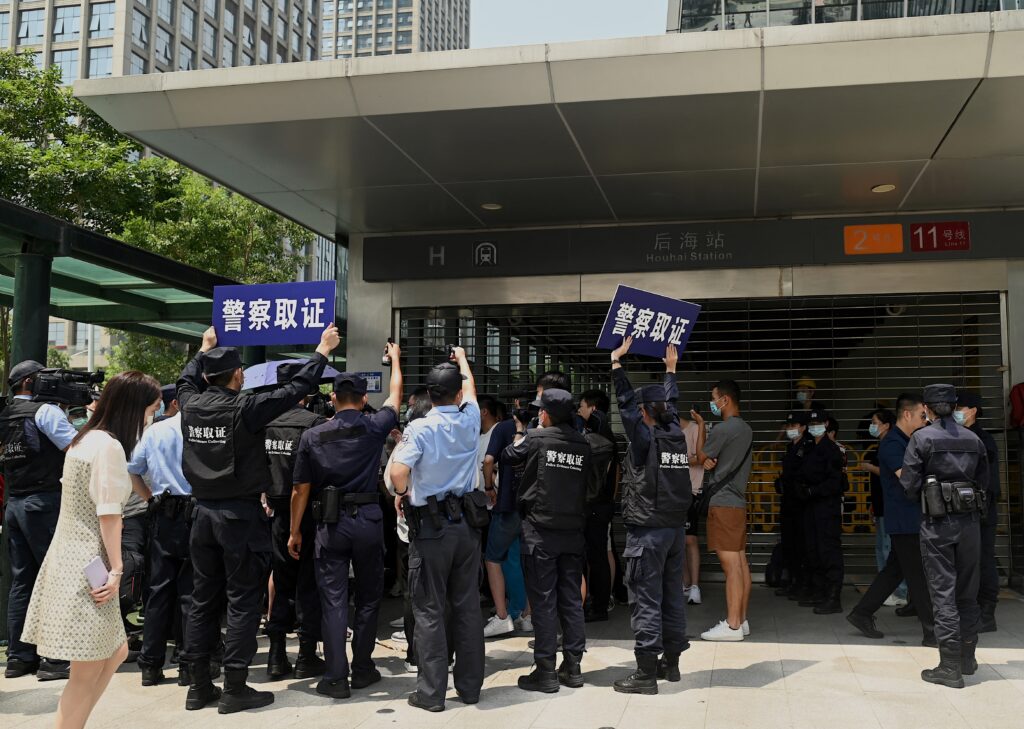
This culminated in the introduction of the Three Red Lines policy in 2020, which imposed strict limits on property developers’ debt ratios: a liability to asset ratio of less than 70%, a net debt-to-equity ratio of less than 100%, and a cash-to-short-term debt ratio of at least 1. Developers exceeding these thresholds faced restrictions on new borrowing. For highly leveraged firms like Evergrande, the policy triggered a severe liquidity crunch. Unable to access new financing while burdened with enormous existing debt, Evergrande struggled to meet obligations to suppliers, creditors, and WMP investors. By 2021, the company began defaulting on its obligations, setting off a crisis that spread across China’s property sector.
The human impact was significant. Briefly in 2022, some stopped paying mortgages on apartments they suspected of never being finished. September 2021 saw many citizens gathered outside Evergrande offices demanding their cash back. One told Reuters “The investors trusted Evergrande and bought Evergrande’s WMPs out of our love for and faith in the Party and government.” Tens of thousands of retail investors who purchased Evergrande WMPs lost savings, and many homebuyers who paid for apartments before construction faced uncertain futures. With roughly 70 percent of urban household wealth tied to real estate, the crisis eroded confidence in property as a primary store of value. Local governments, heavily reliant on land sales for revenue, also experienced fiscal strain as property transactions slowed. After this regulatory crackdown, household funds moved into bank deposits.
The IMF highlights the linkage between local government finances and the property crisis, reflected in rising LGFVs entering arrears. Land sale declines were most evident in provinces where there were pre-existing weaknesses, corroborating the findings of Zhilin Zhang that while defaults among most other SOEs narrowed bond spreads, defaults among LGFVs significantly widened them; defaulting on one LGFV causes capital flight away from the region, highlighting how uniquely devastating the property crisis is on local governments. In order to combat the slump, the government dedicated over 16 billion in their 14th Five Year Plan to renovating unfinished properties and building new lower than market rate government subsidized housing, a move that the IMF considers to be broadly beneficial. While many major cities have started the task, information and data for China’s more local regions, those most devastated by LGFVs and shadow banking failures, are not readily available.
In May 2021, “Notice by the China Banking and Insurance Regulatory Commission and the People’s Bank of China on Matters Concerning Regulating the Administration of Cash Management-based Wealth Management Products” was issued to tighten oversight of a rapidly growing segment of WMPs. Regulators were concerned that some institutions were using these products to circumvent WMP rules, provide implicit guarantees, or indirectly fund riskier, longer-term lending activities outside the balance sheet.
The notice required banks and financial institutions to strictly classify cash management WMPs and limit the mixing of liquidity products with other higher-risk or long-term investments. Institutions were explicitly prohibited from using cash management WMPs to finance credit or lending activities that would bypass regulatory leverage and capital controls. Reporting requirements were strengthened, requiring banks to disclose product portfolios, risk exposures, and investment strategies to both the CBIRC and the PBOC. By restricting the permissible investments for cash management WMPs and closing loopholes for regulatory arbitrage, the policy forced banks to internalize risk on their balance sheets and slowed the expansion of hidden credit, contributing directly to systemic deleveraging efforts such as CBRC No. 45 and the asset management rules. The directive reinforced the broader regulatory trend of reducing shadow-banking activity, strengthening capital and liquidity management, and directing financial institutions to support the real economy. This notice marked an important step in aligning WMPs with official deleveraging objectives and curbing systemic financial risks.
China’s response to the property market collapse demonstrates a deliberate effort to insulate securities markets from systemic contagion through centralized financial governance. Rather than allowing property-sector distress to cascade across capital markets, authorities framed the downturn as a contained structural correction, reinforcing investor confidence in core financial institutions and sovereign oversight even as real estate values declined.
A key mechanism of insulation has been China’s relatively closed financial architecture and direct state influence over major lenders. Capital controls and administrative guidance allowed regulators to steer credit away from failing developers while maintaining liquidity for priority sectors and government-backed entities. Earlier deleveraging campaigns forced recognition of off-balance-sheet risks tied to property-linked securities such as WMPs, LGFVs, and perpetual bonds. By compelling banks to separate wealth-management activities, remove implicit guarantees, and internalize risk, regulators limited the potential for a disorderly unwinding of these instruments when Evergrande defaulted. These reforms did not prevent losses within the property sector, but they prevented a broader financial panic by containing leverage, clarifying risk ownership, and reinforcing state capacity to intervene.
Despite the success at preventing new bubbles, there is still a growing need for greater liberalization of the financial sector. Administrative discipline has been advantageous for managing crises, however market-based signals would identify disasters faster and prevent them from exacerbating. Although developments in market liberalization have been made, including in expanding derivatives markets, some rules such as price hit limits in the stock market still make reading market signals difficult and often benefit the largest enterprises as opposed to protecting the retail investors that dominate the Chinese market. Even as Chinese households begin to park their wealth in bank accounts and away from property, Chinese citizens need alternate financial instruments to grow their assets.
As China cautiously liberalizes its financial markets, authorities continue balancing openness with stability. President Xi’s emphasis on risk control reflects lessons learned from the crisis; strengthening regulation, enhancing transparency, and aligning financial development with national priorities are central to the government’s strategy. Chinese leadership seeks to prevent future crises while enhancing global competitiveness. The legacy of Evergrande and its collapse serve as a cautionary tale, shaping the evolution of China’s financial system and its approach to monetary policy.

The Institute for China-America Studies is an independent nonprofit, nonpartisan research organization dedicated to strengthening the understanding of U.S.-China relations through expert analysis and practical policy solutions.
1919 M St. NW Suite 310,
Washington, DC 20036
icas@chinaus-icas.org
(202) 968-0595
© 2026 INSTITUTE FOR CHINA-AMERICA STUDIES. ALL RIGHTS RESERVED.



China’s Three Transformations for National Rejuvenation