
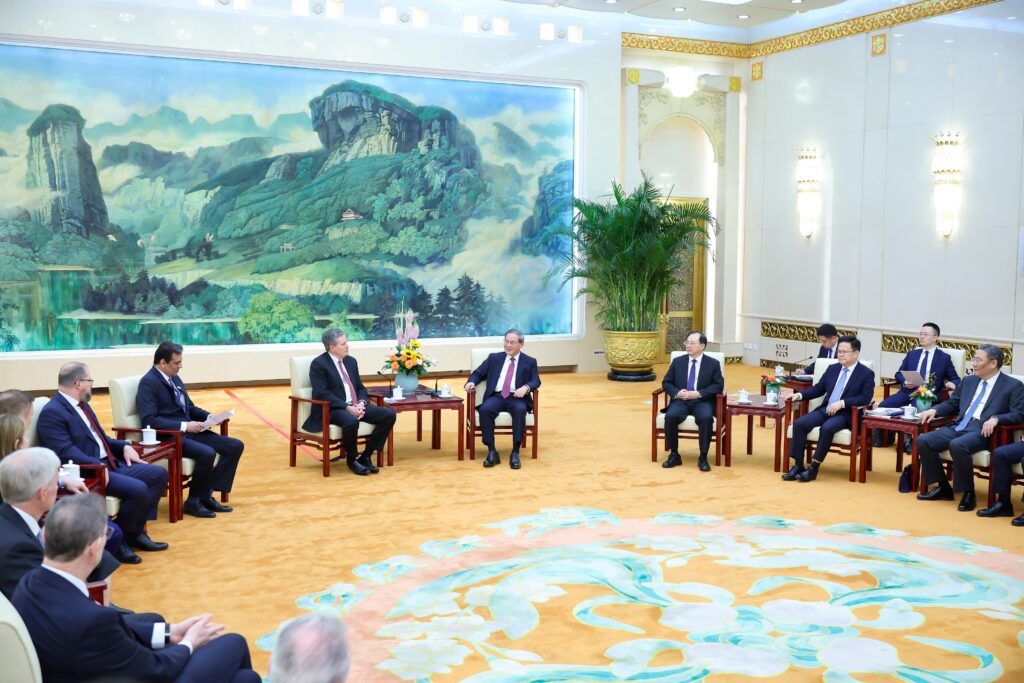

Cover Image Source: Laohang Vongkhamxao, Deputy Prime Minister and Minister of National Defense of Laos; Kim Kang Il, Vice Minister of the Ministry of National Defense of North Korea; Adly Zahari, Deputy Minister of Defense of Malaysia; Jurg Lauber, Vice President of the International Committee of the Red Cross; and Sione Ongoleo Fainga’anuku Lino, Deputy Chief of Staff of Tonga’s Armed Forces attend the third plenary session of the 13th Beijing Xiangshan Forum on September 17, 2026 in Beijing, China. (Photo by Hou Yu/China News Service/VCG via Getty Images)
The 13th Beijing Xiangshan Forum closed on 17 September after bringing together around 2,000 official representatives, scholars and observers from more than 100 countries, regions and international organisations. Its discussions on strategic stability, Asia-Pacific security and maritime governance returned to the same problem: how to manage intensifying competition while keeping dialogue open.
Nowhere is this tension more evident than in the South China Sea. Encounters between China and the Philippines continue, yet none has so far changed the regional military balance or made open conflict imminent. The more useful description is controlled tension. Pressure is persistent, restraint still operates, and each encounter adds to the risk of miscalculation.
The forum also offered modest signs of rhetorical restraint. In his keynote address, Chinese Defence Minister Dong Jun stressed dialogue, multilateralism and the need to avoid provocative acts, without directly singling out the South China Sea or the United States. Washington, meanwhile, sent a more senior Pentagon representative than it had the previous year. These were not breakthroughs, but they suggested that Beijing and Washington still see value in keeping military communication open.
The Security Dilemma
Many disagreements aired at the Xiangshan Forum follow the familiar logic of a security dilemma. One side reinforces its position for defensive reasons; the other reads the move as preparation for coercion and responds in kind. The result is more capability, less confidence and a narrowing margin for error.
China sees expanded US access to regional military facilities, more frequent exercises and surveillance near its coast as part of a containment strategy. Washington and several regional governments describe the same measures as a response to China’s military expansion and maritime conduct. The legal and strategic significance of these actions varies. What matters for the security dilemma is that each side treats its own steps as prudent and the other’s as destabilising.
The legal dispute remains fundamental. The 2016 South China Sea arbitral award found no legal basis for China to claim historic rights over resources within the nine-dash line and concluded that certain Chinese activities had violated the Philippines’ sovereign rights. Beijing rejects the award as null and void. Yet the award alone does not explain why encounters at sea are becoming harder to contain. Legal disagreement now interacts with operational pressure, domestic nationalism and wider China-US rivalry.
Security partnerships sharpen that interaction. Manila regards closer cooperation with Washington, Tokyo and others as protection against coercion; Beijing sees external powers using the dispute to constrain China. The United States and the Philippines have stated that their Mutual Defense Treaty applies to armed attacks on Philippine armed forces, aircraft and public vessels, including coastguard vessels, anywhere in the South China Sea. The commitment may deter a major attack, but it also means that a local incident can acquire alliance consequences quickly.
Controlled Tension at Sea
Recent events show how this pattern works. In June, Manila said it had taken appropriate diplomatic action after Philippine authorities reported what they described as an illegal Chinese floating structure inside Scarborough Shoal. Beijing responded that China has indisputable sovereignty over Huangyan Dao and that activities there, including scientific research, fall within its sovereign rights.
On July 20, the two sides gave sharply different accounts of a confrontation near Second Thomas Shoal. The China Coast Guard said Philippine boats had approached and rammed a Chinese patrol craft and that Philippine personnel attacked its officers with paddles and sticks. Philippine officials rejected that account as false and misleading. The facts remain contested, but the political effect is clear: encounters at sea are becoming more physical and harder to de-escalate.
Even so, the region has not entered a new phase of sustained armed confrontation. No new deployment has fundamentally altered the regional military balance, nor has there been a direct military clash between China and the United States. The principal actors still recognize the costs of open conflict, while economic ties, domestic priorities and the risk of alliance escalation continue to encourage restraint.
That restraint is strongest at the strategic level and weakest at close range. Coastguard and other government vessels operate within meters of one another while trying to demonstrate resolve without using firearms. Each side seeks an advantage below what it assumes to be the opponent’s threshold for military response. The calculation can work repeatedly and still fail once. A collision, a boarding attempt or a serious injury can leave commanders with minutes to interpret intent and governments with little political room to step back.
This is why the absence of escalation should not be mistaken for stability. Repeated brinkmanship encourages the belief that more pressure can be applied safely next time. It also increases the number of occasions on which equipment failure, navigational error or human judgement can turn a controlled operation into a crisis.
ASEAN and Regional Agency
At the centre of the South China Sea disputes are China and several Southeast Asian claimant states. The United States is an important stakeholder, but it is not a claimant. Viewing the issue mainly through the lens of China-US competition obscures the interests and choices of the parties directly involved. These states have different claims, threat perceptions and domestic constraints. Most want economic engagement with China, security ties with several partners and enough autonomy to avoid dependence on any single power.
ASEAN’s diversity makes a unified position difficult, particularly when the claimant states themselves have different priorities. Its value lies elsewhere. ASEAN provides a setting in which maritime security can be discussed without reducing every question to alliance politics.
ASEAN and China continued formal negotiations in May 2026, when senior officials reviewed implementation of the Declaration on the Conduct of Parties and discussed progress toward a Code of Conduct. ASEAN foreign ministers have said they aim to conclude an effective and substantive code in 2026, consistent with international law and particularly the United Nations Convention on the Law of the Sea. The January 2026 ASEAN foreign ministers’ retreat statement also calls for measures to reduce accidents, misunderstandings and miscalculation. The language is cautious, but it addresses the immediate problem.
A code will matter only if it changes behavior at sea. Questions of enforcement, geographic scope and dispute settlement remain difficult. In the meantime, practical rules on advance notice, safe separation, emergency communications and rapid investigation of collisions would reduce risk without requiring any party to surrender its legal position.
From Dialogue to Guardrails
The Xiangshan Forum cannot resolve sovereignty or jurisdictional disputes. Its more realistic contribution is to keep officials talking while competition intensifies and to press broad principles towards operational rules.
Public accounts of the forum stressed dialogue and crisis management, but no new South China Sea hotline, encounter protocol or other operational mechanism was publicly announced. The gap between diplomatic consensus and practical risk reduction therefore remains.
Three measures are especially useful. Military and coastguard hotlines should be tested under realistic conditions and available to officers who manage incidents, not only senior diplomats. Collision-avoidance arrangements should be negotiated separately from sovereignty or sovereignty rights claims. Governments should also preserve room for quiet de-escalation instead of treating every encounter as a public test of national credibility.
The South China Sea has not entered a new phase of major military escalation, and the rhetoric in Beijing was comparatively restrained. The disputes are nevertheless no closer to resolution. Governments continue to exert pressure at sea, while the rules needed to prevent an incident from becoming a crisis remain incomplete. Dialogue remains useful, but its value will ultimately be measured by whether it produces workable crisis-management arrangements.
South China Sea Arbitration at 10: State consent, jurisdiction and contested finality