

Resident Associate
Manager, Trade 'n Technology Program

Part Time Research Assistant Intern
Cover Image: Chinese Premier Li Qiang meets with U.S. Senator Steve Daines and some American business people, who are here to attend the China Development Forum 2025 in Beijing, capital of China, March 23, 2025. (Photo by Liu Bin/Xinhua via Getty Images)
During much of the past decade, Congress frequently played an agenda-setting role in U.S.-China strategic competition, identifying emerging risks and pressing successive administrations toward new restrictions, safeguards, and policy frameworks. In the first half of 2026, that role became noticeably more reactive as the Trump administration increasingly set the pace and parameters of U.S.-China policy.
Congressional attention to China remained substantial. Members of the 119th Congress introduced 67 pieces of China-related legislation between January and June 2026, with technology, Taiwan, supply chains, security, and geopolitics accounting for much of the activity. The volume of legislation, however, contrasts with the limited number of bills that made substantial progress toward enactment.
Taiwan provides the clearest example of Congress responding to executive branch diplomacy. Taiwan-related legislation was concentrated heavily in the months surrounding President Donald Trump’s anticipated and eventual visit to China in May, reflecting congressional concern that efforts to stabilize relations with Beijing could create greater executive flexibility over Taiwan.
Economic security legislation remained an on-going feature, particularly in technology and supply chains. Yet traditional trade and capital-related legislation attracted comparatively less attention. This pattern suggests that Congress increasingly concentrated on the security-sensitive portions of the economic relationship even as the administration sought greater stability in bilateral trade and investment.
Critical minerals reveal a somewhat different relationship between Congress and the Executive Branch. Congressional concern over dependence on China preceded Project Vault, but the administration increasingly supplied the organizing strategy around which legislative efforts on overseas mineral investment, rare-earth magnets, tax incentives, and alternative supply chains could converge.
Congress has not entirely lost its agenda-setting capacity. The South China Sea Strategy Act of 2026 stands out as an attempt to develop a more geographically specific approach to maritime competition with China, demonstrating that individual lawmakers can still introduce new strategic frameworks independent of immediate executive action.
For much of the past decade, the U.S. Congress played an unusually active role in defining the direction of strategic competition with China. Across technology, investment, Taiwan, supply chains, human rights, and economic security, lawmakers frequently sought not simply to respond to executive actions but to identify emerging vulnerabilities, establish new policy tools, and push successive administrations toward a more competitive posture.
The first half of 2026 suggests a subtle but consequential change in that relationship.
Congress has not lost interest in China. Between January 1 and June 30, members of the 119th Congress introduced 67 pieces of significant China-related legislation. Legislative activity also increased as the year progressed, rising from five bills in January and seven in February to 15 in March, 14 in April, 12 in May, and 14 in June. Technology emerged as the largest single area of activity, alongside continued attention to Taiwan, supply chains, security, and geopolitical competition.
What changed was less the volume of congressional attention than its relationship with executive policy.
During earlier phases of U.S.-China strategic competition, Congress frequently sought to set the stage for future policy. Lawmakers identified emerging areas of competition, proposed restrictions before executive agencies had fully developed their approaches, and attempted to push the White House toward a harder or more durable competitive posture. Congressional proposals on outbound investment, semiconductor controls, supply-chain security, forced labor, Taiwan, and Chinese access to U.S. markets often anticipated or accelerated subsequent executive action.
By 2026, the direction of influence had begun to shift.
The Trump administration entered its second year with a more settled approach toward Beijing: continuing strategic competition in sensitive sectors while simultaneously seeking greater stability in the broader bilateral relationship. The political alignment between the executive and legislative branches further reinforced this dynamic. With Republicans controlling both chambers of Congress, congressional majorities were more inclined to work within the direction of China policy established by a Republican White House than to develop a competing agenda of their own, particularly while President Trump was still early in his second term. President Trump’s diplomatic engagement with China, efforts to stabilize trade, new bilateral economic mechanisms, and executive initiatives addressing critical minerals increasingly established the immediate policy environment within which Congress operated.
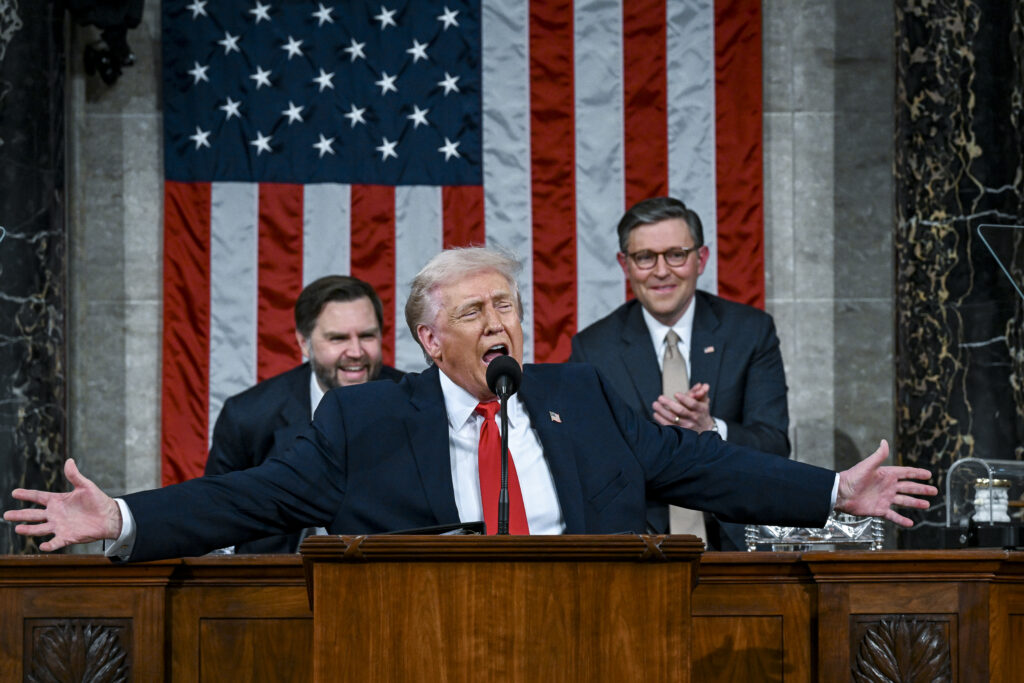
Congressional legislation consequently became less consistently anticipatory and more frequently responsive. Lawmakers sought to reinforce commitments that they feared presidential diplomacy could weaken, regulate areas left outside economic stabilization, supplement executive industrial policies, and signal where congressional limits on accommodation with Beijing remained.
The institutional shift is therefore not from congressional activism to congressional disengagement. Rather, the first half of 2026 points toward a Congress increasingly focused on reacting to, constraining, supplementing, and signaling around an executive-led U.S.-China relationship.
Taiwan offers perhaps the clearest example of Congress reacting to changes in executive-led China policy.
Congressional support for Taiwan is hardly new. What distinguishes the first half of 2026 is the timing of legislative activity.
Congress introduced 10 Taiwan-related bills during the first six months of the year. Six were introduced in March and April alone. All ten appeared by the end of May, while no new Taiwan-related legislation was introduced in June.
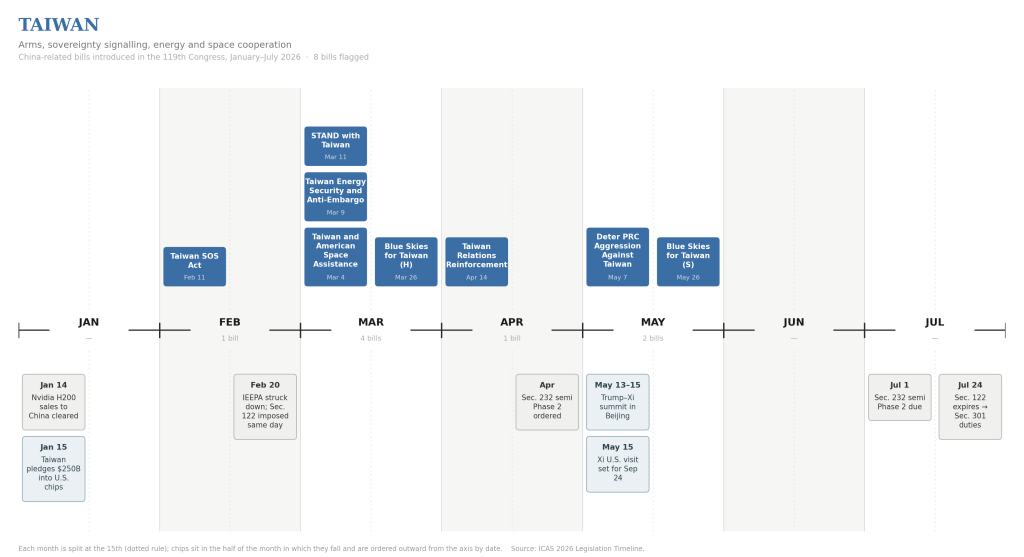
This concentration coincided with growing attention surrounding President Trump’s planned visit to China. From the period when the visit was initially expected to occur in March through the eventual presidential trip in May, renewed high-level diplomacy with Beijing raised questions in Washington over how Taiwan might fit into a broader effort to stabilize U.S.-China relations.
The concern was not necessarily that the administration had decided to alter U.S. policy toward Taiwan. Rather, the prospect of a larger diplomatic and economic accommodation with Beijing revived a longstanding congressional anxiety: that a president seeking stability in the broader bilateral relationship could possess greater flexibility over Taiwan than Congress considered desirable.
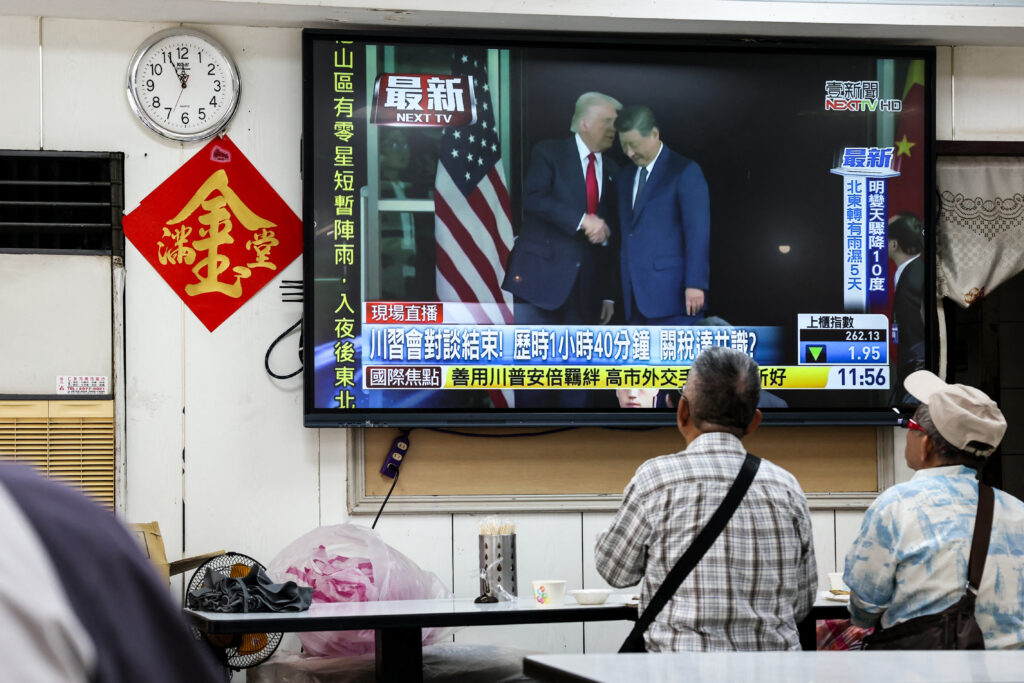
The legislative response was broad.
The Taiwan and American Space Assistance Act, Taiwan Energy Security and Anti-Embargo Act, STAND with Taiwan Act, and Blue Skies for Taiwan Act were introduced in March. They were followed in April by the Critical Undersea Infrastructure Resilience Initiative Act and Taiwan Relations Reinforcement Act. The Deter PRC Aggression Against Taiwan Act and a House version of the Blue Skies for Taiwan Act followed in May.
These measures addressed different dimensions of Taiwan’s security and international position, ranging from resilience against economic and energy coercion to international participation, infrastructure protection, deterrence, and the institutional foundations of U.S.-Taiwan relations.
Taken individually, they largely extend policy directions already familiar in Congress. Taken together and viewed against their timing, however, they reveal a more significant pattern.
Congress was not constructing an entirely new Taiwan strategy. Instead, lawmakers were reinforcing existing commitments and attempting to narrow the possibility that renewed executive diplomacy with Beijing could create uncertainty surrounding Washington’s position toward Taiwan.
Taiwan legislation in early 2026 therefore illustrates an increasingly important congressional function: using legislation as insurance against perceived uncertainty in executive diplomacy.
Economic relations reveal a different form of congressional reactiveness.
The Trump administration devoted substantial attention in early 2026 to stabilizing the U.S.-China economic relationship. President Trump’s May visit to China culminated in new arrangements intended to create more structured channels for managing bilateral trade and investment, including the establishment of a Board of Trade and a Board of Investment.
These initiatives did not represent an end to economic competition. Instead, they increasingly distinguished between areas in which Washington was prepared to manage and stabilize commercial relations and areas that remained firmly embedded within national-security competition.
Congressional legislation reflected this distinction.
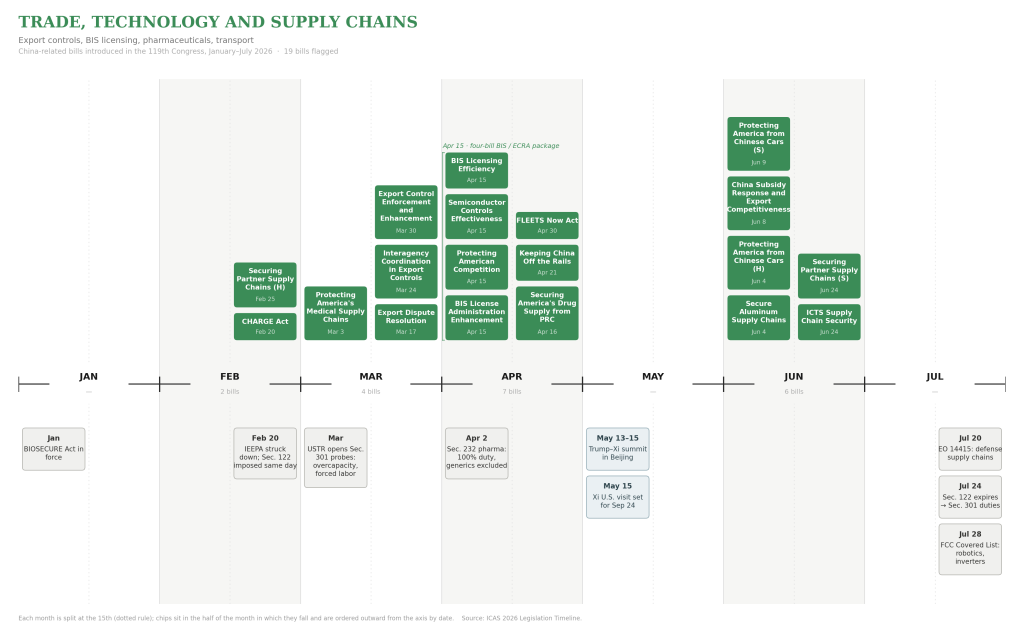
Only 3 China-related bills introduced during the first half of 2026 focused primarily on traditional trade issues. Yet congressional attention to the broader economic relationship remained substantial. Fifteen bills concerned technology and nine addressed supply chains. Together with trade legislation, these measures accounted for roughly 40 percent of all China-related legislation introduced during the period.
Technology was particularly prominent. Congressional activity accelerated toward the end of the first half of the year, with 6 technology-related bills introduced in June alone.
Much of this legislation focused less on tariffs or aggregate trade balances than on the infrastructure governing technological competition: export controls, licensing, semiconductor restrictions, information and communications technology supply chains, Chinese vehicles, quantum technologies, patents, and access to advanced U.S. technology.

Artificial intelligence added further momentum to this trend.
As competition over advanced chips, computing power, models, data centers, and the diffusion of AI capabilities intensified, Congress continued to examine how existing export controls and technology restrictions should adapt to rapidly changing capabilities. Unlike some other areas of China policy, technological competition retained a substantial degree of independent congressional momentum because the underlying technologies themselves continued to generate new policy questions.
The resulting pattern is important.
As the executive branch sought greater stability in ordinary commercial relations with China, Congress concentrated disproportionately on the security-sensitive layer of economic interdependence. Trade could be stabilized without technology exchanges necessarily being liberalized. Commercial engagement could continue while supply chains considered strategically vulnerable remained subject to scrutiny.
Capital presents a notable contrast.
Congress introduced only 5 China-related bills principally concerning capital and investment during the first half of 2026. The issue remained present, but it occupied a less prominent position than technology or supply-chain security and generated less legislative momentum than debates over outbound investment and Chinese access to U.S. capital had during earlier periods.
This relative quiet does not necessarily indicate declining congressional concern.
The establishment of the Board of Investment creates a new institutional question whose practical significance remains uncertain. Its eventual scope—whether it primarily facilitates investment discussions, addresses restrictions on bilateral capital flows, or becomes part of a broader framework governing Chinese investment in the United States and U.S. investment in China—will shape the degree of congressional interest.
Congress therefore may simply have had less to react to, at present.
If the Board of Investment develops into a substantive mechanism affecting investment screening, outbound investment, market access, or the treatment of Chinese capital in the United States, congressional scrutiny could increase considerably.
Critical minerals occupy a distinctive position in the changing relationship between Congress and the Executive Branch.
Unlike Taiwan, congressional concern over critical mineral dependence did not emerge primarily in response to a presidential initiative. Lawmakers had already identified U.S. dependence on China for mining, processing, refining, and rare-earth magnet production as a strategic vulnerability.
Legislation introduced during the first half of 2026 reflected this established concern.
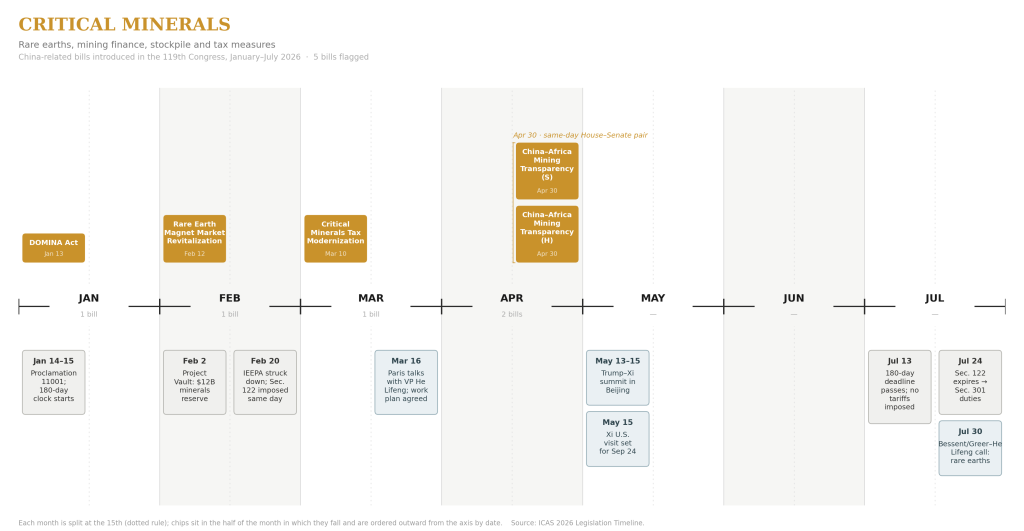
The Developing Overseas Mineral Investments and New Allied Networks for Critical Energies Act, or DOMINANCE Act, was introduced in January with the objective of reducing U.S. dependence on critical-mineral supply chains controlled by China and other strategic competitors. The Rare Earth Magnet Market Revitalization Act followed in February, while the Critical Minerals Investment Tax Modernization Act was introduced in March. House and Senate versions of the China-Africa Mining Transparency Act followed in April.
What changed during this period was not congressional recognition of the problem but the emergence of a clearer executive strategy around which these legislative initiatives could increasingly converge.
On February 2, the Trump administration announced Project Vault, establishing a Strategic Critical Minerals Reserve supported by up to $10 billion in Export-Import Bank financing and nearly $2 billion in private investment. The initiative sought to protect U.S. manufacturers from supply disruptions and reduce vulnerabilities associated with concentrated foreign control over strategically important minerals.
The geopolitical context was difficult to separate from the administration’s broader diplomacy with Beijing.
As Washington prepared for renewed high-level engagement with China, critical minerals represented one of the clearest areas in which Beijing retained potential economic leverage. Reducing exposure to disruptions in rare earths and other strategic materials therefore served not only a long-term industrial objective but also a more immediate strategic purpose: improving U.S. resilience before entering negotiations in which supply-chain dependence could otherwise constrain American options.

Congressional legislation preceded, accompanied, and followed Project Vault. The pattern is therefore better understood as convergence rather than simple reaction.
Legislative proposals addressed different components surrounding that strategy: overseas mineral investment, allied supply networks, tax incentives, domestic rare-earth magnet markets, and transparency regarding Chinese mining activities abroad. Together, these efforts suggest a growing division of labor in which the administration establishes the central strategic initiative while Congress reinforces or extends individual components.
Whether these efforts materially reduce U.S. dependence on China remains a separate matter.
Strategic reserves can mitigate short-term supply disruptions but rebuilding mining, refining, processing, and magnet-production capacity requires sustained investment, commercially viable projects, regulatory coordination, and cooperation with alternative suppliers. The ultimate effectiveness of Project Vault and related legislation will therefore depend less on the number of initiatives announced than on whether they produce durable changes across the critical mineral supply chain.
Critical minerals nevertheless demonstrate that a more executive-led China policy does not necessarily marginalize Congress. In some areas, it can instead produce a convergence in which congressional initiatives reinforce a strategic framework increasingly organized by the executive branch.
Not every significant congressional initiative in 2026 followed an executive action.
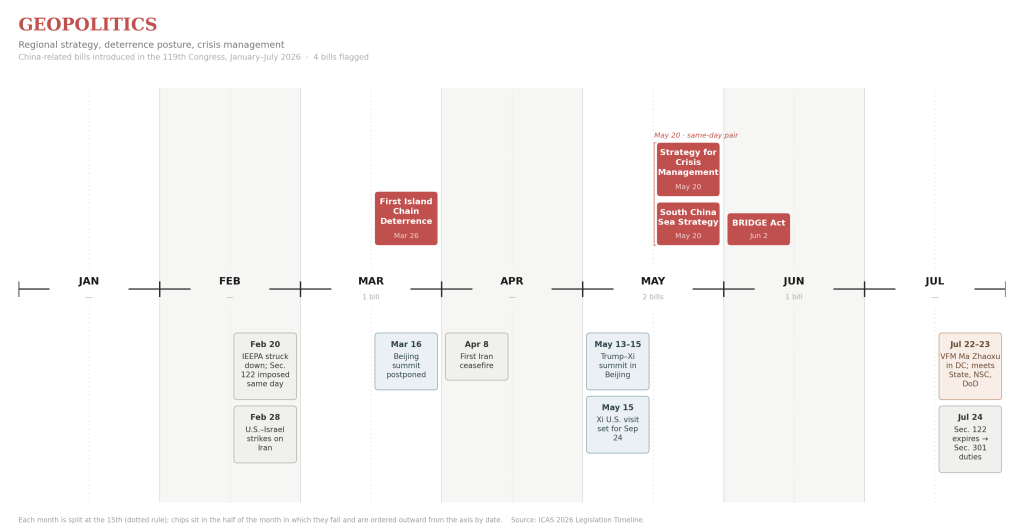
The South China Sea Strategy Act of 2026, introduced by Senator Tammy Duckworth, stands out precisely because it points in the opposite direction. The timing is notable. The legislation coincided with the tenth anniversary of the 2016 South China Sea arbitration, an issue on which Washington and Beijing continue to hold fundamentally different positions. More importantly, the bill pointed toward a renewed effort to define the South China Sea as a distinct arena of U.S.-China geopolitical competition.
For years, congressional discussion of the South China Sea has generally been embedded within broader debates over the Indo-Pacific, freedom of navigation, U.S. alliances and partnerships, maritime security, and military competition with China. The South China Sea Strategy Act moves toward treating the South China Sea itself as a strategic space requiring a more dedicated policy framework.
That distinction matters.
A more geographically specific strategy can organize policy questions that otherwise cut across multiple bureaucratic and legislative categories: maritime security, coast guard cooperation, military posture, economic coercion, undersea infrastructure, shipping routes, relations with Southeast Asian states, and Chinese activities in disputed waters.
The significance of the legislation therefore extends beyond its immediate prospects for passage.
It demonstrates that Congress retains the capacity to identify dimensions of competition with China that have not yet become organizing principles of executive policy and to propose new frameworks through which the United States might approach them.
Duckworth is also a notable sponsor in this context. A decorated Iraq War veteran serving on the Senate Armed Services, Foreign Relations, and Commerce, Science, and Transportation Committees, she occupies an institutional position spanning several areas increasingly central to U.S.-China competition: defense, maritime security, technology, infrastructure, and regional strategy.

The South China Sea Strategy Act can therefore be understood as an example of congressional policy entrepreneurship rather than simply another reaction to an administration initiative.
Whether the approach attracts broader bipartisan support will be worth watching. If it does, it could contribute to a gradual shift away from treating maritime competition with China primarily as one component of a broader Indo-Pacific strategy and toward developing more specific approaches to individual maritime spaces, infrastructure networks, shipping routes, and strategic chokepoints.
More broadly, the legislation provides an important qualification to the larger trend during the first half of 2026.
Congressional agenda-setting has become less dominant. It has not disappeared.
The broader record of the 119th Congress presents a paradox.
Congress continues to generate substantial China-related legislative activity. Yet relatively few made substantial progress through the legislative process during the same period.
The distinction between legislative activity and legislative productivity is increasingly important.
Introducing legislation does not necessarily mean that Congress is successfully translating its preferences into statutory policy. But legislation that does not become law can still matter in U.S.-China relations.
Such bills can signal congressional priorities to the administration, foreign governments, companies, and other policymakers. They can attempt to constrain executive discretion where lawmakers fear that presidential diplomacy could produce unwanted flexibility. They can supplement executive initiatives by proposing authorities, restrictions, reporting requirements, funding mechanisms, or institutional structures. And they can preserve policy ideas that may be incorporated into larger legislation or revived when political conditions change.
The last function is particularly important in understanding the 119th Congress.
Many policies that eventually become part of the U.S. approach toward China spend years moving among stand-alone congressional proposals, authorization and appropriations bills, executive orders, agency regulations, and successive versions of legislation. A bill that fails to advance in 2026 may still provide legislative language, policy concepts, or political signals that shape subsequent action.
The 119th Congress may therefore prove more consequential as a repository of future China policy options and a source of political signals than as a producer of enacted China legislation.
That role differs noticeably from the agenda-setting position Congress occupied during earlier phases of strategic competition.
As Washington’s approach toward China hardened over the previous decade, Congress frequently pushed the Executive Branch toward new areas of competition. Lawmakers sought to define economic dependencies as security vulnerabilities, restrict Chinese access to U.S. technology and capital, strengthen ties with Taiwan, reorganize supply chains, and transform political concerns over China into statutory requirements.
By the first half of 2026, many of those competitive principles had already become embedded within U.S. policy.
At the same time, the Trump administration had begun constructing a more stable framework for managing the relationship: maintaining competition in strategically sensitive sectors while reopening or strengthening mechanisms for diplomacy, trade, investment discussions, and broader bilateral stabilization.
The resulting congressional role was different.
The 119th Congress has not withdrawn from U.S.-China strategic competition. Nor has the bipartisan concern that sustained congressional activism toward China over the past decade disappeared.
What has weakened is Congress’s earlier agenda-setting primacy.
The first half of 2026 instead points toward a legislature that remains highly attentive to China but increasingly reacts to, constrains, supplements, and codifies an executive branch that has reclaimed the initiative in managing the bilateral relationship.
Whether this represents a temporary feature of the 119th Congress or a more durable institutional shift remains uncertain.

The more consequential test may come with the 120th Congress. By then, the Trump administration’s approach toward engagement, trade, investment, technology competition, Taiwan, and supply-chain security will have had more time to acquire institutional form. A new Congress will then face a choice that the 119th Congress has only begun to confront: whether to continue legislating largely within an executive-defined framework for U.S.-China relations, or once again attempt to set the stage for the next phase of strategic competition.


The Xiangshan Forum and the South China Sea: No Major Escalation but No Lasting Stability