
ICAS Bulletin (online ISSN 2836-3418, print ISSN 2836-340X) is published every other week throughout the year at 1919 M St NW, Suite 310, Washington, DC 20036.
The online version of ICAS Bulletin can be found at chinaus-icas.org/bulletins/.
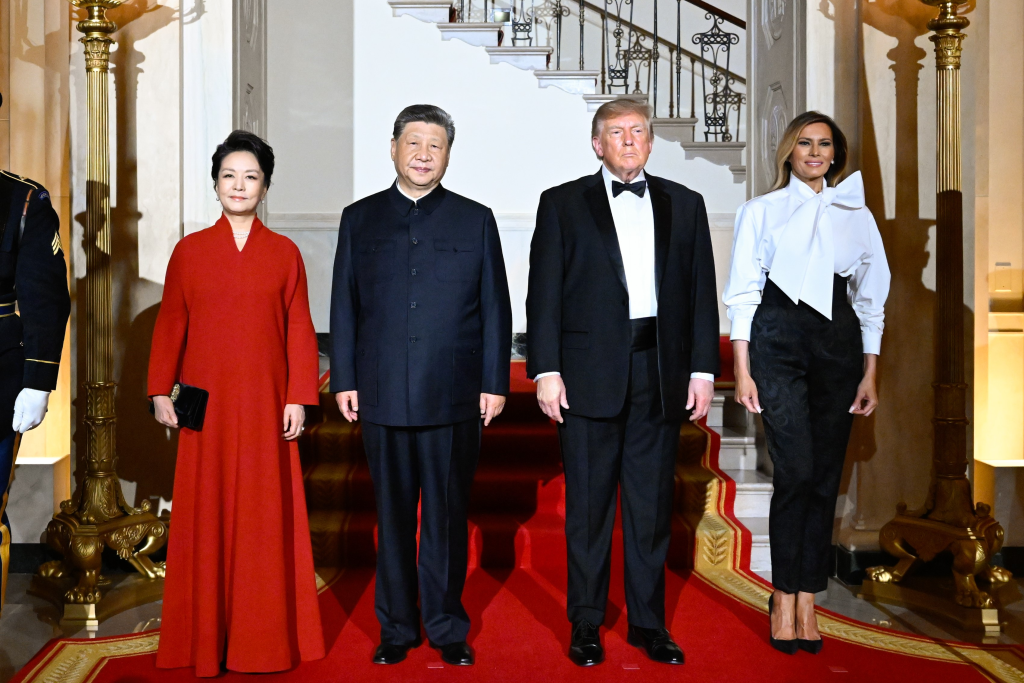
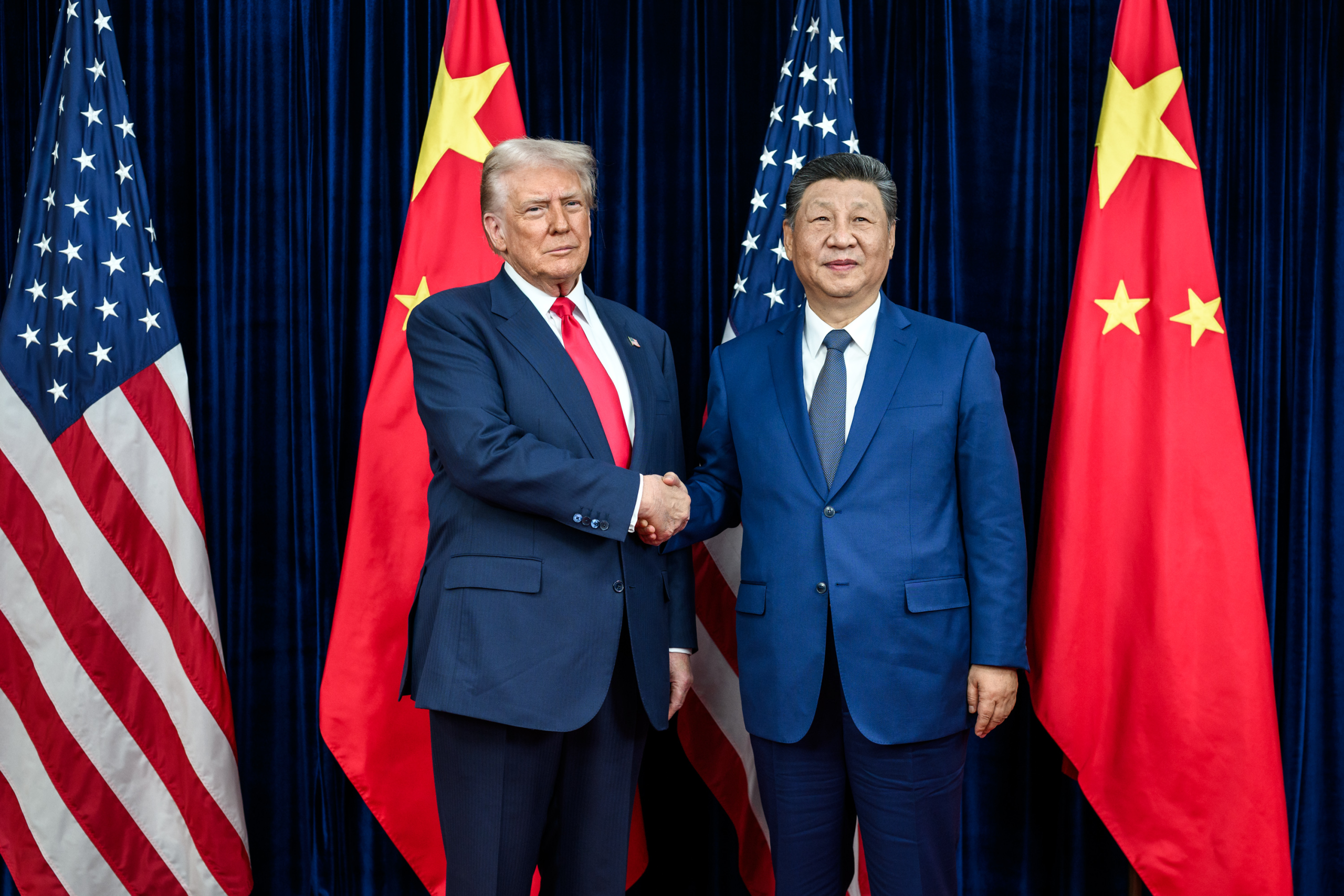
–On September 24, Chinese President Xi Jinping and U.S. President Donald Trump met at the White House, where both emphasized maintaining stable bilateral ties and continued dialogue. President Trump highlighted progress since his May visit to Beijing, while President Xi called for “healthy” competition, fair treatment of each other’s companies, and regular military dialogue to improve crisis prevention.
–Later that evening, President Trump hosted President Xi for a state dinner attended by senior officials and prominent U.S. technology, finance, and business executives. In their remarks, both leaders again stressed cooperation and the importance of managing differences in the relationship.
–During the visit, President Xi announced that China would invite 100,000 young Americans to visit China for exchanges and study over the next five years, and that two giant pandas, Ping Ping and Fu Shuang, would soon arrive at Zoo Atlanta.
–President Xi’s Washington visit coincided with the 81st United Nations General Assembly in New York. China was instead represented at the General Debate by Vice President Han Zheng, who attended UNGA-related events from September 24 to 26.
–On September 23, President Trump and U.S. First Lady Melania Trump personally greeted President Xi and Chinese First Lady Peng Liyuan at Joint Base Andrews, where the welcoming ceremony included an honor guard, a 21-gun salute, and a flyover by B-1B bombers.
Associated News References:
“Trump Welcomes China’s Xi to Washington With Planeside Ceremony and Extension of Trade Truce,” AP News, September 23
“Trump-Xi Summit in Washington Begins With Great Fanfare but Low Expectations,” Reuters, September 24
“Two Pandas to Arrive in Atlanta in a Few Days, Xi Says,” Bloomberg, September 24
“Trump-Xi state dinner guest list includes SpaceX’s Musk, Nvidia’s Huang and LVMH’s Arnault,” Reuters, September 24
“Trump welcomes China’s Xi for state dinner at White House after touting “truly great friendship”,” CBS News, September 25
“Trump-Xi Meeting Live Updates: Final Day of Summit Includes Tours and Tea,” The New York Times, September 25
“Trump Claims Productive Meeting With Xi But Offers No Details,” Bloomberg, September 25
“Xi says he expects to see Trump again as he wraps Washington visit with a peek at the Constitution,” AP News, September 25
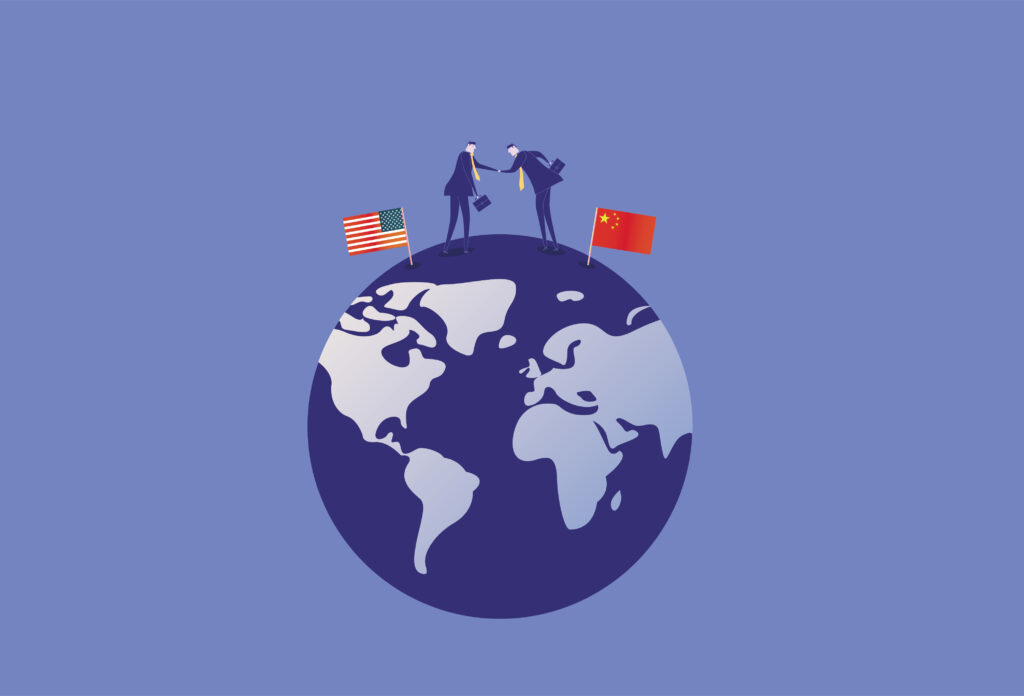
–On September 23, Treasury Secretary Scott Bessent announced that the U.S. and China had agreed to extend their trade truce by two months to January 10, following an unscheduled meeting with Vice Premier He Lifeng in Washington. The extension followed talks in New York earlier in the week, where the two sides also put the U.S.-China Board of Trade into operation.
–The latest developments came after Bessent and Trade Representative Jamieson Greer met He Lifeng in New York on September 20 for eight hours of negotiations focused on trade implementation and remaining areas of disagreement.
–Recent data showed mixed progress under the existing truce. Chinese rare-earth magnet exports to the U.S. fell 21% in August to 512 tons, prompting Greer to cite continued uncertainty over China’s export restrictions.
– At the same time, Greer said China was meeting its soybean purchase commitments and had purchased about $4 billion toward a separate pledge to buy at least $17 billion annually in additional U.S. agricultural products.
–The economic backdrop also shaped expectations surrounding Chinese President Xi Jinping’s Washington visit. President Xi arrived on September 23 without the delegation of Chinese business leaders that Beijing had reportedly sought to bring, limiting expectations for major commercial announcements alongside the state visit.
–On the same day, Bessent announced that the U.S. and China had agreed to extend their trade truce by two months to January 10, following an unscheduled meeting with He Lifeng in Washington.
–Meanwhile, domestic pressure for tighter China-related trade restrictions continued in Congress. On September 24, Senators Bernie Moreno and Elissa Slotkin delayed an effort to fast-track a permanent ban on Chinese vehicles while seeking the support of Senator Rand Paul, with Moreno saying he hoped the Senate would take up the bill the following week.
Associated News References:
“China Says It Hopes to Agree With the US on Tariff Reductions at ‘An Early Date’,” AP News, September 10
“US Announces AI Dialogue With China, Launches Board of Trade,” South China Morning Post, September 20
“China Rare-Earth Exports to US Drop Before Xi-Trump Meet,” Bloomberg, September 20
“China’s Selective Crop Buying Tests US Trade Truce Before Summit,” Bloomberg, September 20
“Rare Earths Friction Threatens to Stall Trade Truce Extension Ahead of Xi-Trump Summit,” South China Morning Post, September 22
“China’s Xi to Visit Washington Without CEO Delegation, Sources Say,” Reuters, September 23
“Bessent Says US, China Extend Their Trade Truce to Jan. 10,” Bloomberg, September 23
“US Senators Delay Effort to Permanently Ban Chinese Cars,” Reuters, September 24
–On September 24, China’s Ministry of Commerce confirmed that U.S. and Chinese officials had held their first talks on artificial intelligence, describing the exchanges as constructive and candid.
– During President Xi Jinping’s meeting with U.S. President Donald Trump, President Xi called for AI to remain “under human control,” while President Trump said he did not want the two countries to negotiate limits on AI development.
–The emerging dialogue followed talks between Treasury Secretary Scott Bessent and Vice Premier He Lifeng in New York beginning September 20. Bessent proposed establishing a bilateral notification mechanism for AI-related incidents that rise to the level of national security, while officials continued discussions on AI, investment, and trade the following day.
–On September 23, Bessent said the two sides were still defining the scope of the dialogue, pointing to risks including uncontrolled AI agents and the use of AI by non-state actors for cyber operations or biological threats.
–On September 23, Bessent said the two sides were still working to define which AI risks the dialogue would cover, such as uncontrolled AI agents or non-state actors using AI for cyber operations or biological threats.
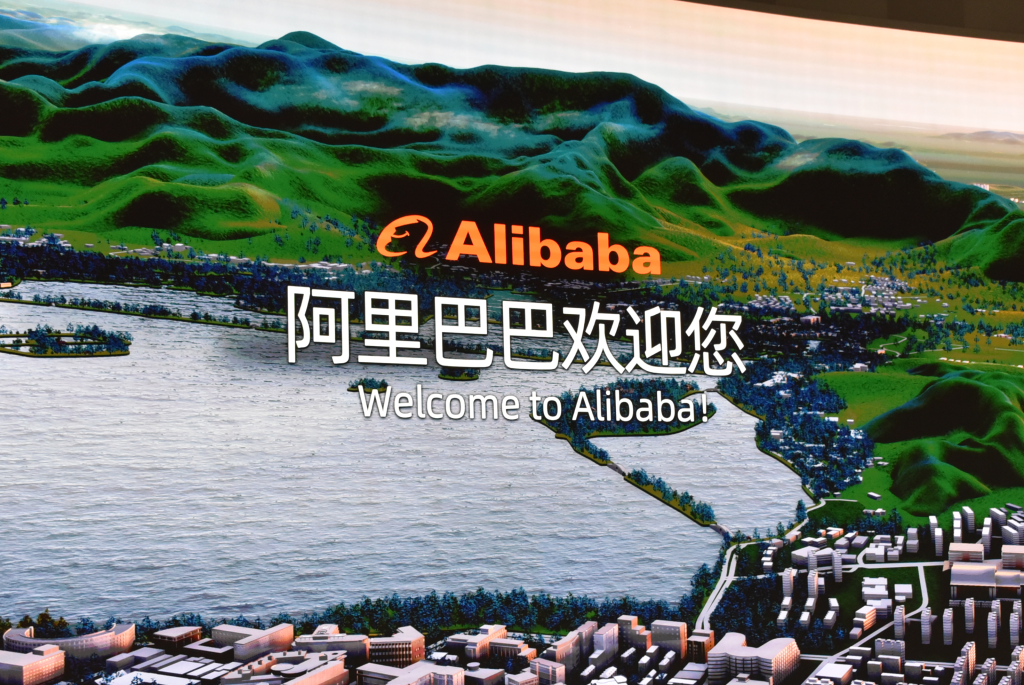
– On September 22, Alibaba unveiled its Zhenwu V900 AI chip, which it said offers three times the performance of its predecessor and can be linked in large clusters for frontier model training. The announcement came amid continuing U.S.-China disputes over access to advanced chips and allegations that Chinese developers have improperly accessed U.S. AI models, which Beijing has rejected.
–On the same day, President Trump wrote on social media that “Super Intelligence” would be a big topic of discussion with Xi, but that he wanted to leave AI “exactly where it is,” adding that this was also China’s position.
Associated News References:
“Bessent Proposes US-China AI Safety Notifications in Talks With Chinese Vice Premier,” Reuters, September 20
“China and US Discuss AI, Investment on Second Day of Trade Talks,” Bloomberg, September 21
“Alibaba Unveils New AI Chip, Calls It China’s Most Powerful,” Bloomberg, September 21
“Bessent Says US, China Extend Their Trade Truce to Jan. 10,” Bloomberg, September 23
“China Confirms First AI Talks With U.S. Have Taken Place, Hints at Trade Truce Extension,” CNBC, September 24 “Trump to Talk AI With Xi at White House, but Wants to ‘Leave It Exactly Where It Is’,” POLITICO, September 24

“Trump Dismisses Report China Entities Helped Iran Before Attack That Killed US Troops,” Reuters, September 13
“World’s Top Rare-Earth Magnet Maker Gives Xi Leverage Over US,” Bloomberg, September 21
“Pentagon Blacklist Lingers as Irritant in Trump-Xi Talks on AI,” Bloomberg, September 21
“US LNG Producers Eye Bonanza If Trump and Xi Can Ease Tariffs,” Bloomberg, September 21
“The Tiny Magnet Maker That Attracted $1.6 Billion From Lutnick,” Bloomberg, September 23
“China Is Holding Sensitive F-35 Parts Diverted to Hong Kong,” Bloomberg, September 23
“Taiwan Is Watching Closely as Xi and Trump Meet and Hopes US Will Keep Up Its Arms Sales,” AP News, September 23
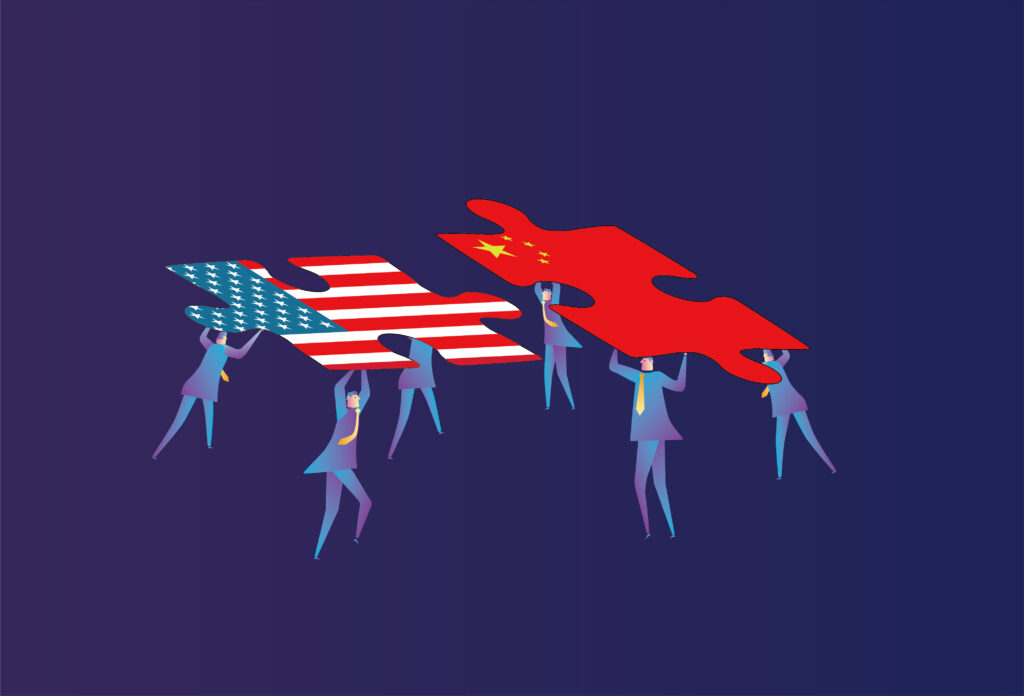
Two themes stood out in Washington’s China policy debate around Xi Jinping’s state visit. The first concerned whether the summit’s limited outcomes represent a more durable framework for managing competition or simply postpone harder disputes. Analysts broadly expected little beyond an extension of the trade truce, modest commercial commitments, and continued leader-level engagement, but differed over whether this restraint signals pragmatic coexistence or a temporary pause in tensions over trade, technology, Taiwan, and regional security. The second focused on whether AI risk can become an area of limited cooperation even as the broader technology rivalry intensifies. While the proposed dialogue and incident-notification mechanisms were generally seen as useful for crisis management, analysts questioned how far cooperation can go amid continuing competition over chips, model access, and technological leadership. Any emerging AI channel is therefore more likely to manage specific risks than to bridge the underlying strategic rivalry.
September 11 hosted by Stimson Center
September 11 hosted by Johns Hopkins SAIS ACF
September 21 hosted by Asia Society
September 22 hosted by PIIE
September 25 hosted by CSIS
September 28 hosted by CSIS
September 28 hosted by CSIS
September 28 hosted by Stimson Center
September 28 hosted by Atlantic Council
September 29 hosted by Atlantic Council
September 30 hosted by Hudson Institute
October 2 hosted by Brookings Institution
October 5 hosted by Stimson Center
October 6 hosted by Brookings Institution
Competing Narratives in the Arctic
Hosted by ICAS, The Fletcher School of Law and Diplomacy, Tufts University
Friday, October 9, 2026
4:05PM-5:00PM (GMT)
On Friday, October 9, ICAS and The Fletcher School of Law and Diplomacy at Tufts University will cohost the breakout session “Competing Narratives in the Arctic” at the Arctic Circle Assembly in Reykjavík, Iceland. Panelists include Rockford Weitz (Fletcher Maritime Studies Program, Tufts University), Nong Hong (Executive Director and Senior Fellow, ICAS), Pavel Devyatkin (Quincy Institute), and Whitney Lackenbauer (Trent University), with Pia Hansson (Institute of International Affairs, University of Iceland) moderating. Bringing together perspectives from the United States, China, Europe, Russia, and Indigenous communities, the session will examine how competing narratives of security, development, science, and sovereignty are shaping Arctic governance and policy choices.
The Missing Capital and Investment Dimension in U.S.-China Economic Stabilization
By Yilun Zhang
September 22, 2026
As Chinese President Xi Jinping prepares for his September 23–25 visit to the United States, Washington and Beijing are giving greater substance to the economic framework announced at their May summit. The Board of Trade has acquired a concrete agenda: identifying non-sensitive goods that can be traded on relatively balanced terms. The Board of Investment remains less clearly defined operationally. This asymmetry exposes a distinction that trade agreements cannot resolve alone: the conditions governing what countries buy and sell are not necessarily those governing what their companies can finance, own, or build.

Forging ‘Constructive Strategic Stability based on Fairness and Reciprocity’
By Sourabh Gupta
September 22, 2026
China and the United States stand on the cusp of a historic achievement. When President Xi receives his ceremonial welcome on September 24th – the first visit by a Chinese president to the White House in over a decade, it will also mark the first time in the history of the bilateral relationship that their leaders have exchanged visits in the same year. That presidents Xi and Trump are slated to meet at the APEC and G20 leaders’ summits as well, to be held in Shenzhen and Miami respectively, means that 2026 provides an opportunity like no other to lock down the delicate stability in China-U.S. ties and forge a clear-eyed but coexistent relationship of ‘constructive strategic stability based on fairness and reciprocity’.
Success of Trump-Xi Summit Lies in What Happens Afterwards
By Nong Hong
September 21, 2026
Chinese President Xi Jinping is expected to meet US President Donald Trump in Washington this week, after the May talks in Beijing and before the November Apec summit in Shenzhen. This sequence of diplomacy will test if the commitment to building a “constructive China-US relationship of strategic stability” translates into practical arrangements.
The Washington meeting faces clear limits. Differences over trade, technology, industrial policy, Taiwan and regional security are deeply embedded in the relationship.
The Xiangshan Forum and the South China Sea: No Major Escalation but No Lasting Stability
By Nong Hong
September 18, 2026
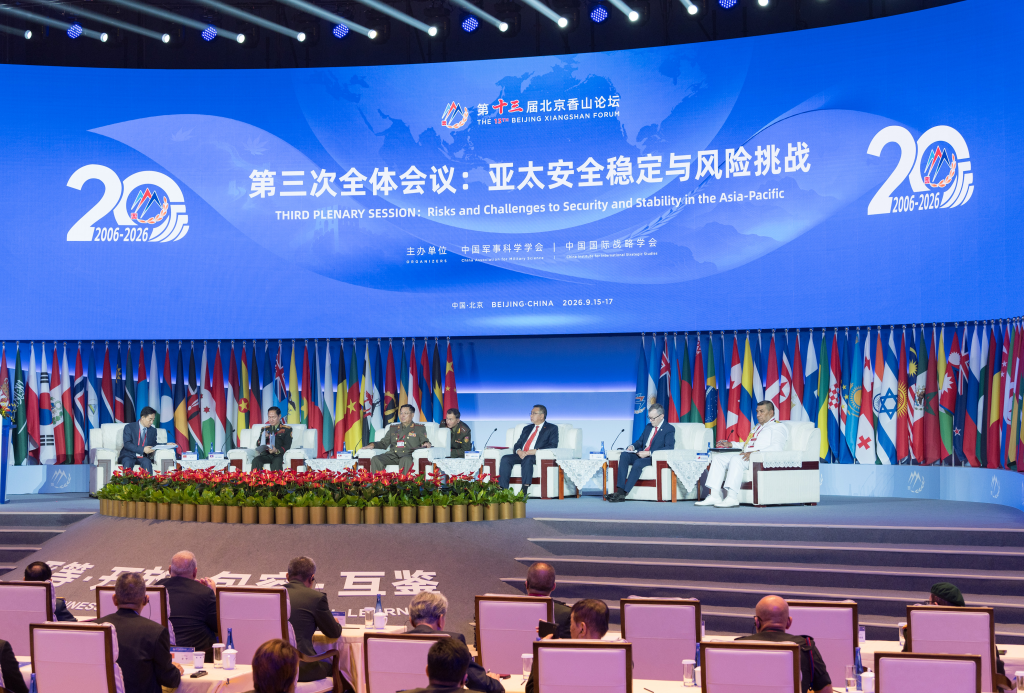
The 13th Beijing Xiangshan Forum closed on 17 September after bringing together around 2,000 official representatives, scholars and observers from more than 100 countries, regions and international organisations. Its discussions on strategic stability, Asia-Pacific security and maritime governance returned to the same problem: how to manage intensifying competition while keeping dialogue open.
Nowhere is this tension more evident than in the South China Sea. Encounters between China and the Philippines continue, yet none has so far changed the regional military balance or made open conflict imminent. The more useful description is controlled tension. Pressure is persistent, restraint still operates, and each encounter adds to the risk of miscalculation.
On Wednesday, September 23, 2026, Senior Fellow Sourabh Gupta was quoted in CBC News on the prospects for U.S.-China cooperation on AI.
On Tuesday, September 22, 2026, Senior Fellow Sourabh Gupta was cited by the South China Morning Post regarding the prolongation of the bilateral commercial pause.
On Monday, September 21, 2026, Senior Fellow Sourabh Gupta spoke with TRT World regarding the dynamics of bilateral technological engagement and governance between Washington and Beijing.
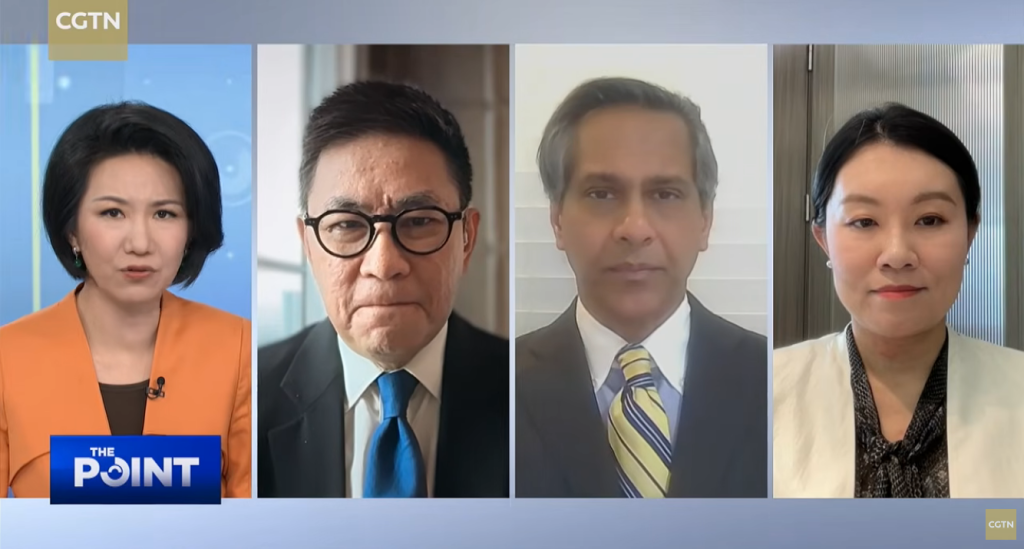
On Saturday, September 19, 2026, Senior Fellow Sourabh Gupta appeared on CGTN to discuss Beijing’s strategic approach toward BRICS and emerging technological alignment across developing economies.
On Monday, September 15, 2026, Senior Fellow Sourabh Gupta offered commentary on CGTN America’s The World Today regarding multilateral responses to Middle Eastern tensions and institutional expectations.
On Monday, September 15, 2026, Senior Fellow Sourabh Gupta examined institutional expansion and cross-regional commerce with Latin America on CGTN America.
On Monday, September 14, 2026, Senior Fellow Sourabh Gupta was cited in the South China Morning Post analyzing strategic initiatives to mitigate foreign currency vulnerabilities.
On Saturday, September 12, 2026, Senior Fellow Sourabh Gupta was quoted in the South China Morning Post regarding diplomatic architecture and institutional frameworks for high-level consultations.
On Friday, September 11, 2026, Senior Fellow Sourabh Gupta provided analysis to Anadolu Agency on geopolitical alignment surrounding the leadership summit in New Delhi.