
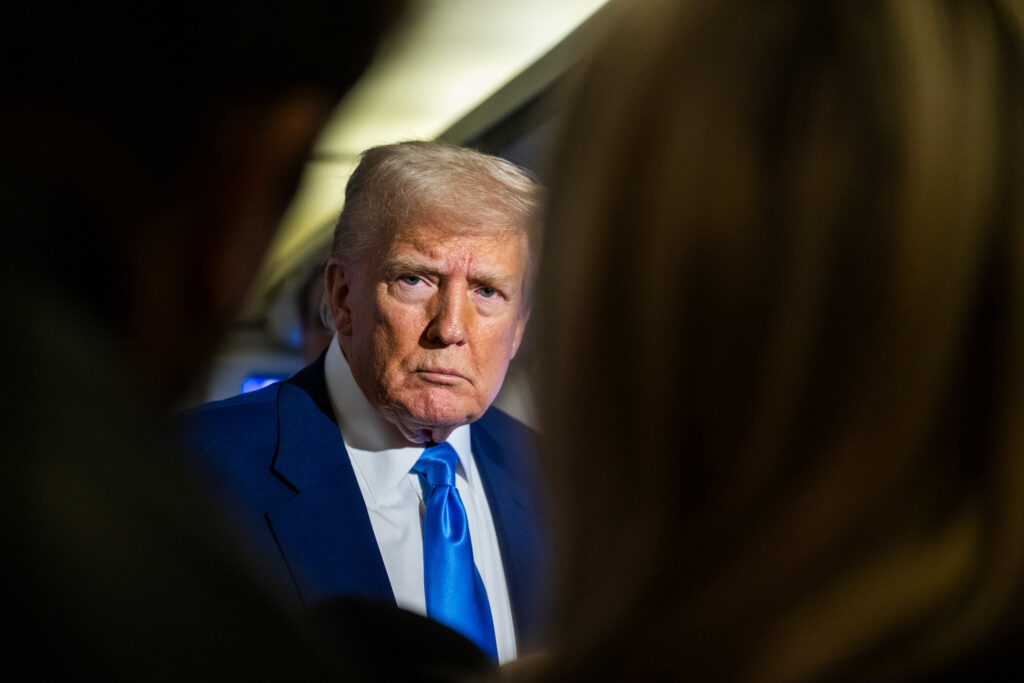
US President Donald Trump speaks during a campaign rally at the Covelli Centre in Youngstown, Ohio, on October 12, 2026. Photo by Kent NISHIMURA / AFP via Getty Images
At an October rally in Ohio supporting Senator Jon Husted, President Donald Trump defended data centers with a familiar warning: “They’ll go to China.” Sherrod Brown’s criticism concerned subsidies for technology companies and costs passed to households. The immediate argument was about electricity bills, local authority, and corporate benefits. China supplied the strategic justification for one side’s answer.
That exchange captures a feature of the 2026 midterms that could outlast the election itself. The vote may change who controls Congress without changing the competitive assumptions underlying its China policy. Democrats appear to have an increasingly favorable electoral environment, especially in the House, though it may still be too early to put that final conclusion down given the unprecedented redistricting. Yet even a change of majority would not necessarily bring the legislative branch closer to Trump’s efforts to stabilize relations with Beijing. It could instead give Democrats another reason to challenge him: that his diplomacy is too accommodating toward China.
The electoral outcome remains unsettled. A Reuters/Ipsos poll conducted October 16–19 put Democrats ahead of Republicans by 47 percent to 35 percent among registered voters on the congressional ballot. But national preferences do not translate directly into seats. Polling error, turnout, and an unprecedented wave of mid-decade redistricting complicate that conversion. Republican resources also remain substantial: MAGA Inc. still held more than $164 million in mid-October, even after major spending and transfers to affiliated groups. Democrats’ advantage is meaningful, but treating either chamber as already decided would be premature.
For U.S.-China relations, uncertainty about congressional control should not obscure the durability of the competitive premise. A Democratic victory in one or both chambers would change committee leadership, oversight, and the terms on which Trump must defend his agreements. It would provide little reason to expect Democrats to abandon strategic competition. Even when the parties disagree over particular policies, they continue to share the assumption that the United States must compete with China.
Democrats have already demonstrated how they might use that consensus against Trump. Ahead of President Xi Jinping’s September state visit, senior Democratic senators demanded stronger restrictions on Chinese access to advanced chips and warned against concessions over Taiwan. They warned that allowing Xi to leave stronger than when he arrived would be a sign of weakness. A subsequent Democratic statement acknowledged the importance of diplomacy while accusing Trump of exchanging long-term technological advantage for short-term commercial gains. Among all the Trump style bargains, pausing Taiwan arms sale delivery in exchange for trade concessions is particularly notable to observers. An opposition majority could support dialogue in principle while challenging particular bargains as evidence that the president is soft on China.
Iowa’s Senate debate made the shared premise even clearer. Republican Ashley Hinson and Democrat Josh Turek both supported competing with China in AI, while endorsing safeguards and opposing data-center tax breaks. Their differences concerned how development should be governed. On trade, Turek criticized lost soybean markets while retaining support for strategic tariffs. Both candidates offered ways to adjust the terms and domestic costs of competition, rather than a case for abandoning it.
The same pattern reaches House races. An October campaign targeted Hinson and Republican representatives in Wisconsin, Colorado, and Pennsylvania over the Save Our Bacon Act, portraying the bill as favoring Chinese-owned Smithfield at American farmers’ expense. Supporters of the legislation emphasized protection from conflicting state production rules. Chinese ownership gave a domestic dispute over regulation and market interests a readily understood geopolitical meaning. The argument could mobilize opposition without resolving which regulatory arrangement best served American producers.
China therefore functions as a convenient political justification even when the underlying security concerns are sincerely held. Candidates can disagree over investment, utility charges, tariffs, and agricultural regulation while claiming to protect Americans from the same external competitor. This flexibility helps preserve the competitive premise. An election can change who bears a policy’s costs without producing a mandate to reconsider the rivalry invoked to justify it. In Congress, that recurring language can acquire practical consequences through investigations, procurement restrictions, and pressure on executive decisions.
Recent Pew findings offer grounds for optimism, but also reveal the distance still to travel. In its January survey, the share describing China as an enemy fell from 33 percent in 2025 to 28 percent, while the competitor category rose from 56 percent to 60 percent. Respondents could also select “partner”, a description chosen by roughly one in ten. That change is consistent with reduced hostility, but does not establish a broad transition toward partnership.
The congressional statements also illustrate the political implications of this distinction. In prevailing political use, competition encourages a test based on relative gains: if China becomes stronger, American policy must explain why that is acceptable. Calling competition healthy or emphasizing mutual benefit does not automatically remove that zero-sum presumption. An agreement can benefit both countries and still become vulnerable to the charge that Beijing gained more. Less hostile language does not, by itself, displace that political test.
President Trump and President Xi’s planned encounters around APEC in November and the G20 in December may further clarify the constructive relationship of strategic stability endorsed in their recent diplomacy. More regular communication and specific understandings could make that formula more substantive. Yet agreement between presidents will not automatically establish agreement within American politics about the restraints or accommodations it requires. Legislators can favor avoiding war while opposing technology access, investment arrangements, or other decisions that give stabilization practical content.
A Democratic majority would have additional institutional means to challenge Trump’s bargains. Continued Republican control would preserve lawmakers whose competitive commitments need not yield to every presidential deal. The election will therefore matter considerably for how China policy is contested, without necessarily changing its starting point. Strategic stability must become defensible in a political environment where invoking China as a rival remains easier than explaining why reciprocal restraint serves American interests. That task will extend well beyond the midterms, whichever party wins.

The Missing Capital and Investment Dimension in U.S.-China Economic Stabilization