

Research Associate
Manager, Trade 'n Technology Program

Research Assistant Intern
Cover Image: Voters cast ballots at a polling station during the 2026 United States midterm elections on November 3, 2026 in New York City. (Photo by Wang Fan/China News Service/VCG via Getty Images)
The FY2027 National Defense Authorization Act (NDAA) remains an important route for translating congressional competition with China into policy.
Narrow Republican majorities in the outgoing 119th Congress increased the importance of the NDAA as a vehicle for China-related legislation. The incoming Democratic majority will operate under different political conditions while inheriting the competitive instruments developed by its predecessors.
The pending NDAA proposals would deepen Taiwan defense cooperation, extend scrutiny of Chinese technology and capital through defense supply chains, and carry China-related exclusions into everyday procurement and local education. They elaborate a competitive approach consolidated during the 116th Congress and sustained by its successors.
The AI OVERWATCH Act would give Congress a formal role in reviewing advanced chip exports. Even without blocking a sale, lawmakers could raise the political cost of offering Beijing limited chip access in bilateral negotiations.
The Chip Security Act drew unanimous House committee support for preventing diversion while leaving the verification method to Commerce. Built-in tracking could reassure U.S. regulators while making Chinese buyers more wary of American chips.
The MATCH Act would press allies to adopt U.S. restrictions on chipmaking equipment. The objections of the Dutch government points to a limit on that approach: even where allies share Washington’s concerns about China, they may resist letting Washington decide what their firms can sell.
Congressional references to stability require attention to their purpose. Senator Tammy Duckworth’s South China Sea initiatives seek to sustain American involvement and partner coordination while managing escalation. This conception of stability does not establish congressional acceptance of broader political accommodation with Beijing.
The campaign exchanges examined here contested the domestic costs and implementation of policy while retaining China as a common competitive reference point.
China supplies a convenient common justification for conflicting positions on electricity costs, farm regulation, and commercial interests.
Democratic control of the incoming Congress will create additional opportunities to scrutinize Trump’s arrangements with Beijing, without automatically generating support for a less competitive congressional approach to China.
President Donald Trump’s efforts to stabilize relations with China have not produced a comparable congressional agenda for sustaining that accommodation. The September White House summit’s bilateral arrangements advanced trade and investment mechanisms and extended the suspension of certain economic measures into January 2027. These steps give the administration an interest in preserving negotiating flexibility and delivering commercial results. They coexist with congressional initiatives that would make competitive commitments and restrictions more durable.
The Midterm Elections changed the institutional setting for this tension. Democrats won control of both chambers of the incoming 120th Congress, giving the president’s opponents greater influence over committee agendas, oversight hearings, and negotiations over authorization and spending. These powers could increase scrutiny of particular accommodations with Beijing. Their significance lies in how the new majority uses them, rather than in an assumption that a change of party control necessarily produces a different strategic assessment of China.
The administration’s post-election diplomacy also indicates that engagement remains part of its approach. In remarks published by the Treasury Department on November 11, Scott Bessent emphasized the work of the bilateral trade and investment boards and announced plans for further presidential meetings in Shenzhen and Miami. These initiatives preserve an executive interest in maintaining negotiating channels and demonstrating practical economic benefits. The incoming congressional majority will therefore confront an administration continuing to pursue specific arrangements with Beijing, rather than a diplomatic agenda suspended by the election results.
The pending FY2027 NDAA and the midterm campaign explain different aspects of that persistence. The defense bill gives lawmakers a consequential vehicle for extending security cooperation, controlling technology, and scrutinizing commercial dependencies. The election campaign showed how candidates can dispute the domestic costs of these policies while continuing to invoke China as their common strategic reference point. A legislature sharply divided over domestic priorities can still preserve restrictions that complicate a president’s efforts to stabilize the broader relationship.
The FY2027 NDAA remained unfinished as of mid-November. The House passed H.R. 8800 on July 22 by a 216–212 margin, while the Senate’s committee-reported proposal, S. 4784, had not passed the chamber. Cloture on the motion to proceed failed 50–46 on July 14, and the Armed Services committees are working to reconcile their texts during the lame-duck session. The provisions examined here therefore remain respective bargaining positions rather than the contents of an enacted law.
The House’s narrow passage vote does not establish a comparable division over the bill’s China provisions. The election changes the next Congress’ leadership, but the immediate fate of the FY2027 NDAA remains with the outgoing Congress. Lame-duck negotiations will determine which restrictions and cooperation requirements enter a final package. The incoming majority may then inherit reporting duties, procurement restrictions, and security-cooperation authorities negotiated by its predecessors. The transition consequently involves both the durability of existing instruments and the new majority’s choices about their implementation and future expansion. The NDAA remains one of Congress’s most consequential opportunities to turn China-related proposals into requirements agencies must implement. Its annual defense mandate creates a route for provisions that might struggle for separate floor time. Limited progress on stand-alone legislation therefore does not mean limited congressional capacity to shape China policy. Restrictions accumulated through successive defense bills can establish operating conditions that outlast an individual summit or commercial arrangement.
Taiwan provisions would embed U.S. cooperation more deeply in defense production and planning. The House bill would authorize up to $1 billion for the Taiwan Security Cooperation Initiative in FY2027, seek a defense industrial partnership, further specify joint drone and counter-drone development, and require a plan for Taiwan’s full naval participation in RIMPAC 2028. These are proposed authorizations and planning duties; they do not establish appropriated funding, completed deliveries, or an invitation to the exercise.
The Senate proposal would broaden the assistance architecture. Section 1233 would rename the Taiwan initiative the First Island Chain Security Cooperation Initiative, add Philippine forces, authorize up to $1.5 billion for FY2027, and extend the authority through December 31, 2032. The larger authorization would cover the expanded initiative rather than Taiwan alone. Connecting the two recipients in one program would give Taiwan Strait and South China Sea commitments a linked-up legislative framework.
Sen. Duckworth’s (D-IL) South China Sea initiatives show why the word “stability” cannot, by itself, establish convergence with the administration’s broader diplomacy. Duckworth and Republican Senator John Curtis (R-UT) introduced the South China Sea Strategy Act and the Strategy for Crisis Management Act on May 20. The first would organize State Department engagement with regional partners, including defense and maritime law-enforcement capacity building. A modified version of the second appears in Section 1238 of the Senate NDAA.
The crisis-management provision would require identification of likely flashpoints, sequenced defense response options, assessments of risks and benefits, and plans for advance coordination with partners. Its objectives begin with denying Chinese aims and deterring further Chinese provocation or actions that expand a crisis, alongside protecting Americans, trade routes, and treaty commitments. De-escalation and strategic stability operate within that competitive mission. The proposed framework would make American involvement more systematic and coordinated while managing the danger of war.
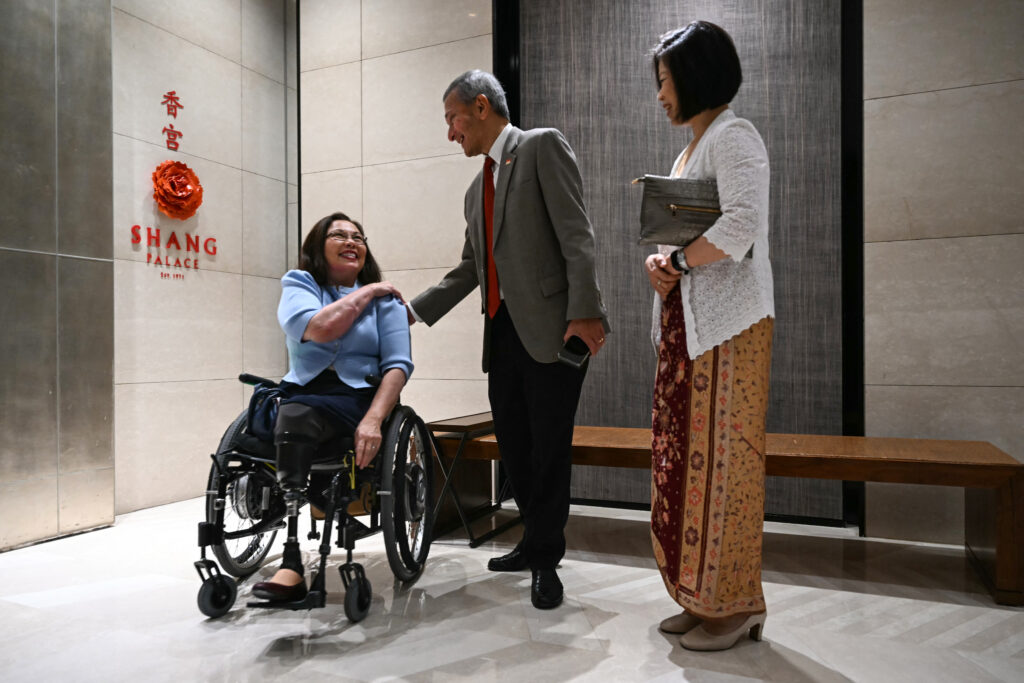
Duckworth’s regional diplomacy reinforces this reading. Her subsequent late-May visits to the Philippines and Singapore brought the proposals into discussions with regional partners. Her May 27 statement explicitly connected the bills with the trip and with sustained American support for those partners. In July, she emphasized that partner engagement should endure regardless of who occupied the White House, while criticizing Trump’s May summit and hesitation over a Taiwan arms package.
Taken together, the legislative requirements and public advocacy make stability a policy rationale for maintaining an effective American regional role. Preventing escalation can make a competitive posture more sustainable, including by reassuring partners that Washington has plans beyond an improvised military response. This is a substantive approach to crisis control, but it offers little evidence of a congressional move toward reciprocal political accommodation with Beijing. Its potential effect is to institutionalize engagement and preparedness; the NDAA provision would not create a new authorization to use force.
The NDAA’s technology provisions increasingly examine what an American supplier incorporates. The Senate’s bill’s Section 1651 would strengthen the existing defense AI framework and extend coverage to models materially derived from specified Chinese models through adaptation techniques. Section 1652 would require an AI functional bill of materials before covered defense contract awards, renewals, or extensions, including information on model origin, lineage, and dependencies.
The two measures would connect an exclusion rule with a means of identifying upstream inputs. A product offered by an American firm could still face questions about the model on which it depends. This shifts compliance decisions into development and supplier selection before the final procurement transaction. The requirements concern the defense market; their commercial influence would arise through firms’ decisions about serving that customer. Sen. Elissa Slotkin (D-MI) promoted the bill of materials requirement while opposing the overall committee bill over spending levels and the Iran War, illustrating how support for particular safeguards can survive disagreements over the package.
The Senate bill also proposes, in Section 1248, recurring assessments of advanced AI chips’ contribution to Chinese military capabilities, including remote access and illicit acquisition. Such reporting would keep congressional scrutiny active after an individual licensing decision or diplomatic understanding. It would not itself impose a new export prohibition, but could supply recurring grounds for questioning the administration’s judgments about technology access.
The institutional continuity is explicit in the Chinese Military-Company framework. House Section 1243 would extend the Section 1260H mechanism established in the FY2021 NDAA from 2030 to 2035. Section 1812 would require referrals of listed companies and their affiliates for consideration of government-wide procurement exclusions. Referral would be mandatory; exclusion would still depend on the subsequent review and decision process.
This is a concrete link to the competitive approach consolidated during the 116th Congress. Successive lawmakers are prolonging an existing instrument and connecting it to additional administrative consequences. A company’s eventual removal from the Military-Company list would not automatically undo an exclusion order. Even where executive agencies retain discretion, the proposed process could make the effects of a designation harder to unwind through a single negotiating decision.
Supply-chain proposals similarly reach upstream. The House bill would assess dependence on Chinese mineral processing and establish a mineral traceability pilot. Its silicon-carbide provision would restrict specified defense semiconductor purchases involving Chinese-made wafers, while seeking domestic and allied alternatives. These measures address a practical limitation of diversification: moving a mine or final assembly plant does not necessarily remove dependence on Chinese intermediate processing.
Investment scrutiny would also extend beyond a single acquisition. House Section 1816 and Senate Section 842 would assign responsibility for assessing adversarial-capital vulnerabilities, including financial flows, beneficial ownership, and lower-tier suppliers. These proposed assessment mechanisms could sustain attention to a firm’s financing and control after its initial entry into a defense supply chain. They would create monitoring duties, rather than a blanket prohibition on Chinese investment.
The Trump administration shares many of these security objectives but seeks flexibility over their implementation. Its July 21 policy statement raised concerns about the breadth and immediate effect of House Section 2825, which would place covered-country equipment restrictions on data facilities operating through certain leases of defense property. The White House warned that the provision could discourage private capital needed for industrial modernization. The same statement supported stronger investment screening against malign capital and faster treatment of beneficial investment.
The disagreement therefore concerns how broadly to apply exclusions and how much room agencies retain to weigh competing objectives. Congressional efforts to make restrictions durable can collide with Executive Branch efforts to attract investment, deliver capacity, or preserve a particular accommodation. Broader bilateral stabilization will encounter these concrete decisions even when both branches continue to endorse strategic competition.
Some of the most revealing provisions concern ordinary products and institutions. Senate Section 881 would bar defense acquisition of televisions involving covered Chinese entities. Rick Scott highlighted that restriction among his NDAA achievements alongside military pay and construction projects. China-related procurement restrictions thus extend from advanced strategic systems to mundane consumer equipment.
The House would also withhold FY2027 defense funds from K–12 schools hosting defined Confucius Institutes or Classrooms while exempting assistance paid directly to students. Its seafood provision would further specify exclusions affecting military dining facilities and commissaries, continuing restrictions already present in the FY2026 NDAA.
These riders illustrate the widening reach of the competitive framework. A defense authorization bill can attach consequences to a school’s cultural partnership or a commissary’s sourcing decision, giving comparatively narrow proposals a consequential legislative vehicle. Each measure can be defended through a particular security or procurement concern. Their cumulative effect is to make association with China relevant to a growing range of decisions, even when the connection to military capability is indirect. That tendency can continue alongside, and create friction for, executive efforts to normalize selected commercial exchanges.
Three export-control bills outside the NDAA base text have become a focus of congressional efforts to restrict China’s access to advanced semiconductors. On July 14, Senate negotiators agreed to add the AI OVERWATCH Act, the Chip Security Act, and the MATCH Act to a proposed manager’s amendment to S. 4784, but the failed cloture vote that day left the amendment unadopted. The November disclosures surrounding Nvidia revived the effort. On November 12, the chairs of the House Foreign Affairs, China Select, and Intelligence committees described the episode as “a prime example of why Congress must immediately pass the AI OVERWATCH Act,” together with the Chip Security, MATCH, and Remote Access Security Acts, in the NDAA. Four days later, the Commerce Department issued a rule restricting remote access to advanced chips through foreign data centers, and the following day Nvidia’s acting chief executive said the company would stop selling H200 chips in China.
| AI OVERWATCH Act | Chip Security Act | MATCH Act |
Gap it closes | Who decides chip exports | Smuggling after export | Allied chipmaking equipment |
Core mechanism | 30-day congressional review; ban on top-tier chips | Mandatory location verification | Country-wide tool ban; 150-day ally deadline |
Lead sponsors | Mast (H.R. 6875); Banks, Warren (S. 4456) | Cotton (S. 1705); Huizenga, Foster (H.R. 3447) | Baumgartner (H.R. 8170); Ricketts, Kim (S. 4281) |
Furthest step | HFAC 42–2, Jan 21, 2026 | HFAC 42–0, Mar 26, 2026 | HFAC markup, Apr 22, 2026 |
Hill | Bipartisan; China Select and HFAC chairs pushing | Bipartisan; SIA opposed | Bipartisan, incl. Schumer |
White House | Sacks critical in Jan; per Mast, added remote-access language in Nov | AI Action Plan backed location verification | Technical feedback, no endorsement |
China | Not named | CAC summoned Nvidia over tracking (Jul 2025) | MOFCOM named it, warned of “necessary measures” |
Table 1. Three chip export-control bills at a glance
The AI OVERWATCH Act would give Congress a role in advanced chip exports comparable to its review of arms sales. House Foreign Affairs Chairman Brian Mast (R-FL) introduced the bill as H.R. 6875 on December 19, 2025, and the committee advanced it 42–2 on January 21. As amended in committee, it would require the Commerce Department to notify Congress at least 30 days before licensing covered chips, such as Nvidia’s H200, to a country of concern, and would allow Congress to block the sale through a joint resolution of disapproval. The most capable chips, including Nvidia’s Blackwell line, would not be licensed to these countries at all. Chips first marketed after January 1, 2026 that meet the control thresholds would also be denied, closing a path for designs calibrated just below the line.
The bill would also reset existing authorizations. Licenses already granted to countries of concern would terminate, and new ones would await the administration’s submission of an “American Artificial Intelligence Victory Strategy,” with technical thresholds fixed for at least 24 months. A “Trusted United States Person” track would speed exports to allies for American firms that meet security and ownership standards. The Senate companion, S. 4456 from Republican Jim Banks (R-IN) and Democrat Elizabeth Warren (D-MA), would codify the ban on the most advanced chips and require Commerce to certify that end users will not support adversary military, intelligence, surveillance, or cyber capabilities. Even if Congress never blocked a sale, the House bill’s 30-day review period would give lawmakers time to publicly challenge a proposed license. That prospect alone could make it harder for the White House to offer limited chip sales as a concession in negotiations with Beijing.
Side | Who, when | Reaction |
Hill | House Foreign Affairs Committee, Jan 21, 2026 | Advanced 42–2, one present (Lawfare); 15 cosponsors including China Select Chair Moolenaar (HFAC). Mast: “It keeps America’s advanced AI chips out of the hands of Chinese commie spies.” |
Hill | Senate sponsors, May 4, 2026 | Bipartisan cosponsors Cotton, Cortez Masto, Ricketts, Shaheen. Warren: “Selling advanced chips to China is bad in the short run and worse in the long run” (Senate Banking). |
Hill | Chairs Mast, Moolenaar, Crawford, Nov 12, 2026 | “This situation is a prime example of why Congress must immediately pass the AI OVERWATCH Act,” plus the Chip Security, MATCH and Remote Access Security Acts, in the NDAA. Letters went to Huang, Nvidia counsel Tim Teter and Commerce Under Secretary Jeffrey Kessler (China Select Committee). Huang and Teter later agreed to transcribed interviews on Dec 1 and 2 (HFAC, Nov 17; The Next Web). |
White House | David Sacks, White House AI czar, Jan 21, 2026 | Replied “Correct” to a post attacking the bill as orchestrated by “never Trumpers” (The Register); critics framed it as an intrusion on Article II powers (Lawfare). |
White House | Per Mast, early Nov 2026 | Officials offered technical assistance on the bill (Punchbowl News, Nov 6). Mast said the White House added language targeting Chinese access to U.S. chips through overseas data centers; no revised text is public, and Trump has not endorsed the bill (SCMP via Korea Times, Nov 11). |
Industry | Nvidia | Opposes; commercial stakes in “tens of billions of dollars” (Lawfare). |
China | MFA, MOFCOM | No statement naming this bill found. November responses addressed U.S. chip curbs generally: “China opposes abuse of export control measures” (MFA, Nov 13, transcript). |
Table 2. Reactions to the AI OVERWATCH Act
The Chip Security Act addresses diversion after a lawful sale. Senator Tom Cotton’s (R-AR) S. 1705 would require, within six months of enactment, a location verification mechanism on export-controlled advanced chips and products containing them, and would oblige exporters to report diversion or tampering to the Bureau of Industry and Security (BIS). The Commerce and Defense Departments would study additional chip security mechanisms, and Commerce would recommend how export controls could be made more flexible to streamline shipments. The House version, H.R. 3447 from Republican Bill Huizenga (R-MI) and Democrat Bill Foster (D-IL), passed the Foreign Affairs Committee 42–0 on March 26. It leaves the method to BIS, which could choose among on-site audits, attestations, or location trackers (CBO). The bill would reveal a chip’s location but would not allow it to be disabled remotely.
The unanimous House committee vote shows how readily lawmakers could agree on preventing diversion while leaving Commerce to decide how to verify a chip’s location. That choice matters for U.S.-China trade: a built-in tracker might reassure U.S. officials enough to approve a sale while giving Chinese buyers a reason to avoid the chip altogether.
Side | Who, when | Reaction |
Hill | House Foreign Affairs Committee, Mar 26, 2026 | Ordered H.R. 3447 reported 42–0. Huizenga: “This bill directly supports the Trump administration’s AI Action Plan recommendations” (Ripon Advance). |
Hill | Rep. Foster, Nov 2026 | Said Nvidia told him privately the tracking was technically feasible (“yeah, of course we can do this”); plans a stricter licensing-based bill next year (MIT Technology Review). |
Hill | Chairs Mast, Moolenaar, Crawford, Nov 12, 2026 | Named it among four bills Congress must pass in the NDAA (China Select Committee). |
White House | AI Action Plan, Jul 23, 2025 | Recommended that the government “explore leveraging new and existing location verification features on advanced AI compute.” Foster said this “aligns closely” with the bill (Reuters via Yahoo Finance). No endorsement of the bill itself found. |
Industry | Semiconductor Industry Association, Mar 2026 | Opposed the tracking mandates as “new, untested, and potentially infeasible” (MIT Technology Review). |
China | Cyberspace Administration of China, Jul 31, 2025 | Summoned Nvidia over alleged “backdoor safety risks” in H20 chips, citing “a call by U.S. lawmakers to require tracking and locating capabilities.” It did not name the bill. Nvidia: “NVIDIA does not have ‘backdoors’ in our chips” (AP via WSLS). |
Table 3. Reactions to the Chip Security Act
The MATCH Act moves the focus from chips to the equipment used to make them. H.R. 8170, from Representative Michael Baumgartner (R-WA), and S. 4281, from Republican Pete Ricketts (R-NE) and Democrat Andy Kim (D-NJ), would bar the sale or servicing of the most essential chipmaking tools, including certain lithography and etching equipment, anywhere in a country of concern, except at facilities controlled by the United States or its allies. All fabrication facilities of CXMT, Hua Hong, Huawei, SMIC, and YMTC, together with their subsidiaries and affiliates, would face Entity List-style restrictions on exports, servicing, and technical support. The bill would direct the administration to seek matching controls from allies. Absent progress within 150 days, Commerce would impose the controls unilaterally, reaching foreign-made items through the Foreign Direct Product Rule, subject to a national security waiver.
The Dutch objection shows why the 150-day deadline could complicate efforts to align export controls. Even where Washington and The Hague agree that a particular tool should be kept out of China, they can still disagree over who gets to decide what a Dutch company may sell or service.
Side | Who, when | Reaction |
Hill | House Foreign Affairs Committee, Apr 22, 2026 | Advanced the bill (HFAC). Mast: “Without these tools, China can’t make their own chips.” |
Hill | Senate sponsors, Apr 2, 2026 | Bipartisan, including Minority Leader Schumer: “a vital and necessary leap forward.” Ricketts: “This status quo puts American companies last” (Sen. Ricketts). |
White House | Administration officials, Nov 2026 | Gave technical feedback on the bill, per Punchbowl News (Nov 6); short of an endorsement (SCMP via Korea Times, Nov 11). |
Allies | Dutch foreign ministry, Nov 18, 2026 | “Extraterritorial measures run counter to this principle and are unacceptable between partners” (POLITICO Europe via The Next Web). No Japanese government position found. |
China | MOFCOM spokesperson, Apr 25, 2026 | Named the bill. If enacted, it “would severely undermine the international economic and trade order”; China will “decisively take necessary measures” (MOFCOM). |
Table 4. Reactions to the MATCH Act
The Midterm Election campaigns offer another explanation for the persistence of congressional competition. China supplies a convenient justification for faster investment, stronger safeguards, protection of American producers, or attacks on an opponent’s credibility. This does not require assuming that candidates privately disbelieve their security arguments. The more consequential point is that the competitive premise can accommodate conflicting policies without itself becoming the principal subject of electoral disagreement.
At an October 3 Ohio rally supporting Republican Senator Jon Husted (R-OH), Trump defended data centers by warning, “They’ll go to China.” The appeal connected local investment with strategic competition. Democratic challenger Sherrod Brown’s criticism focused on tax benefits for technology companies and costs borne by households. The immediate dispute concerned who pays for development and who controls it.
The Ratepayer Protection Act would require state regulators to consider standards for recovering infrastructure costs from large customers. On September 30, a motion to advance the bill failed to secure cloture despite 57–43 support, including four Democrats. Critics such as Senator Martin Heinrich (D-NM) argued that it lacked binding protections. Both sides could claim to defend households while disputing the regulatory mechanism; the procedural vote did not establish a division over whether America should compete with China.
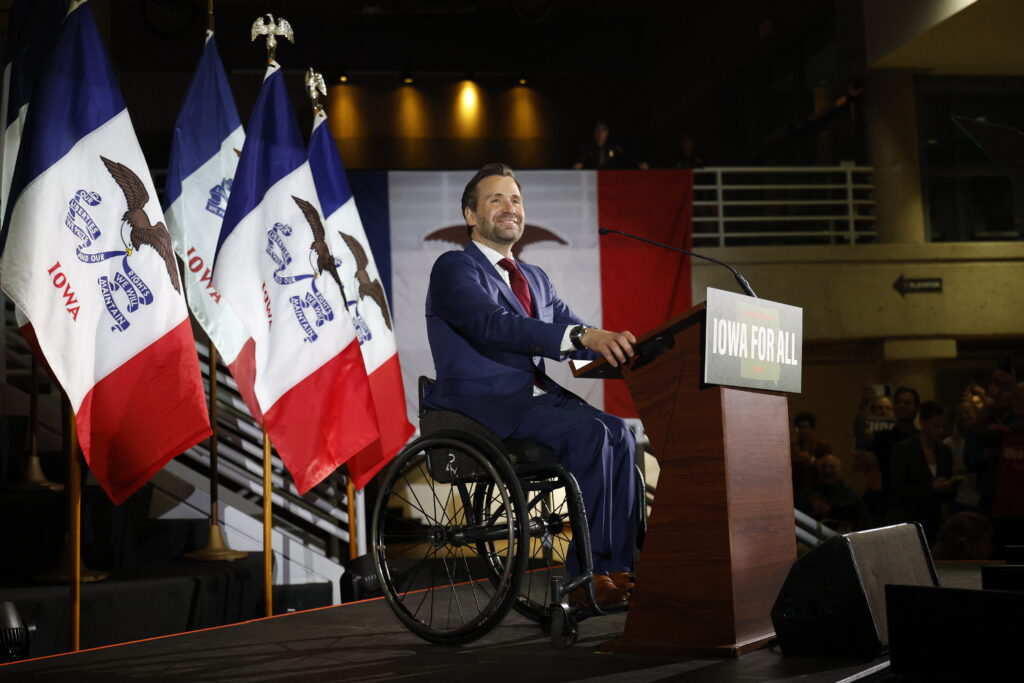
Democrat Josh Turek’s victory in Iowa makes the October Senate debate relevant to the incoming Congress. Turek supported competition with China in AI while challenging data-center tax benefits and the agricultural costs of the administration’s trade policies. His Republican opponent, Ashley Hinson, also accepted the competitive premise. Their disagreement concerned the instruments and domestic consequences of policy, rather than whether China should remain a central strategic competitor.
These exchanges make China a flexible political reference point. An appeal to the AI race can support development, but does not determine acceptable utility rates, tax incentives, water use, or permitting rules. Concern for farmers can support market access while preserving a case for selected tariffs. In these exchanges, candidates competed over the terms and domestic distribution of policy within a shared strategic premise.
The Save Our Bacon Act shows how a domestic regulatory conflict can become a China test. The proposal would restrict states from imposing certain production conditions on livestock raised elsewhere or products derived from them. Supporters, including the National Pork Producers Council, argue that producers need protection from incompatible state rules. Opponents emphasize Smithfield Foods’ majority ownership by Hong Kong-based WH Group and portray the measure as a benefit to Chinese agribusiness.The fight moved to Congress after the litigation route closed. Pork producers challenged California’s Proposition 12 under the dormant Commerce Clause, and the Supreme Court upheld the law in National Pork Producers Council v. Ross in May 2023, leaving federal preemption as the industry’s principal remaining route. The judicial dimension may persist into the next Congress. The Senate of the 120th Congress will review future judicial nominations and a Democratic majority in both chambers may also seek to expand its oversight of the executive and judicial branches.
The dispute also has a continuing legislative vehicle. Language associated with the Save Our Bacon Act was incorporated into the House-passed Farm Bill, while the Senate committee proposal omitted it. Its inclusion in a final package therefore remains unresolved. The ownership argument can therefore continue to shape negotiations over a domestic regulatory question, even when the underlying disagreement concerns state authority and production standards.
Ownership can be relevant to who benefits, but it does not resolve the merits of state production standards or explain every producer’s position. American firms and farmers have interests on both sides. The geopolitical framing supplies a simpler common rationale for a coalition whose underlying concerns include regulation, market structure, and animal welfare. It also makes ordinary commercial association with China a potential electoral liability, adding to the political costs of defending closer economic ties.
South Carolina illustrates how quickly the same frame can move from policy to personal association. At the October 11 Senate debate, Democrat Annie Andrews proposed a two-year data-center moratorium while protections were developed. Republican Senator Darline Graham (R-SC), who also supported local control, warned that the pause would advantage China. Andrews then raised Chinese imports by employers of Graham’s husband and subsequently demanded Graham’s recusal from China-related trade and military votes. Graham responded that her husband was an employee with no ownership or equity.
Their victories give critics of the administration’s domestic policies a stronger institutional position, but do not establish an electoral mandate for a broader accommodation with China. In the exchanges examined here, household costs, agricultural losses, and demands for stronger safeguards could all be advanced within a competitive framework. The relevant continuity concerns how these candidates justified their positions, rather than a claim that China determined their victories or that voters endorsed every China-related statement they made.The pork campaign followed a similar path into electoral politics. The American Meat Producers Association launched its $30 million campaign in June to stop the Save Our Bacon Act in the Senate, naming Hinson and Senators Chuck Grassley, Joni Ernst and Amy Klobuchar ahead of the Senate Agriculture Committee’s farm bill markup. By October, its targets had widened to three House Republicans in competitive districts, Derrick Van Orden, Gabe Evans and Rob Bresnahan, none of whom is a cosponsor of H.R. 4673.
The Democratic victory has changed the distribution of congressional power without establishing a comparable mandate to reconsider competition with China. The campaign exchanges examined here show how candidates could challenge the domestic costs of the administration’s policies while retaining China as a common strategic reference point. Sherrod Brown’s (Ohio) return to the Senate and the victories of Josh Turek (Iowa) and Annie Andrews (South Carolina) make these arguments relevant to the incoming Congress. Criticism of household electricity costs, lost agricultural markets, or inadequate safeguards did not require these candidates to advocate a broader accommodation with Beijing. Their victories should not be attributed to individual China-related statements, but those statements indicate how demands for domestic policy changes can remain compatible with a competitive approach.
China’s usefulness as a political justification helps sustain that continuity. The same competitive argument can support faster data-center construction or stronger conditions on development, protection for American producers or criticism of the administration’s trade policies. It can also turn an opponent’s commercial associations into a question of political independence. These uses connect disputes over costs, regulation, and accountability with an established national-security concern. Changing the policy instrument consequently need not change the assumption that China is the rival against which American choices should be judged.
Democratic control of both chambers will give the president’s opponents greater influence over committee agendas, oversight hearings, and negotiations over authorization and spending. Those tools could bring greater scrutiny to President Trump’s arrangements with Beijing, including demands for more verifiable commitments, stronger security safeguards, or clearer benefits for American households and producers. An accommodation presented by the administration as successful diplomacy could be challenged as an unnecessary concession or evidence that Trump is being soft on China. Such criticism would allow Democrats to oppose the president while drawing on arguments familiar to Republicans. It would not require the new majority to reject dialogue in principle, but could increase the political costs of translating diplomatic understandings into specific policy decisions.
The NDAA provides an institutional foundation for this tension. Its immediate disposition remains with the outgoing 119th Congress, whose lame-duck negotiations will determine which proposed requirements enter a final package. Any enacted reporting duties, procurement restrictions, or security-cooperation authorities could then shape the choices available to the incoming majority and the administration. The election therefore changes the officials directing congressional scrutiny without automatically removing the instruments through which their predecessors made competition durable.
For Trump, further presidential engagement can preserve negotiating channels and strengthen particular forms of bilateral cooperation. Sustaining those arrangements will also require managing the domestic disputes surrounding their implementation. Investment access, technology safeguards, procurement eligibility, and the distribution of commercial benefits will expose those pressures more clearly than general statements about strategic stability. The central question after the midterms is how the new majority will use its powers within a competitive framework that the campaign largely left intact. The election has changed the institutional setting for U.S.-China policy; building durable support for strategic stabilization remains a separate political task.
The Midterms May Change Congress but Not Its China Consensus