
ICAS Bulletin (online ISSN 2836-3418, print ISSN 2836-340X) is published every other week throughout the year at 1919 M St NW, Suite 310, Washington, DC 20036.
The online version of ICAS Bulletin can be found at chinaus-icas.org/bulletins/.
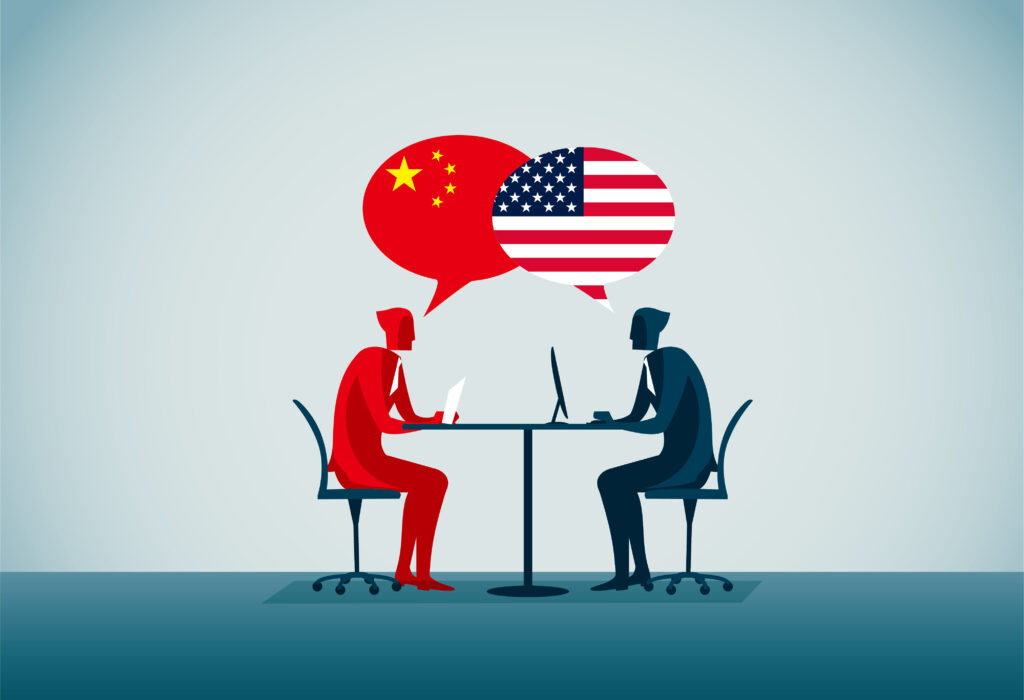
– President Trump on March 26 confirmed the new dates of his previously postponed China visit will be May 14-15, and said he would host President Xi for a reciprocal visit in Washington later this year.
– On the same day, the White House said President Xi acknowledged and understood the reasons for the delay.
– USTR Jamieson Greer on March 31 said preparations for the Trump-Xi summit are on track and he sees “stability with China over the next year,” downplaying concerns that the Iran war could cause a further delay after officials reached “general agreement on the types of outcomes” during Paris talks earlier this month.
– China’s Commerce Ministry on March 27 launched two counter-investigations into U.S. trade practices that “disrupt global supply chains” and “hinder trade in green products,” responding to recent U.S. Section 301 probes while refraining from immediate retaliation as the bilateral trade truce holds ahead of the Trump-Xi summit.
– China’s Foreign Ministry on April 7 criticized former U.S. Ambassador Nicholas Burns for “nefarious” claims that Beijing looked like a “fickle friend” to Iran and Venezuela, while urging all sides to de-escalate and facilitate peace talks as Trump’s deadline for Iran to reopen the Strait of Hormuz approached.
– Data released on March 27 showed that Chinese industrial profits surged 15.2% in January-February, led by a 58.7% jump in high-tech manufacturing driven by unmanned aerial vehicles and semiconductors, though the National Bureau of Statistics warned that spillover risks from “escalating geopolitical tensions” may impact the growth outlook.
– Data released on March 31 showed China’s official manufacturing PMI rose to 50.4 in March, beating expectations amid two months of contraction as factories resumed production after the national holiday, though rising raw material and shipping costs from the Middle East conflict weighed on surveyed companies.
Associated News References:
“China slams former US envoy’s ‘nefarious’ claims about Beijing’s position on Iran, Venezuela,” Andalou Agency, April 7
“Trump-Xi Summit on Track Even as Iran War Drags On, Greer Says,” Bloomberg, March 31
“China’s factory activity returns to growth, expanding at its sharpest pace in a year,” CNBC, March 30
“China launches two probes into US trade practices,” Reuters, March 27
“China industrial profits surge 15% to start year, but oil price shock threatens outlook,” CNBC, March 26
“Trump plans May visit to China for talks with Xi after Iran war delay,” Reuters, March 25
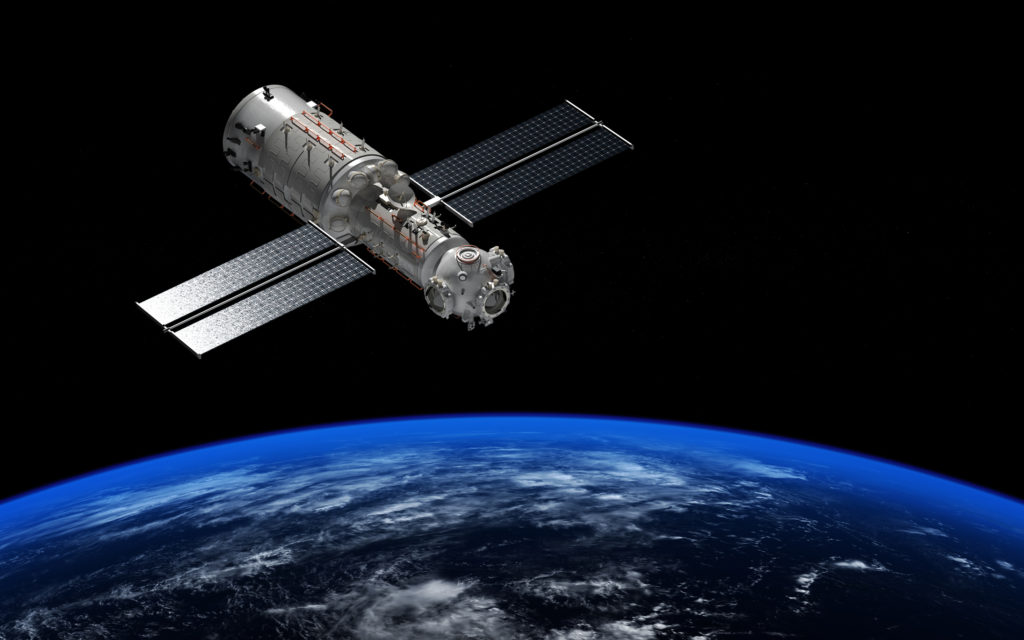
– NASA on April 1 launched its Artemis II mission, sending four astronauts aboard a roughly 10-day test flight that will take them around the Moon and back.
– The Artemis II mission marks the first crewed lunar flyby in more than 50 years, and is preparation for a first-ever manned landing on the moon’s South Pole in 2028.
– President Trump, who signed an executive order titled “Ensuring American Space Superiority” in 2025, wants the U.S. to return to the Moon by 2028 and establish a permanent outpost by 2030.
– Meanwhile, China is also preparing to send its first astronaut to the Moon by 2030, with key hardware including the Lanyue lunar lander and Long March 10 rocket under active testing, as part of a broader plan to build an International Lunar Research Station by 2035 and eventually support crewed Mars missions by 2045.
– NASA Administrator Jared Isaacman has repeatedly framed space ambitions as a direct competition with China, driven by the potential to access valuable resources including helium-3, water ice, and rare earth minerals that could fuel what experts are calling a “lunar gold rush.”
– Despite the lunar goals, on April 3, just days after the successful launch of Artemis II, the White House proposed cutting NASA’s overall budget by 23%, including nearly 50% cuts to science programs, while boosting the Artemis moon program by a billion dollars.
– The proposal drew sharp criticism from advocacy groups who called it “a budget of surrender” that undermines U.S. leadership in space science.
– The SMILE satellite, jointly developed by the Chinese Academy of Sciences and the European Space Agency as China’s first mission-level deep cooperation with ESA in space science, has completed pre-launch preparations in French Guiana and is scheduled to launch on April 9, aiming to achieve the first global view of Earth’s magnetosphere using soft X-ray imaging technology.
Associated News References:
“As 4 astronauts aim to make history at the moon, Trump recommends slashing NASA’s budget,” CNN, April 5
“China is planning to land people on the Moon — and might beat the United States to it,” Nature, April 2
“Liftoff! NASA Launches Astronauts on Historic Artemis Moon Mission,” National Aeronautics and Space Administration, April 1
“Trump sees ‘America First’ opportunity in Nasa mission to Moon,” BBC, April 1
“Isaacman aims to reinvigorate NASA’s image, starting with the moon,” Politico, April 1
“China-Europe SMILE Satellite Ready for Launch,” Chinese Academy of Sciences, March 27
– The U.S. Commerce Department on April 1 launched an AI export initiative inviting American companies to form consortiums offering full-stack AI solutions globally with diplomatic and financial backing, while barring participation from “countries of concern” including China, setting a 51% U.S.-ownership threshold for AI models, and prioritizing markets where U.S. technology could displace Chinese alternatives.
– A bipartisan group of lawmakers on April 2 introduced the MATCH Act to ban the sale of deep ultraviolet lithography machines and other advanced chipmaking equipment to China, closing what experts call ‘critical loopholes’ in current export controls, while also pushing allies in the Netherlands and Japan to adopt matching restrictions or face enforcement through the foreign direct product rule.
– OpenClaw creator Peter Steinberger on March 26 highlighted a stark divide in AI adoption between the U.S. and China, and urged broader adoption so society can better prepare for the technology’s impact.
– China’s National Intellectual Property Administration on March 31 issued a warning against using AI agents like OpenClaw to draft patent applications, citing risks of technical information leakage, AI hallucinations causing substantial defects, and dishonest applications, with patent agencies facing potential license revocation for unauthorized use.
– It was reported on April 3 that Chinese semiconductor firms including SMIC, Hua Hong, and ChangXin Memory Technologies reported record revenues in 2025, driven by AI demand, a global memory chip shortage, and U.S. export restrictions that have accelerated Beijing’s push to build a domestic chip supply chain.
– During the Semicon China international exhibition held from March 25-27, 13 top Chinese semiconductor executives set a target of 80% domestic chip self-sufficiency by 2030, including building fully domestic 7-nm production lines and creating a Chinese rival to ASML, as the government mandates that chipmakers use at least 50% Chinese-built equipment in new plants. China’s current self-sufficiency rate stands at 33%.
– JPMorgan CEO Jamie Dimon on March 31 said AI could disrupt the labor market if the pace of change is “too fast,” calling for public-private partnerships to retrain and redeploy displaced workers into labor-short industries, while predicting the technology will ultimately lead to 3.5-day work weeks and long-term job creation.
– Chinese GPU and AI chip makers captured nearly 41% of China’s AI accelerator server market in 2025 with 1.65 million cards shipped, led by Huawei at roughly 812,000 units, while Nvidia’s share fell to 55% as Beijing pushed government agencies and companies to adopt domestic alternatives amid U.S. export controls.
– Huawei’s cloud computing revenue from external customers fell 3.5% in 2025 despite its push to develop Ascend AI chips as a domestic alternative to Nvidia, lagging behind rivals Alibaba and Tencent which posted 36% and 22% growth respectively. The company’s overall revenue grew just 2% to 880.9 billion yuan.
Associated News References:
“Chinese chip firms hit record high revenue driven by the AI boom and U.S. curbs,” CNBC, April 3
“Washington launches export initiative to ensure ‘future of AI is led by the United States’,” South China Morning Post, April 3
“Bill to ban sale of key AI chipmaking equipment to China introduced in House,” NBC, April 2
“CNIPA Warns Against Using AI Agents Including OpenClaw in Drafting Patent Application Documents,” National Law Review, April 1
“Chinese chipmakers claim nearly half of local market as Nvidia’s lead shrinks,” Reuters, April 1
“Jamie Dimon says ‘life will be better’ with AI, but notes risks for workers,” CBS, March 31
“Huawei’s cloud computing revenue dropped in 2025 as Chinese AI lagged U.S. rivals,” CNBC, March 31
“China chip sector targets 80% self-sufficiency with US in its sights,” Nikkei Asia, March 28
“OpenClaw Creator Says US Can Learn From China’s AI Adoption,” Bloomberg, March 26

– On April 5, President Trump delayed the ultimatum for a third time, moving it from April 6 to April 7 for Iran to open up the Strait of Hormuz.
– As part of his ultimatum, President Trump threatened to destroy all of Iran’s power plants and bridges by April 7 at 8 pm EST if Tehran does not reopen the Strait of Hormuz.
– Later on April 7, Trump stepped up his threat from infrastructure, saying Iran’s “whole civilization will die tonight” if Tehran did not comply with his demands.
– While holding a joint press conference with Hungarian President Orban on April 7, Vice President JD Vance said Iran faces two pathways as Trump’s 12-hour deadline approaches: either become “a normal country” that stops funding terrorism and rejoins global commerce, or face worsening economic consequences.
– Vice President Vance also confirmed that the U.S. had struck military targets on Kharg Island.
– Tehran on March 26 rejected the White House’s 15-point ceasefire proposal transmitted through Pakistan, though Iranian Foreign Minister Araghchi confirmed the two sides were exchanging messages through intermediaries.
– On the same day, U.S. envoy Steve Witkoff said there were “strong signs” an agreement was possible.
– China and Pakistan on March 31 jointly presented a five-point peace initiative calling for an immediate ceasefire, reopening of the Strait of Hormuz, and protection of critical infrastructure, after Pakistani Foreign Minister Ishaq Dar met with Chinese counterpart Wang Yi in Beijing, while Trump declined to comment on the specifics but said negotiations with Iran were “going well.”
– Traffic through the Strait of Hormuz climbed to 21 ships between April 4-5, the highest since the start of the war, as more countries including Iraq, India, Japan, and China secured safe-passage agreements with Iran, though the volume remains a fraction of the pre-war average of 135 vessels per day.
– It was reported on April 1 that Iran’s Revolutionary Guard Corps has established a formal toll system for vessels transiting the Strait of Hormuz, requiring ships to undergo background checks, pay fees starting at around $1 per barrel of oil in yuan or stablecoins, and sail under flags of Iran-friendly nations.
Associated News References:
“Vance says Iran has ‘2 pathways’ as 12-hour deadline looms, prays US on ‘God’s side’ in nixing nuclear threat,” Fox News, April 7
“Hormuz Traffic Rises to Highest in Weeks,” Bloomberg, April 6
“Trump Issues Iran Threats as Mediators Reportedly Seek Ceasefire,” Bloomberg, April 5
“Trump Warns Iran He Could Strike ‘Every Power Plant,’ in WSJ Interview,” The Wall Street Journal, April 5
“China aims to show global leadership with Iran war diplomacy. US appears uninterested,” AP News, April 3
“Secret Codes and Yuan Fees Get Ships Through Iran’s Hormuz Tollbooth,” Bloomberg, April 1
“China and Pakistan present new Iran deal: Ceasefire for opening Hormuz,” Axios, March 31
“Trump says U.S. to hold off for 10 days on hitting Iran energy sites,” The Washington Post, March 26

– Taiwan opposition leader Cheng Li-wun will visit China in early April, marking the first Kuomintang leader trip in a decade and signaling closer cross-strait engagement ahead of a summit between President Xi Jinping and President Donald Trump.
– Cheng Li-wun warned Taiwan risks becoming a “post-Ukraine” scenario ahead of her planned China visit, emphasizing dialogue with Beijing to avoid conflict.
– A bipartisan U.S. Senate delegation led by Jeanne Shaheen and John Curtis visited Taiwan on March 30 as part of a broader Indo-Pacific trip aimed at strengthening regional alliances. The visit, which also included Thom Tillis and Jacky Rosen, underscored continued U.S. congressional support for Taiwan and long-term commitment to partnerships in the region.
– During the March 30 visit, U.S. senators urged Taiwan to pass a stalled $40 billion defense spending package, emphasizing the need to strengthen deterrence against China. The proposal remains contested within Taiwan’s legislature, while delays in U.S. arms deliveries and Beijing’s opposition continue to complicate defense planning.
– The visit prompted strong criticism from Beijing, with Director of the Foreign Ministry Information Department Mao Ning warning against the U.S.-Taiwan “official interactions”, reaffirming China’s sovereignty claims over the island. During the trip, U.S. senators also urged Taiwan to increase defense spending, highlighting growing cross-strait security concerns ahead of a potential Trump-Xi summit.
– A bipartisan group of U.S. senators—including Jeff Merkley, Ted Cruz, John Curtis, and Andy Kim—introduced legislation to strengthen U.S.–Taiwan defense cooperation by supporting Taiwan’s drone industry and developing China-independent supply chains.
– The proposal, titled the Blue Skies for Taiwan Act of 2026, would establish a U.S.-led working group to assess Taiwan’s drone production capacity, expand integration of Taiwan-made components into defense supply chains, and streamline certification processes for Taiwanese manufacturers.
Associated News References:
“Kuomintang Leader Warns Taiwan Risks ‘Post-Ukraine’ Fate,” Chosun, April 7
“Taiwan’s opposition leader seeks to win friends in China with a high-stakes visit,” NBC, April 4
“U.S. senators introduce bill to boost Taiwan drone cooperation,” Focus Taiwan, April 2
“U.S. Senators Press Taiwan to Raise Military Spending as China Protests,” The New York Times, April 1
“Exclusive / US bill aims to strengthen Taiwan ties,” Semafor, March 31
“China Hits Out At US Visit To Taiwan,” Newsweek, March 30
“U.S. Senate delegation visits Taiwan to strengthen regional alliances,” Focus Taiwan, March 30

“Young people in China have found a digital lucky charm in Kris Jenner,” NBC, April 4
“China Edges Past U.S. in Global Approval Ratings,” Gallup, April 3
“OpenClaw Unlocks China’s AI Token Export Business,” Bloomberg, April 2
“German firms trapped between U.S. and China, study finds,” Bloomberg, March 30
“China suppliers warn of higher prices for Americans due to Strait of Hormuz closure,” CNBC, March 30
“Asean countries warned against exploiting US-China tensions for short-term gain,” South China Morning Post, March 28
The Iran conflict expands U.S. doctrine of economic pressure to counter China
By Yilun Zhang
April 6, 2026
The Iran conflict is no longer merely a regional security crisis; it is rapidly evolving into a macroeconomic shock amplifier—one that is reshaping how global markets, capital flows, and supply chains interact. More critically, it highlights a deeper shift in how the United States is adapting economic power in an era where it no longer dominates the physical layers of globalization.
Bridging the Gap Between Science and Policy in Arctic Climate Cooperation
By Zhangchen Wang
April 2, 2026
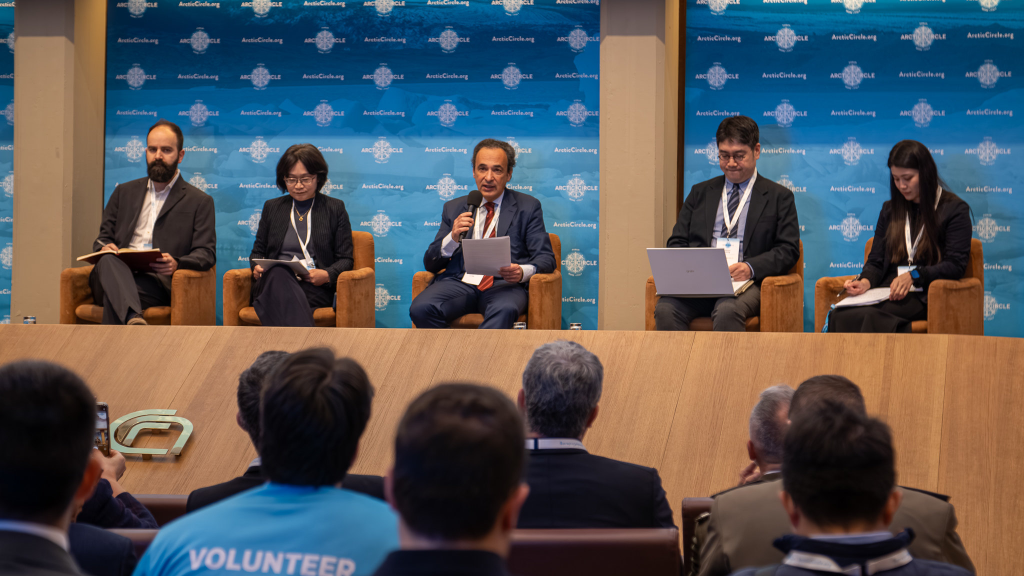
During the 2026 Arctic Circle Rome Forum – Polar Dialogue, a familiar pattern emerged across discussions on climate change and international cooperation. Policy-focused panels repeatedly emphasized the importance of sustaining international climate cooperation amid ongoing geopolitical tensions and escalating climate risks. At the same time, scientific sessions covered a wide range of ongoing research and highlighted the practical challenges they face, many of which could be better alleviated through broader international collaboration.
Conflict in the Middle East is boosting the value of the Arctic windfall
By Nong Hong
March 27, 2026
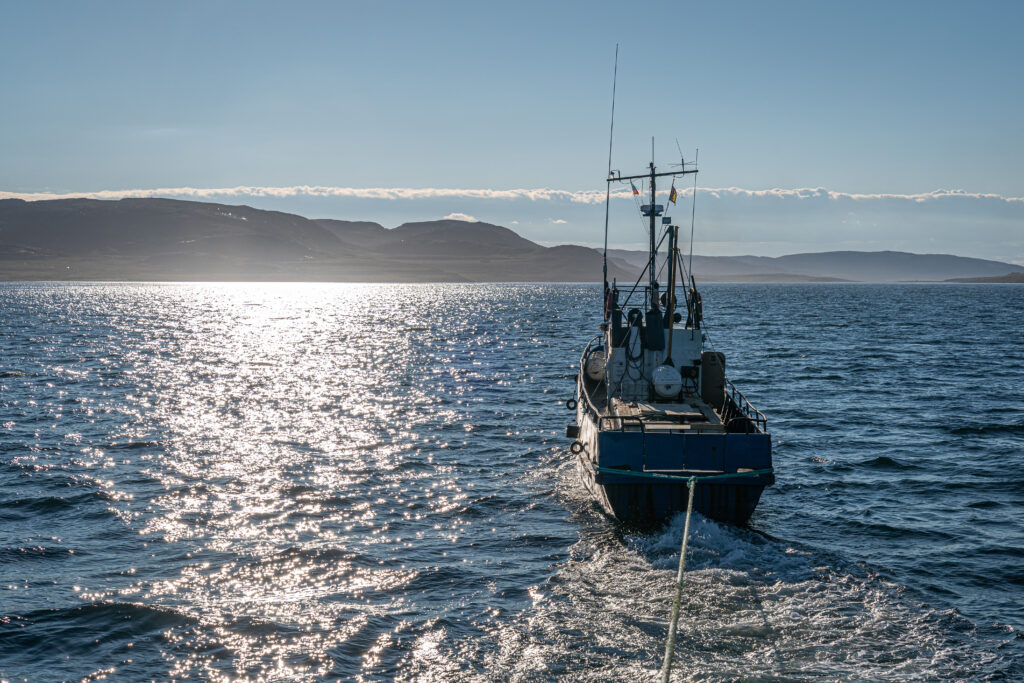
Gulf exporters are scrambling to bypass the Strait of Hormuz after Iran choked off most of the maritime traffic in one of the world’s most critical energy corridors. Saudi Arabia and the United Arab Emirates rushed to divert exports through overland pipelines; officials warned that even naval escorts could not guarantee safe passage. About a fifth of the world’s oil and liquefied natural gas (LNG) trade passed through this narrow waterway.
The immediate shock was felt in the Gulf. The strategic aftershock is being felt much farther north.
Marcos Jr.’s China reset promotes Philippine security
By Rommel Banlaoi
March 27, 2026
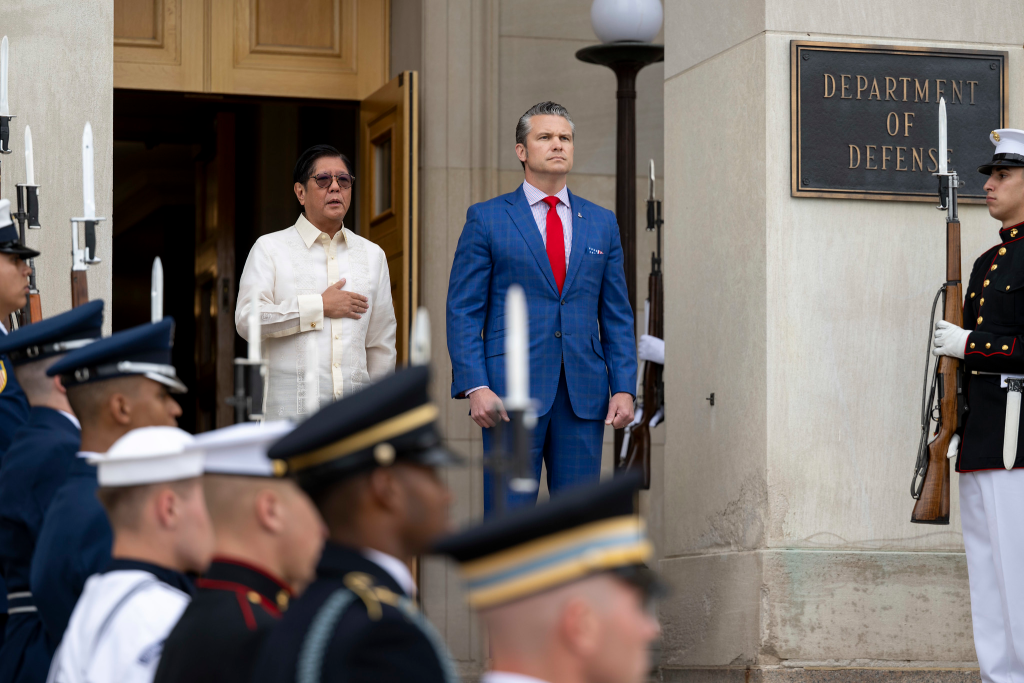
President Ferdinand Marcos Jr.’s declaration that the Philippines is “resetting” ties with China is not a knee-jerk reaction. It is a calculated pragmatic move to strengthen national resilience and promote Philippine security in the face of global energy crisis, regional tensions, and worsening great power rivalry. This reset is a strategic opportunity—one that builds on past engagements and seeks to secure a better future for the Philippines.
On Thursday, April 2, 2024, Senior Fellow Sourabh Gupta was quoted by Krautreporter on U.S.-China strategic competition.